Skip to content

Punjab Board Class 10 Physics · Chapter 17: Electromagnetism

Magnetic field of a current: straight wire and solenoid

Section 17.1

A current produces a magnetic field. Round a straight wire the lines are circles, strongest near the wire, with direction given by the right-hand grip rule. Outside, a solenoid acts like a bar magnet; inside, its field is nearly uniform. More current, more turns or an iron core make it stronger.

Loading simulation…

Symbols match your course. Open the full magnetic fields in 3d (wire, coil and solenoid) simulation for more presets and teacher tools.

A compass that twitched

In 1820 the Danish physicist Hans Christian Ørsted noticed that a compass needle near a wire swung round whenever he switched the current on. It was the first evidence that electricity and magnetism are linked: an electric current produces a magnetic field around it. When the current stops, the field disappears. This link is the starting point of electromagnetism, and every electric motor, relay and loudspeaker depends on it.

The field of a long straight wire

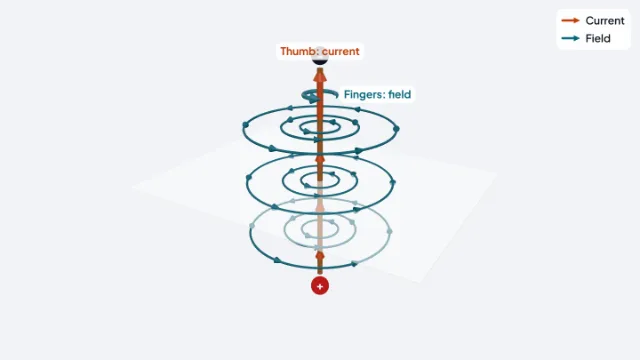
Push a thick wire vertically through a hole in a flat piece of cardboard and connect it to a battery so that a large steady current flows. Shake some iron filings evenly over the cardboard and give it a few light taps. The filings arrange themselves in rings with the wire at their common centre. Small plotting compasses set down around the wire line up along these rings, each needle touching a ring like a tangent.

From the pattern we learn that:

  • the lines of force are circles, and every circle lies in a flat sheet that the wire pierces at right angles;
  • the field is most intense next to the wire and fades with distance, so the rings are drawn more widely spaced the further out they are;
  • a larger current gives a stronger field at every point.

The right-hand grip rule

Reverse the battery and every compass needle turns round to point the opposite way, so the direction of the field depends on the direction of the current. To find it, use the right-hand grip rule.

Hold the wire loosely in your right fist, like the handle of a cricket bat, with the thumb stretched out in the direction of the conventional current. The way your fingers wrap round shows the way the field lines go.

On paper, a wire running at right angles to the page is drawn as a small circle. A dot in the centre means the current comes out of the page towards you (think of the point of an arrow coming at you); a cross means it goes into the page (the tail feathers of an arrow moving away). For a current out of the page, the field lines go anticlockwise; for a current into the page, clockwise.

Coils: the solenoid

A solenoid is made by coiling insulated wire round a tube, many turns next to each other. Each turn contributes its own small field, and these combine. Inside, they merge into one powerful field whose lines run straight and evenly spaced along the axis, so the field there is almost uniform. Outside, the pattern is the same shape as that of a bar magnet: lines come out of one end, which acts as a north pole, sweep round through the air and go back in at the opposite end, which acts as a south pole.

To find which end is north, curl the fingers of your right hand round the solenoid in the same sense as the conventional current in its turns. Your outstretched thumb now points at the north pole. A quick check from the end: if, looking straight at an end, you see the current circulating anticlockwise, that end is a north pole; clockwise means a south pole.

A solenoid is a temporary magnet: switch off the current and its magnetism vanishes. That is exactly what makes it useful.

Making the field stronger

Section 17.1 names the current as the way to control an electromagnet's strength; the extra turns and the iron core in this list go a little beyond the book. The field of a solenoid can be made stronger by:

  1. increasing the current;
  2. adding more turns of wire on the same length;
  3. putting a soft iron core inside, which becomes strongly magnetised itself and multiplies the field many times.

A solenoid wound on a soft iron core is an electromagnet. Because its strength is set by the current, it can be switched on and off, made stronger or weaker, and reversed. Electromagnets are used in relays, electric bells, magnetic door locks, cranes in scrapyards and in motors.

Reversing the current reverses the field of a wire or a solenoid: the north and south poles of the solenoid swap ends.

Rules for magnetic field lines

Field lines are an imaginary way of picturing a field, and they follow a few rules:

  • in the space around a magnet they leave the N pole and arrive at the S pole, then carry on through the magnet back to N, so every line forms a closed loop;
  • the field at any point is along the tangent to the line through that point;
  • two field lines never cross, because the field cannot point two ways at once;
  • crowded lines mark a strong field, and widely spaced lines a weak one.

The field in the 3D simulation

Turn the 3D view by dragging it, and use the Front, Side and Top camera buttons to look along the wire or the coil.

  1. With Wire chosen, look from the Top. The field lines are circles on the card, and the compasses point along them. Press Reverse: every compass turns round.
  2. Turn on Right-hand grip rule to see the thumb follow the current and the fingers follow the field.
  3. Change to Solenoid. The Field direction card tells you which end is the N pole. Raise the Current, then switch on the Soft iron core and see how many times stronger the field becomes.
  4. Back on Wire, drag one plotting compass in a ring round the wire: at every spot its needle lies along a circle, at right angles to the line joining it to the wire.
Common mistakes

  • Drawing the field round a straight wire as lines running along the wire. They are circles in planes at right angles to it.
  • Spacing the circles evenly. The field weakens with distance, so the circles should get further apart.
  • Using the left hand for the grip rule. Both grip rules use the right hand.
  • Swapping the roles in the solenoid rule. For a solenoid the fingers follow the current and the thumb points to the north pole.
  • Reading a dot as current into the page. A dot is the point of the arrow coming towards you: current out of the page.
  • Forgetting that the field vanishes when the current is switched off. A solenoid is only a temporary magnet.

Exam practice

Exam-style questions

Original questions written in the style of Punjab board exams. Try each one before you reveal the answer.

  1. 1.A thick copper wire stands upright through a hole in a flat sheet of cardboard and carries a large steady current upwards.

    1. (a)Describe how you would show the shape of the magnetic field on the card.

      2 marks
      Show the answer

      Answer: Scatter iron filings over the cardboard and tap it lightly, or set several plotting compasses round the wire and mark where each needle points.

      Marking points

      • Iron filings or plotting compasses on the cardboard
      • Pattern of concentric circles appears round the wire
    2. (b)Seen from above, is the field clockwise or anticlockwise? Name the rule you used.

      2 marks
      Show the answer

      Answer: Anticlockwise. Right-hand grip rule: with the thumb pointing up along the current, the fingers curl anticlockwise when viewed from above.

      Marking points

      • Anticlockwise
      • Right-hand grip rule
    3. (c)State two changes seen when the current is reversed and then increased.

      2 marks
      Show the answer

      Answer: Reversing the current makes the compass needles point the opposite way round the circles. Increasing the current makes the field stronger at each point.

      Marking points

      • Field direction reverses
      • Field becomes stronger with larger current
  2. 2.A student winds insulated copper wire on a cardboard tube to make a solenoid and connects it to a battery.

    1. (a)Sketch the magnetic field pattern inside and outside the solenoid and describe it.

      2 marks
      Show the answer

      Answer: Inside, the lines run straight along the axis, side by side at equal gaps: a strong, almost uniform field. Outside, the pattern matches a bar magnet, the lines leaving one end (N) and curving back to the other (S).

      Marking points

      • Uniform parallel lines inside
      • Bar-magnet pattern outside, N to S
    2. (b)Explain how the student can decide which end is the north pole.

      2 marks
      Show the answer

      Answer: Grip the solenoid with the right hand with the fingers wrapped the same way as the current round the turns; the outstretched thumb shows the north pole. (Or: the end where the current is seen flowing anticlockwise is north.)

      Marking points

      • Right hand, fingers along the current
      • Thumb points to N pole
    3. (c)Give three ways of making the solenoid a stronger magnet.

      3 marks
      Show the answer

      Answer: Increase the current; increase the number of turns; put a soft iron core inside the tube.

      Marking points

      • Larger current
      • More turns
      • Soft iron core
  3. 3.Field lines are used to picture magnetic fields.

    1. (a)Give the reason that lines of magnetic force cannot intersect.

      1 mark
      Show the answer

      Answer: If two lines met, a compass placed there would have to point in two directions together, but the field at any point has just one direction.

      Marking points

      • Field at a point has a single direction
    2. (b)On a drawing of field lines, how can you tell where the field is strongest?

      1 mark
      Show the answer

      Answer: The lines are drawn closest together where the field is strongest.

      Marking points

      • Lines closer together = stronger field

Quiz

Quick check

6 questions

  1. 1.The magnetic field lines around a long straight current-carrying wire are:
  2. 2.Current flows into the page along a wire drawn as ⊗. Its field lines go:
  3. 3.Which change does NOT make an electromagnet stronger?
  4. 4.Inside a long current-carrying solenoid, the magnetic field is:
  5. 5.Viewed end-on, the current in a solenoid circulates clockwise. The end facing you is:
  6. 6.Who first showed that an electric current has a magnetic effect?

Related articles

Next step

Now see it move

Open the full magnetic fields in 3d (wire, coil and solenoid) simulation for every preset, graphs and the teacher tools, then test yourself.

Magnetic fields in 3D simulation: a current-carrying wire, a flat circular coil and a solenoid in 3D3D