Skip to content

Punjab Board Class 10 Physics · Chapter 17: Electromagnetism

The d.c. electric motor

Section 17.4

A d.c. motor turns electrical energy into kinetic energy. A coil on an axle sits between magnetic poles; the forces on its sides make it turn. A split-ring commutator, fed through carbon brushes, swaps the coil's current at each half revolution, so the rotation carries on in one direction.

Loading simulation…

Symbols match your course. Open the full dc motor in 3d simulation for more presets and teacher tools.

Electrical energy in, motion out

An electric motor changes electrical energy into kinetic energy of rotation. Ceiling fans, washing machines, water pumps, hand drills, toy cars and the cooling fan in a computer all depend on one. There are two broad families: a.c. motors, which run straight from the mains, and d.c. motors, which run from cells, batteries or a d.c. supply. The simple d.c. motor shows the key idea most clearly.

The parts of a simple d.c. motor

  1. Armature coil. A rectangular coil of many turns of insulated copper wire, mounted on an axle so it can spin. In real motors it is wound on a soft iron core, called the armature.
  2. Field magnet. A permanent magnet (or electromagnet) with its N and S poles facing each other on either side of the coil.
  3. Split-ring commutator. A copper ring cut into two halves, insulated from each other and from the axle. The two ends of the coil are soldered one to each half, so the ring rotates along with the coil.
  4. Carbon brushes. Two blocks of carbon (graphite) pressed lightly against opposite sides of the commutator by springs. They stay still while the commutator slides round underneath them, and they carry current from the battery into the coil. Carbon is chosen because it conducts, is slippery, and wears away instead of scratching the copper.

How it keeps turning

When the battery is connected, current flows in through one brush, round the coil and out through the other brush. Because the long sides carry opposite currents, the magnet forces them opposite ways, a couple appears and the coil begins to spin.

Without a commutator, this would only last a quarter of a turn. Once the coil passes the upright position, the old forces would start turning it backwards, and the coil would just rock and stop.

This is where the split ring earns its place. At the moment the coil goes through the upright position, the gaps in the ring pass the brushes, and each brush slides off one half and onto its partner. The coil's connections to the battery are swapped, so the current through the coil flips twice per revolution. Whichever side of the coil happens to be on the left always has current flowing the same way as its predecessor in that position, so the left-hand side is always pushed the same way and the rotation never reverses.

As the coil passes the upright position, the brushes briefly touch the gaps and no current flows; the coil coasts past on its own momentum (inertia) and the next half turn begins.

Controlling a motor

  • Speed and turning force both go up if you raise the current, wind extra turns or fit a stronger magnet.
  • Reversing the direction of rotation: reverse the current (swap the battery connections) or reverse the magnetic field (swap the poles). Doing both together leaves the motor spinning the same way.

Improvements in real motors (beyond the book)

The single-coil motor in the textbook is a teaching model. It has a weak, jerky turning effect and can get stuck upright. Practical motors improve on it:

  • many coils set at different angles, each with its own pair of commutator segments, so that some coil is always close to the level position and the turning effect is large and smooth;
  • a soft iron armature inside the coils, which strengthens the magnetic field;
  • curved pole pieces that keep the field strong all the way round the coil;
  • electromagnets instead of permanent magnets in large motors.

Worked numerical: a toy motor

The coil of a toy motor has 60 turns. Each long side has 3.0 cm in a field of 0.10 T and carries 0.40 A. The coil is 2.0 cm wide. Find the force on each side and the largest turning effect.

F=N BIL=60×0.10×0.40×0.030=0.072 NF = N\,BIL = 60 \times 0.10 \times 0.40 \times 0.030 = 0.072\ \text{N} largest torque=F×width=0.072×0.020=1.44×10⁻³ N m\text{largest torque} = F \times \text{width} = 0.072 \times 0.020 = 1.44 \times 10^{-3}\ \text{N m}

If the battery is replaced with one giving twice the current, the force on each side, and therefore the torque, doubles. Section 17.4 has no numericals, so this one is extra practice beyond the book.

The motor in 3D

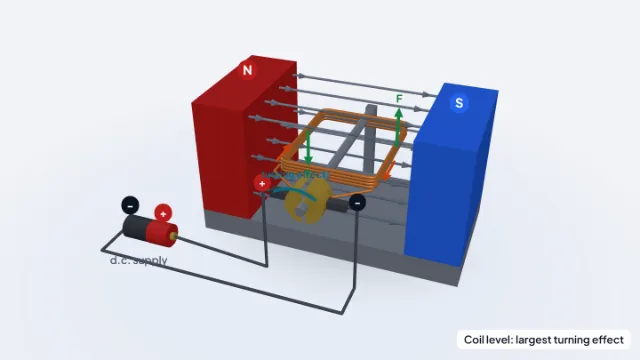
Drag to view the motor from any direction; three camera buttons (Front, Side, Top) give set views.

  1. Press Play. With the Split ring chosen, the coil keeps turning, and the Turning effect now card swings between its largest value (coil level) and zero (coil upright).
  2. Turn on Current (I) and force (F) arrows. Watch the arrows on a side of the coil just as it passes upright: the current in it flips, so the push on the left and right of the motor never changes direction.
  3. Switch to Slip rings. The current never reverses, and the coil swings back and forth instead of spinning.
  4. Use Reverse I or Flip magnet to change the direction of rotation, and raise the Current, Field between the poles or Turns on the coil to make it spin faster.
Common mistakes

  • Saying the commutator reverses the current in the battery or the brushes. It reverses the current in the coil only; the supply current is unchanged.
  • Stating that the commutator reverses the current every full turn. It does so twice per revolution, each time the coil goes through the upright position.
  • Mixing up the split ring and slip rings. Motors running on d.c. use the split ring; slip rings belong to a.c. generators.
  • Thinking the brushes turn with the coil. The brushes stay still and press on the commutator as it rotates.
  • Believing a motor runs backwards after you swap the battery leads and turn the magnet round. The two changes undo each other.
  • Forgetting that the coil passes the upright position by its own momentum, while the brushes touch the gaps.

Exam practice

Exam-style questions

Original questions written in the style of Punjab board exams. Try each one before you reveal the answer.

  1. 1.A simple d.c. motor has a rectangular coil between the poles of a magnet, a split-ring commutator and two carbon brushes.

    1. (a)State the energy change in an electric motor.

      1 mark
      Show the answer

      Answer: Electrical energy is changed into kinetic (mechanical) energy, with some wasted as heat.

      Marking points

      • Electrical to kinetic / mechanical
    2. (b)Explain the purpose of the split-ring commutator.

      3 marks
      Show the answer

      Answer: Twice in each revolution, at the moment the coil is upright, it swaps the coil's connections so the current in the coil changes direction. The left and right sides of the motor therefore always feel forces the same way, the torque never reverses, and rotation is continuous.

      Marking points

      • Reverses current in the coil
      • Every half turn / when coil is upright
      • So the coil keeps turning in the same direction
    3. (c)Give the job of the carbon brushes and one reason carbon is used.

      2 marks
      Show the answer

      Answer: They make sliding electrical contact between the fixed supply leads and the rotating commutator. Carbon conducts and is soft and slippery, so it wears without damaging the commutator.

      Marking points

      • Carry current to the rotating commutator / sliding contact
      • Carbon conducts and is slippery / wears instead of the commutator
  2. 2.A student builds a motor that turns too slowly, and in the wrong direction.

    1. (a)State two ways to make it turn faster.

      2 marks
      Show the answer

      Answer: Any two: increase the current; add more turns to the coil; use a stronger magnet.

      Marking points

      • First correct method
      • Second correct method
    2. (b)State one way to reverse the direction of rotation.

      1 mark
      Show the answer

      Answer: Reverse the battery connections (current), or reverse the magnet (field), but not both.

      Marking points

      • Reverse current or reverse field
    3. (c)Explain one benefit of building a motor with several coils set at different angles.

      2 marks
      Show the answer

      Answer: At every moment one coil is near the level position, where the turning effect is largest, so the motor turns with a larger, smoother turning effect and cannot get stuck.

      Marking points

      • Some coil is always near the position of largest turning effect
      • Smoother / larger turning effect, no dead position
  3. 3.A motor coil has 120 turns. Each side has 4.0 cm in a 0.050 T field and carries 0.30 A. The coil is 2.5 cm wide.

    1. (a)Calculate the force on each long side of the coil.

      2 marks
      Show the answer

      Answer: F = N × BIL = 120 × 0.050 × 0.30 × 0.040 = 0.072 N.

      Marking points

      • N × BIL with L = 0.040 m
      • 0.072 N
    2. (b)What is the maximum turning effect produced?

      2 marks
      Show the answer

      Answer: Maximum torque = 0.072 N × 0.025 m = 1.8 × 10⁻³ N m.

      Marking points

      • Force × width
      • 1.8 × 10⁻³ N m

Quiz

Quick check

6 questions

  1. 1.A d.c. motor converts:
  2. 2.The split-ring commutator reverses the current in the coil:
  3. 3.Which part of a d.c. motor stays still while the coil turns?
  4. 4.Which single change sends the motor spinning backwards?
  5. 5.If the split ring were replaced by slip rings in a d.c. motor, the coil would:
  6. 6.Why do practical motors have a soft iron armature?

Related articles

Next step

Now see it move

Open the full dc motor in 3d simulation for every preset, graphs and the teacher tools, then test yourself.

DC motor in 3D simulation: a copper coil turns between red N and blue S poles3D