Skip to content

Punjab Board Class 10 Physics · Chapter 17: Electromagnetism

Forces between parallel current-carrying wires

Section 17.1

Two parallel wires carrying currents in the same direction attract each other; with currents in opposite directions they repel. Each wire sits in the circular magnetic field of the other, so each feels a force. The two forces are equal and opposite, and grow with bigger currents and a smaller gap.

Loading simulation…

Symbols match your course. Open the full magnetic field around a wire and solenoid simulation for more presets and teacher tools.

Two wires, no magnet, still a force

Section 17.1 shows that every current is surrounded by a circular magnetic field. So what happens when two current-carrying wires are laid side by side? Each wire sits in the field of the other, and each feels a force. No magnet is needed: the currents alone push or pull on each other.

The rule

  • Currents in the same direction: the wires attract each other.
  • Currents in opposite directions: the wires repel each other.

This is the reverse of what you might guess from charges ("like repel, unlike attract"), so learn it carefully: for parallel currents, like currents attract.

The two forces are always equal in size and opposite in direction, a pair of forces obeying Newton's third law, even when one wire carries more current than the other.

Why it happens: one wire in the other's field

Call the wires P and Q, with both currents flowing up the page.

  1. By the right-hand grip rule, the field of P goes round P in circles. At the place where Q lies, this field points straight into the page (if Q is to the right of P).
  2. So Q is a wire carrying current through a field that crosses it at 90°, exactly the situation of section 17.2.
  3. Fleming's left-hand rule with the field into the page and the current upwards gives a force on Q pointing towards P.
  4. Working the same way for P in Q's field gives a force on P pointing towards Q.

So the wires move together. Reverse the current in Q only, and the force on it reverses: the wires now push apart.

Why it happens: the field-line picture

You can also explain it by looking at the combined field of both wires.

  • Same direction: in the space between the wires their two circular fields point in opposite directions and largely cancel, so the field there is weak. Outside the pair the fields add, and the combined lines wrap round both wires together. The wires are pushed from the strong field outside towards the weak field between them, so they attract.
  • Opposite directions: between the wires the two fields now point the same way and add, so the field there is strong and the lines are crowded. The wires are pushed away from this strong region, so they repel.

Field lines behave rather like stretched elastic bands that also push sideways on each other. Lines wrapped round both wires pull them together; lines squeezed between them push them apart.

What changes the size of the force

The force on each wire is bigger when:

  • either current is bigger (the force is proportional to each current);
  • the wires are closer together (the field of a straight wire weakens with distance);
  • a longer length of the wires runs side by side.

Where the force matters

  • In power stations and substations, thick bars carry thousands of amperes side by side. In a fault the current rises sharply and the force between the bars can bend them, so they must be firmly clamped.
  • A coil of wire carries current the same way in neighbouring turns, so the turns attract and a loose coil squeezes together slightly when switched on.
  • The same idea, force between currents, is the basic principle of electric motors and electromagnets, which you meet in the rest of this chapter.

Worked numerical 1: field of one wire, force on the other (beyond the book)

Two long parallel wires are 5.0 cm apart. Wire 1 carries 10 A and wire 2 carries 5.0 A in the same direction. Find the force on 2.0 m of wire 2.

Field of wire 1 at wire 2: μ0/2π=2×10−7\mu_0 / 2\pi = 2 \times 10^{-7}, so

B=2×10−7×100.050=4.0×10−5 TB = \frac{2 \times 10^{-7} \times 10}{0.050} = 4.0 \times 10^{-5}\ \text{T}

Force on wire 2, using F=BILF = BIL from section 17.2:

F=4.0×10−5×5.0×2.0=4.0×10⁻⁴ NF = 4.0 \times 10^{-5} \times 5.0 \times 2.0 = 4.0 \times 10^{-4}\ \text{N}

The currents are in the same direction, so this is an attraction. Wire 1 feels exactly the same 4.0 × 10⁻⁴ N, pulling it towards wire 2.

Worked numerical 2: changing the set-up

Using the answer above, find the new force when (a) both currents are doubled, (b) only the distance is doubled.

(a) The force is proportional to each current: 2×2=42 \times 2 = 4 times bigger.

F=4×4.0×10−4=1.6×10⁻³ NF = 4 \times 4.0 \times 10^{-4} = 1.6 \times 10^{-3}\ \text{N}

(b) The field at wire 2 halves, so the force halves:

F=4.0×10⁻⁴÷2=2.0×10⁻⁴ NF = 4.0 \times 10^{-4} \div 2 = 2.0 \times 10^{-4}\ \text{N}

Worked numerical 3: an appliance cable (beyond the book)

The two cores of a heater flex are 3.0 mm apart and carry 10 A, in opposite directions. Find the force on each metre of one core.

FL=2×10−7×10×100.0030≈6.7×10⁻³ N per metre\frac{F}{L} = \frac{2 \times 10^{-7} \times 10 \times 10}{0.0030} \approx 6.7 \times 10^{-3}\ \text{N per metre}

The currents are opposite, so the cores repel, but the force is far too small to notice. For a.c. both currents reverse together, so the force is still a repulsion.

The field of a wire in the simulation

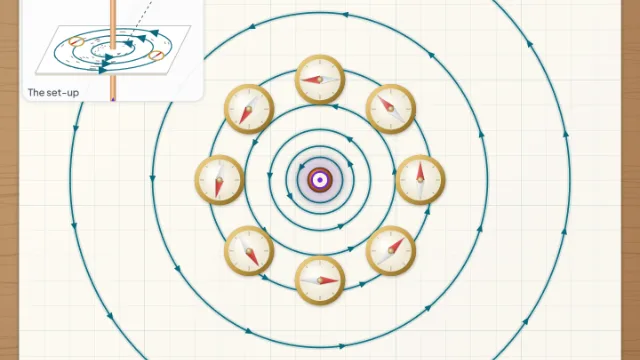
The simulation shows the field of one wire. Imagine a second wire standing where a compass is placed.

  1. Choose Straight wire. Move compass 1 a few centimetres from the wire with Distance from the wire and read Field at compass 1. This is the field a second wire would sit in.
  2. Double the Distance from the wire: the field roughly halves, so the force between two wires would halve too. Raise the Current and the field grows in step.
  3. Press Reverse. Every compass turns round: the field at the second wire's position reverses, and so would the force on it. Use Fleming's left-hand rule on the compass direction to decide whether a second wire, with current out of the card, would be pulled in or pushed away.
Common mistakes

  • Saying currents in the same direction repel, by analogy with like charges. Parallel currents in the same direction attract.
  • Thinking the wire with the bigger current feels the bigger force. Both wires feel the same size of force, pointing in opposite directions.
  • Saying the fields between two same-direction wires add up. Between the wires they point opposite ways and largely cancel.
  • Using the right hand for the force. Use the grip rule (right hand) to find the field, then Fleming's left-hand rule to find the push on the second wire.
  • Forgetting that a magnet is not needed. The force comes from the currents' own magnetic fields.
  • Assuming a.c. makes the force reverse to and fro between attraction and repulsion. When both currents reverse together, the type of force stays the same.

Exam practice

Exam-style questions

Original questions written in the style of Punjab board exams. Try each one before you reveal the answer.

  1. 1.Two long straight wires are placed parallel to each other and a short distance apart.

    1. (a)State what happens to the wires when the currents in them flow (i) in the same direction (ii) in opposite directions.

      2 marks
      Show the answer

      Answer: (i) They attract each other. (ii) They repel each other.

      Marking points

      • Same direction: attract
      • Opposite directions: repel
    2. (b)Explain, in terms of magnetic fields, why each wire feels a force.

      3 marks
      Show the answer

      Answer: Each current produces a circular magnetic field around its wire. The other wire lies across this field, so as a wire carrying current inside a magnetic field it feels a force (motor effect); Fleming's left-hand rule tells you which way.

      Marking points

      • Each current sets up a circular magnetic field
      • The other wire is a current-carrying conductor in that field
      • So a force acts on it (direction by the left-hand rule)
    3. (c)Compare the force on the wire with the larger current with the force on the other wire.

      1 mark
      Show the answer

      Answer: Both forces have equal size, acting in opposite directions.

      Marking points

      • Equal and opposite
  2. 2.Two parallel wires carry currents in the same direction. A student draws the combined magnetic field of the pair.

    1. (a)Describe the field in the region between the two wires.

      2 marks
      Show the answer

      Answer: The fields of the two wires point in opposite directions there, so they largely cancel and the field is weak.

      Marking points

      • Fields opposite between the wires
      • Weak (cancelling) field
    2. (b)Use the field pattern to explain why the wires attract.

      2 marks
      Show the answer

      Answer: Beyond the wires the two fields reinforce, so the combined lines loop round both wires: strong field outside, weak between. Each wire is forced from its strong-field side towards the weak region, so they move together.

      Marking points

      • Strong combined field outside, weak between
      • Wires pushed towards the weak region, so they attract
  3. 3.Two long parallel wires carry 4.0 A and 8.0 A and are 2.0 cm apart. The force on each metre of either wire is 3.2 × 10⁻⁴ N.

    1. (a)Find the force when both currents are halved and the separation is unchanged.

      2 marks
      Show the answer

      Answer: The force is proportional to each current, so it falls by 2 × 2 = 4: 3.2 × 10⁻⁴ ÷ 4 = 8.0 × 10⁻⁵ N.

      Marking points

      • Force falls to one quarter
      • 8.0 × 10⁻⁵ N
    2. (b)With the original currents, the wires are moved to 4.0 cm apart. Find the new force.

      2 marks
      Show the answer

      Answer: Doubling the distance halves the field at each wire, so the force halves: 1.6 × 10⁻⁴ N.

      Marking points

      • Force halves
      • 1.6 × 10⁻⁴ N

Quiz

Quick check

6 questions

  1. 1.Two parallel wires carry currents in the same direction. They:
  2. 2.The force on each wire is caused by:
  3. 3.Wire A carries 2 A and wire B carries 6 A, side by side. The force on A is:
  4. 4.Between two parallel wires carrying currents in opposite directions, the magnetic field is:
  5. 5.The distance between two parallel current-carrying wires is doubled. The force between them:
  6. 6.Which rule gives the direction of the force on the second wire, once the field direction is known?

Related articles

Next step

Now see it move

Open the full magnetic field around a wire and solenoid simulation for every preset, graphs and the teacher tools, then test yourself.

Magnetic field around a wire and solenoid simulation: a vertical wire through a card