Skip to content

Punjab Board Class 10 Physics · Chapter 17: Electromagnetism

Earth's magnetic field

Section 17.6

The Earth acts like a giant, slightly tilted bar magnet, so a compass points to magnetic north; the pole in the Arctic is a magnetic south pole. The field shields the Earth from the solar wind and aids navigation. It is thought to come from currents in the moving molten iron of the outer core.

Loading simulation…

Symbols match your course. Open the full magnetic field of a bar magnet simulation for more presets and teacher tools.

A planet-sized magnet

Hang a bar magnet from a thread, well away from iron and wires, and it slowly swings until one end points roughly north. A compass needle does the same. Something is pulling on them everywhere on the planet: the Earth's magnetic field.

Near the surface, the field looks much as if a huge bar magnet were buried inside the Earth, tilted a little from the axis about which the Earth spins. Field lines leave the Earth in the southern hemisphere, loop round through space and re-enter it in the northern hemisphere. The field reaches far out into space, tens of thousands of kilometres on the side facing the Sun and much further on the night side.

Which pole is which?

The end of a compass that points north is called its north-seeking pole, or N pole. Since unlike poles attract, the magnetic pole near the Earth's geographic North Pole must actually be a magnetic south pole. Similarly, the magnetic pole near the geographic South Pole is a magnetic north pole. It sounds confusing, but it simply follows from the rule that a compass's N end is pulled towards an S pole.

The geographic poles mark the two ends of the axis the Earth spins about, and the magnetic poles lie some distance from them. So a compass points to magnetic north, which in most places is a few degrees east or west of true north. Navigators correct for this angle, and the correction is different in different parts of the world.

The field changes

The Earth's field is not fixed like that of a steel magnet.

  • The magnetic poles wander, moving many kilometres each year.
  • The strength of the field changes slowly over centuries.
  • Over geological time, the field has reversed many times: north and south magnetic poles have swapped places. Volcanic rocks that cooled at different times keep a record of the field direction when they solidified, which is how geologists know.

The field is also weak by laboratory standards. At the surface it is roughly 25 to 65 microtesla, depending on where you are, while the gap of a school horseshoe magnet can reach about a tenth of a tesla, thousands of times stronger.

Why the field matters

  • A shield against space radiation. The Sun constantly blows out a stream of charged particles, the solar wind, and cosmic rays arrive from deeper space. Moving charges are deflected by a magnetic field, so most of them are turned aside by the region of space controlled by the Earth's field, called the magnetosphere. Without it, the solar wind would slowly strip away parts of the upper atmosphere, and more harmful radiation would reach the ground. Particles that leak in near the poles make the glowing curtains of the aurora.
  • Navigation. Ships, aircraft and hikers have used the compass for centuries. Many animals, including migrating birds, sea turtles and some fish, appear to sense the field and use it to find their way over thousands of kilometres.

Where does the field come from?

The Earth's centre is far too hot for a permanent magnet: above about 770 °C, iron cannot stay permanently magnetised. Scientists instead explain the field with the dynamo theory:

  1. The Earth has a solid inner core and a liquid outer core, both made mainly of iron with some nickel.
  2. Heat escaping from the deep interior keeps the molten metal of the outer core churning in convection currents, which the spinning of the Earth (its rotation) bends into spirals.
  3. The molten metal is an excellent conductor and contains charges that move with it. Moving charge is an electric current, and, as in section 17.1, electric currents produce magnetic fields.
  4. The field produced in turn helps to drive more current in the moving metal, so the process keeps itself going, like a self-powered generator.

This is why the field is said to be produced by the Earth's rotation together with the motion of charged particles in its molten iron core. Because the flows in the core shift and change, so does the field, which explains its wandering poles and occasional reversals.

Worked numerical: the Earth's field and a power cable

A straight horizontal cable 120 m long, running east to west, carries a steady current of 400 A. Where it runs, the Earth's field has a horizontal component of 3.0 × 10⁻⁵ T, pointing north, so it is at right angles to the cable. Find the force on the cable.

F=BIL=3.0×10−5×400×120=1.44 NF = BIL = 3.0 \times 10^{-5} \times 400 \times 120 = 1.44\ \text{N}

Even with a very large current, the force is only about 1.4 N, roughly the weight of an apple, because the Earth's field is so weak.

The Earth's field in the simulation

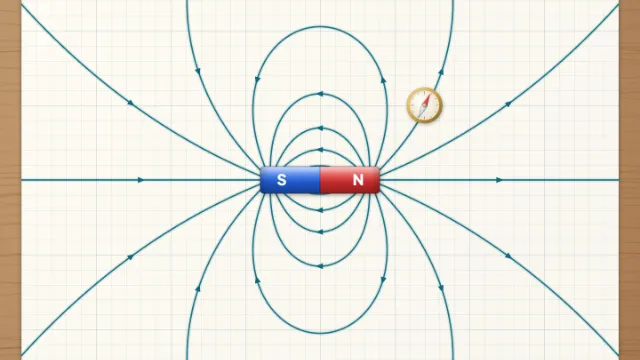
The simulation above shows bar magnets on graph paper with a plotting compass, field lines and a strength map.

  1. Choose With the Earth’s field. Out near the edges the lines turn almost parallel and point up the page, to the north, because at that distance the magnet's own field has become weaker than the Earth's.
  2. Drag the compass from close to the magnet out towards the edge. Near the magnet it follows the magnet's field; far away it settles pointing north.
  3. Switch the Earth’s field toggle off and on to see how the pattern near and far from the magnet changes, and note how weak the Earth's field is compared with the magnet near its poles.
Common mistakes

  • Labelling the magnetic pole up near the Arctic as a north pole. A compass's north-seeking end is drawn towards it, so it must be a south pole.
  • Saying a compass points exactly to the geographic North Pole. It points to magnetic north, a few degrees away in most places.
  • Thinking the field comes from a solid iron magnet inside the Earth. The core is far too hot; the field is generated by moving molten metal.
  • Believing the field never changes. The magnetic poles drift, and the field has reversed many times in the past.
  • Forgetting that the solar wind is made of charged particles. Only moving charges are turned aside by a magnetic field.

Exam practice

Exam-style questions

Original questions written in the style of Punjab board exams. Try each one before you reveal the answer.

  1. 1.A freely suspended bar magnet always comes to rest pointing roughly north–south.

    1. (a)Explain why the magnet settles in this direction.

      2 marks
      Show the answer

      Answer: The Earth has a magnetic field, like that of a large bar magnet. The suspended magnet turns until it lies along this field, with its north-seeking end drawn towards the northern magnetic pole.

      Marking points

      • Earth has its own magnetic field
      • Magnet aligns with the field (N end towards the northern magnetic pole)
    2. (b)What type of magnetic pole lies near the Earth's geographic North Pole? Give a reason.

      2 marks
      Show the answer

      Answer: A magnetic south pole, because it attracts the north-seeking (N) pole of a compass, and unlike poles attract.

      Marking points

      • Magnetic south pole
      • It attracts the N pole of a compass; unlike poles attract
  2. 2.Scientists explain the Earth's magnetic field using the dynamo theory.

    1. (a)Describe the structure of the Earth's core.

      2 marks
      Show the answer

      Answer: A solid inner core surrounded by a liquid outer core, both made mostly of iron with some nickel.

      Marking points

      • Solid inner core, liquid outer core
      • Mainly iron (and nickel)
    2. (b)Explain how the field is thought to be produced.

      3 marks
      Show the answer

      Answer: Heat from the interior drives convection currents in the molten metal of the outer core, and the spinning Earth twists the flows. The moving, conducting metal carries charge, which forms electric currents, and electric currents produce magnetic fields. The field in turn sustains the currents.

      Marking points

      • Convection / flow of molten metal in the outer core
      • Moving charges / electric currents in the metal
      • Currents produce a magnetic field (Earth's rotation helps organise it)
    3. (c)Why can the field not be due to a permanent magnet at the centre of the Earth?

      1 mark
      Show the answer

      Answer: The core is far hotter than the temperature (about 770 °C) above which iron loses its permanent magnetism.

      Marking points

      • Core too hot for iron to stay permanently magnetised
  3. 3.The Earth's magnetic field extends far into space and forms the magnetosphere.

    1. (a)State two ways in which the Earth's magnetic field is useful to living things.

      2 marks
      Show the answer

      Answer: It deflects most of the charged particles of the solar wind and cosmic rays, protecting the atmosphere and life; and it lets people and animals (birds, turtles) find direction.

      Marking points

      • Shields from solar wind / cosmic radiation
      • Navigation by compass or by animals
    2. (b)A 50 m horizontal cable carrying 200 A lies at right angles to a horizontal field of 4.0 × 10⁻⁵ T. Calculate the force on it.

      2 marks
      Show the answer

      Answer: F = BIL = 4.0 × 10⁻⁵ × 200 × 50 = 0.40 N.

      Marking points

      • F = BIL with values
      • 0.40 N

Quiz

Quick check

6 questions

  1. 1.The magnetic pole located near the Earth's geographic North Pole is:
  2. 2.According to the dynamo theory, the Earth's magnetic field is produced by:
  3. 3.Which layers of the Earth are involved in producing its magnetic field?
  4. 4.The Earth's magnetic field protects life mainly by:
  5. 5.A typical strength of the Earth's magnetic field at its surface is about:
  6. 6.A compass points to magnetic north rather than true north because:

Related articles

Next step

Now see it move

Open the full magnetic field of a bar magnet simulation for every preset, graphs and the teacher tools, then test yourself.

Magnetic field of a bar magnet simulation: glossy bar magnets on a sheet of graph paper