Electricity from movement
In Chapter 17 a current made a magnetic field, and a field pushed on a current. In 1831 Michael Faraday in England, and Joseph Henry in America at about the same time, found the reverse effect: a changing magnetic field can make a current in a wire, with no battery at all. Nearly every power station, and every transformer, depends on this idea.
Electromagnetic induction: producing an e.m.f. (and so a current, if the circuit is complete) in a conductor by changing the magnetic field through it.
Experiment 1: a magnet and a coil
Join a coil of many turns to a galvanometer, a meter whose needle sits at zero in the middle and swings either way.
| What you do | What the needle does |
|---|---|
| Hold the magnet still near or inside the coil | stays at zero |
| Push the magnet into the coil | swings one way |
| Pull the magnet out of the coil | swings the other way |
| Push it in faster | swings further |
| Keep the magnet still and move the coil instead | swings just the same |
The needle moves only during the time the field in the coil is changing. It is the relative motion of magnet and coil that matters, not which one moves.
Experiment 2: a wire cutting field lines
Place a straight wire of length between the poles of a horseshoe magnet and join its ends to a galvanometer to make a closed loop.
- Moving the wire across the field, so that it cuts the field lines, gives a current. Moving it the other way reverses the current.
- Holding it still, or sliding it along the field lines, gives nothing.
Try different resistors in the loop while moving the wire at the same speed. A bigger resistance gives a smaller current, but the product stays the same. That constant is the induced e.m.f.: the movement acts like a battery, and the resistance only decides how much current that "battery" can push.
Making the induced e.m.f. bigger
The induced e.m.f., and so the current, can be increased by:
- using a stronger magnet;
- moving the magnet or wire faster;
- using a coil with more turns.
Each one makes the coil cut more field lines every second.
Magnetic flux
To put numbers on "how much field passes through a coil", we use magnetic flux, symbol .
- is the magnetic field strength in tesla (T);
- is the area of the coil in m²;
- is the angle between the field and the normal to the coil (a line at right angles to its face).
The unit of flux is the weber (Wb). One weber is the flux when a 1 T field passes straight through an area of 1 m²: .
Flux is largest () when the field passes straight through the coil (), and zero when the field runs along the face of the coil ().
Faraday's law
Faraday's law: the average e.m.f. induced in a coil of turns equals the rate of change of the flux through it, multiplied by , with a negative sign.
is in volts, in webers and in seconds. The size of the e.m.f. depends on how fast the flux changes, not on how much flux there is. When working out a size, leave the minus sign aside; it carries the direction, which Lenz's law explains.
Lenz's law
Lenz's law: the induced current always flows in the direction that opposes the change that produced it.
- Push the N pole of a magnet towards a coil. The coil's current turns its nearer end into an N pole, which repels the approaching magnet.
- Pull the N pole away. The current reverses, so that end becomes an S pole, pulling back on the retreating magnet (attraction).
Either way, you have to do work against a magnetic force to move the magnet. That work is the source of the electrical energy. If the induced current helped the motion instead, the magnet would speed up by itself and energy would appear from nothing, which conservation of energy forbids. Lenz's law is the energy principle applied to induction.
Worked numerical 1: flux through a coil
A coil of area 0.050 m² sits in a uniform field of 0.40 T. Find the flux through it when the field makes an angle of (a) 0°, (b) 60° with the normal to the coil.
(a)
(b)
Worked numerical 2: the induced e.m.f.
The coil in numerical 1 has 200 turns. It is pulled out of the field, so the flux falls from 0.020 Wb to zero in 0.10 s. How big is the average e.m.f. induced? If the coil and meter have a total resistance of 8.0 Ω, find the current.
Worked numerical 3: finding the time
A 50-turn coil has a steady e.m.f. of 3.0 V induced in it while its flux changes by 0.012 Wb. How long does the change take?
Worked numerical 4: the constant I × R
A wire is moved through a magnet's field at a steady speed. With a 2.0 Ω loop the current is 0.15 A. What current flows if the loop's resistance is 6.0 Ω and the wire moves at the same speed?
Induction in the simulation
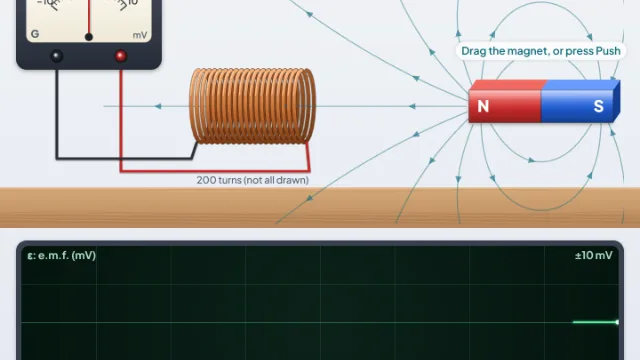
Choose the Magnet and coil experiment.
- Press Push and watch the Induced e.m.f. card and the meter. Let the magnet stop: the reading drops back to zero. Press Pull and the reading has the opposite sign.
- Raise the Push and pull speed, then the Turns on the coil, and push again. Each change gives a bigger peak e.m.f.
- Watch the Coil end facing the magnet card while you push: the coil's near end has the same pole as the approaching end of the magnet and repels it. On the way out it pulls on the magnet. That is Lenz's law.
- Press Flip (with the magnet pulled out) so the S pole faces the coil, and push again: every reading reverses.