Changing the voltage of a.c.
A phone charger plugged into a 220 V socket gives out only about 5 V. Power lines between cities run at hundreds of thousands of volts. The device that changes one alternating voltage into another is the transformer. It has no moving parts, and its input and output circuits are not joined by any wire at all.
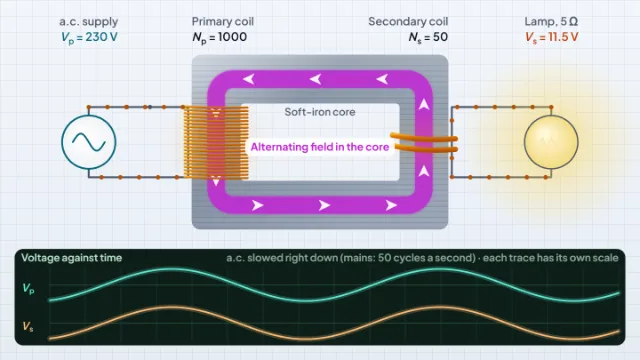
Structure of a simple transformer
- A soft iron core, usually a closed rectangular frame, which links the two coils magnetically.
- A primary coil of turns of insulated wire, connected to the a.c. supply (the input).
- A secondary coil of turns of insulated wire, connected to the load (the output).
Soft iron is chosen because it is magnetised and demagnetised very easily, so it can follow a 50 Hz field, which reverses direction 100 times a second.
How it works
- An alternating voltage across the primary coil drives an alternating current through it.
- This current produces a field in the core that keeps changing: growing, shrinking and reversing.
- Because the core passes through both coils, the secondary sits in this changing field, so the flux through it never stays the same.
- By electromagnetic induction (section 18.1), an alternating voltage is induced across the secondary. If a load is connected, an alternating current flows in it.
Energy passes from the primary to the secondary through the magnetic field in the core, not through any wire.
Why only a.c.? A steady direct current in the primary makes a steady field. A steady field gives no change of flux, so nothing is induced in the secondary (apart from a brief pulse when the d.c. is switched on or off). A transformer will not work on a battery.
Step-up and step-down
Step-up transformer: is bigger than , and the voltage comes out higher than it went in.
Step-down transformer: is smaller than , and the voltage comes out lower than it went in.
The turns-ratio equation
For a transformer with no energy losses, each voltage is proportional to the number of turns on its coil:
- and : input and output voltages, across the primary and secondary;
- and : turns on the primary and secondary.
If the secondary has three times as many turns, the output voltage is three times the input. If it has a tenth as many, the output is a tenth.
Why power is sent at high voltage
Electricity reaches homes through long cables, and every cable has resistance. The power lost as heat in the cables is
where is the current in the cables and their resistance. For a fixed amount of power to deliver, a higher voltage means a smaller current, because power = voltage × current. Since the loss depends on , making the current ten times smaller cuts the heating loss a hundred times.
So at power stations step-up transformers lift the voltage before it is sent along the lines, and near towns step-down transformers bring it down to a safe 220 V.
Worked numerical 1: designing a step-down transformer
A 12 V lamp is to be run from the 220 V mains. The primary coil has 1100 turns. How many turns are needed on the secondary?
Data: , ,
Worked numerical 2: stepping up for the grid
At a power station, a transformer raises the generator's 11 kV to 132 kV for transmission. Its primary has 500 turns. Find the turns on the secondary.
Worked numerical 3: why high voltage saves energy
A town needs 1.0 MW of power, sent through cables of total resistance 5.0 Ω. Compare the heating loss in the cables when the power is sent at (a) 10 kV, (b) 100 kV.
(a)
That is 50 kW, or 5 % of the power sent.
(b)
Ten times the voltage gives one tenth of the current and one hundredth of the loss.
Worked numerical 4: currents in an ideal transformer (beyond the book)
A 220 V to 12 V transformer supplies a 12 V lamp taking 2.0 A. Assuming no losses, find the current in the primary.
The low-voltage side carries the bigger current, so its coil is wound from thicker wire.
The transformer in the simulation
Choose the Transformer view.
- Pick the 230 V down to 11.5 V example. Compare Turns on the primary coil with Turns on the secondary coil, and check on the Output voltage card that output ÷ input voltage matches secondary ÷ primary turns.
- Raise the Turns on the secondary coil above the primary's. The Turns card changes from step-down to step-up and the output voltage climbs above the input.
- Press Use d.c. The core's field becomes steady and the output voltage drops to zero: a steady field induces nothing.
- Switch to the National Grid view and change Send the power at. Watch the Heating the lines card (and the Current in the lines card beside it) shrink as the transmission voltage rises.