A wave that sometimes acts like bullets
Everything so far in this book has treated light as a wave: it reflects, refracts, diffracts and has a wavelength. Yet some experiments only make sense if light arrives in separate little bundles, like a stream of tiny bullets rather than a smooth flow. Modern physics accepts both pictures. This section looks at the particle side.
Photons
According to modern physics, light (and every other electromagnetic wave) travels as a stream of photons.
Photon: a packet, or quantum, of light energy.
- A photon has no rest mass: it is not a small lump of matter like an electron.
- Even so, each photon carries energy and carries momentum.
- Photons move at the speed of light, .
The particle picture helps exactly where the wave picture struggles: when light hands its energy over to individual particles of matter.
Evidence 1: the photoelectric effect
Shine light onto a clean metal surface and, under the right conditions, electrons are knocked out of the metal. This is the photoelectric effect, and the ejected electrons are called photoelectrons.
What happens is that a single photon gives all its energy to a single electron in the metal. If that packet of energy is large enough, the electron breaks free from the surface. The energy arrives in lumps, one photon at a time, not spread evenly like a wave lapping against a shore. That is why the photoelectric effect is the classic evidence that light energy comes in packets.
Evidence 2: radiation pressure and solar sails
Because photons carry momentum, light can push on whatever it hits. The push from a single photon is unimaginably small, and even full sunlight presses on a surface only very gently. This push is called radiation pressure.
In space it is enough to be useful. A solar sail is a huge, very thin, mirror-like sheet attached to a spacecraft. Sunlight reflects off it, the photons bounce back, and their change of momentum pushes the sail away from the Sun. There is no air to slow the craft, so this tiny force, acting day after day, steadily builds up its speed without using any fuel. Japan's IKAROS spacecraft, launched in 2010, was the first to show solar sailing working in deep space, on its way past Venus.
The dual nature of light
Light behaves:
- as a wave when it travels and spreads out: interference, diffraction, refraction, scattering in the sky;
- as a stream of particles (photons) when it gives energy or momentum to matter: the photoelectric effect, radiation pressure.
Neither picture alone tells the whole story. Which one shows up depends on how the light interacts with the materials around it. This dual nature is one of the central ideas of modern physics.
| Wave behaviour | Particle behaviour |
|---|---|
| Has a wavelength and frequency | Comes in packets called photons |
| Reflects, refracts and diffracts | Knocks electrons out of metals |
| Scatters in the atmosphere | Pushes on surfaces (radiation pressure) |
Worked numerical 1: energy of a blue photon (beyond the book)
Blue light has a wavelength of m. Find (a) its frequency and (b) the energy of one photon.
(a) From the wave equation :
(b)
Worked numerical 2: how many photons from a laser pointer? (beyond the book)
A red laser pointer gives out 1.0 mW (0.0010 J each second) of light of wavelength 650 nm. Each photon carries J.
More than three thousand million million photons every second: that is why light from a lamp or laser seems perfectly smooth, even though it is made of packets.
Worked numerical 3: the push on a solar sail (beyond the book)
Near the Earth, sunlight pushing on a perfectly reflecting sail gives a force of about N on each square metre. For a sail of 200 m²:
That is about the weight of a mass of 0.2 g. On a 300 kg craft it gives an acceleration of only about m s⁻², but after 30 days with nothing slowing it down the craft has gained roughly 16 m s⁻¹.
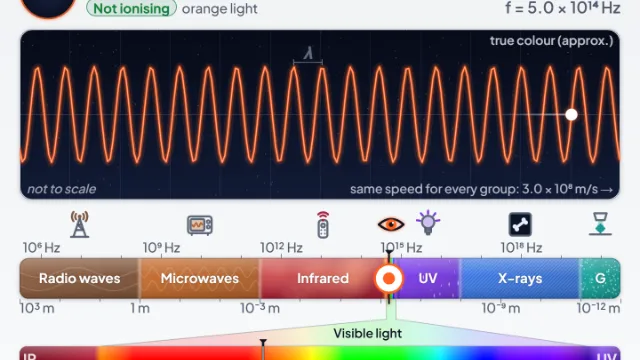
Photons in the spectrum simulation
The electromagnetic spectrum simulation above shows the Energy per photon for any wavelength you pick.
- Under Jump to an example, choose Red light, then Blue light. The Energy per photon card rises as the wavelength gets shorter.
- Step on to UV lamp and X-rays. The photon energy climbs steeply; this is why ultraviolet can eject electrons from metals that red light cannot, and why X-rays can ionise atoms.
- Choose FM radio and compare: a radio photon carries only a tiny fraction of the energy of a visible one.
- Watch the Frequency card as you go. Higher frequency always goes with more energy per photon.