Blue at noon, red at dusk
Look up on a clear afternoon and the whole sky is blue. A few hours later, as the Sun touches the horizon, the same sky near the Sun burns orange and red, and the Sun itself looks like a red disc you can almost look at. Nothing about the Sun has changed. What changes is the path its light takes through the air, and the way the air treats different colours.
What scattering means
Scattering of light: the redirecting of light into many new directions when it strikes very small particles, such as the molecules of the gases in air.
When sunlight meets a nitrogen or oxygen molecule, the molecule picks up a little of the light's energy and sends it out again in all sorts of directions. The light is not used up, it is simply sent somewhere else. Each molecule scatters only a tiny fraction of the light, but the atmosphere contains so many molecules that, together, they light up the whole sky.
Shorter wavelengths scatter more
Sunlight is white light: a mixture of every colour of the rainbow, from red through to violet (see dispersion of light). Each colour has its own wavelength, from about 700 nm for red down to about 400 nm for violet.
Gas molecules are far smaller than any of these wavelengths, and such tiny scatterers deflect the short wavelengths far more readily than the long ones. So, out of all the colours in sunlight, blue and violet are scattered the most and red the least.
The blue sky explained
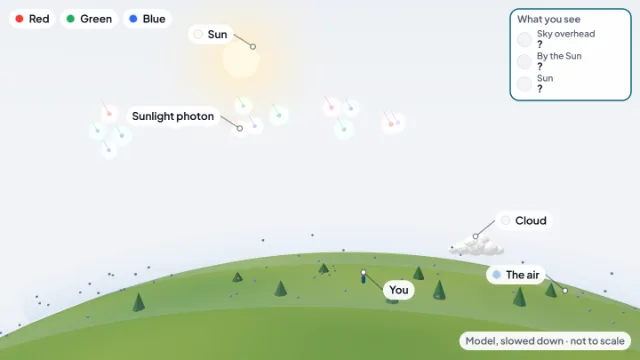
During the day, sunlight comes down through the atmosphere. All along its path, molecules scatter some of the light sideways, and the scattered light is mostly blue. This scattered blue light reaches your eyes from every direction in the sky, so the sky looks blue in every direction except straight at the Sun.
Why not violet? Violet has an even shorter wavelength than blue and is scattered even more. Yet the sky looks blue, not violet, because sunlight contains less violet than blue to start with, and the eye responds only weakly to violet. The scattered mixture of violet, blue and some green is seen by our eyes as sky blue.
Why sunsets are red
When the Sun is high, its light crosses a fairly short thickness of air to reach you. When it is low, at sunrise or sunset, its light must slant through a much longer path in the atmosphere, many times longer.
Over that long distance, the direct beam loses nearly all its blue and a good deal of its green to scattering, which sends that light off elsewhere (to give someone else a blue sky). The light that survives the journey is mostly the longer wavelengths, orange and red. So the Sun looks orange-red, and the clouds and sky near the horizon glow with the same warm colours.
Dust, smoke, pollution and tiny water droplets in the air add even more scattering along that long path. They can make sunsets deeper red, and sometimes purple. After big volcanic eruptions, fine particles high in the atmosphere have given vivid sunsets around the world for months.
Worked example 1: which sky is which?
Match each situation to the colour of the sky overhead:
- The Moon at midday. No atmosphere, so nothing scatters light towards you: the sky is black and the Sun is a white disc.
- Pakistan at noon, clear weather. A short path through clean air; blue is scattered across the sky: blue sky, Sun white-yellow.
- Pakistan at sunset, dusty air. A very long path plus extra particles: most blue removed from the sunlight; the sky near the Sun is deep orange-red.
Worked example 2: comparing two colours (beyond the book)
Using the rule, how many times more strongly is violet light (400 nm) scattered than red light (700 nm)?
Violet is scattered about nine times as strongly as red.
Scattering is one of the effects that light shows as a wave. The next section turns to the evidence that light also arrives in packets, as photons.
Scattering in the 3D simulation
- Press Send in sunlight and watch the stages. During Hitting the air, see which colour of photon is knocked off course most often.
- Read the Blue against red row: it shows how much more strongly blue is scattered than red.
- Drag the Sun height slider down towards 0°. Watch Air the sunlight crosses grow and the colour in The Sun row change from white to orange and red.
- Under Air, choose None (Moon). With no molecules, nothing is scattered and the Sky overhead turns black. Then try 4 × Earth and see what a much thicker atmosphere would do.