Skip to content

Punjab Board Class 10 Physics · Chapter 14: Light

Dispersion of light by a prism

Section 14.8

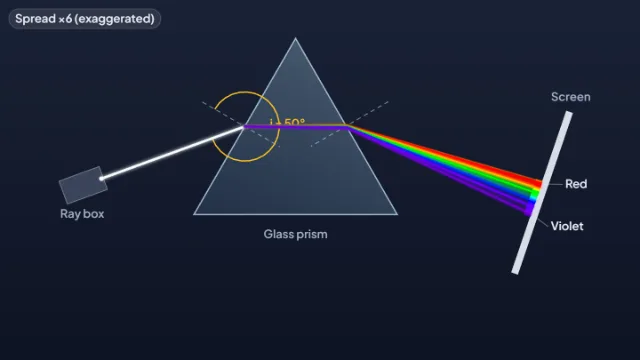
White light is a mix of colours. Glass slows each colour by a slightly different amount, so a prism bends them by different angles and spreads them into a spectrum: red bends least and violet most. Invisible infrared lies beyond the red end and can be detected with a thermometer.

Loading simulation…

Symbols match your course. Open the full dispersion, prisms and colour simulation for more presets and teacher tools.

Where the colours come from

Shine a narrow beam of sunlight or white torchlight into a glass prism and look at the light coming out of the far side on a white card. Instead of a white spot you see a band of colours, from red at one edge to violet at the other. The prism has not painted the light. It has separated colours that were mixed together in the white light all along. Section 14.8 explains how.

Refraction through a prism

A prism is a block of transparent material, usually glass, with polished flat faces that are tilted towards each other. A triangular prism with three 60° angles is the common school kind.

A ray entering the first face slows down and bends towards the normal. When it reaches the second face it speeds up again as it leaves and bends away from the normal. Because the two faces are not parallel, the two bends do not cancel: the ray that comes out (the emergent ray) is turned away from its original direction, towards the thicker base of the prism. The angle between the incident direction and the emergent ray is the angle of deviation, D.

Dispersion

Dispersion is the splitting of white light into its seven component colours when it passes through a prism.

White light is a mixture of many wavelengths. The speed of light in glass, and therefore the refractive index of the glass, is slightly different for each wavelength:

  • Violet and blue light, with the shortest wavelengths, are slowed the most. They have the largest refractive index and are bent the most.
  • Red light, with the longest wavelength, is slowed the least and bent the least.

The colours therefore emerge heading off at slightly different angles, and the beam fans out into a spectrum. In order from the least bent to the most bent, the colours are:

red, orange, yellow, green, blue, indigo, violet

A common way to remember the order is the name "ROY G BIV".

Beyond the visible colours

The spectrum does not stop at the edges you can see.

  • Just past the red end lies infrared (IR) radiation, with wavelengths longer than red light.
  • Just past the violet end lies ultraviolet (UV) radiation, with wavelengths shorter than violet.

Our eyes cannot detect either, but they can be detected in other ways. A thermometer held a little past the red edge of the spectrum warms up, showing that invisible infrared energy is arriving there.

Infrared thermometers

Every warm object gives out infrared radiation, and the hotter it is, the more it emits. An infrared thermometer has a sensor that measures the infrared reaching it from an object and works out the object's temperature. It does not need to touch anything, which is why it is used to check a person's body temperature quickly from a short distance.

Worked numerical 1: two speeds in the same glass

In a crown glass, the refractive index is 1.513 for red light and 1.531 for violet light. Find the speed of each colour in the glass. (c=3.00×10⁸c = 3.00 \times 10^{8} m s⁻¹)

Using n=c/vn = c/v, so v=c/nv = c/n:

vred=3.00×1081.513=1.98×10⁸ m s−1,vviolet=3.00×1081.531=1.96×10⁸ m s−1v_{\text{red}} = \frac{3.00 \times 10^{8}}{1.513} = 1.98 \times 10^{8}\ \text{m s}^{-1}, \qquad v_{\text{violet}} = \frac{3.00 \times 10^{8}}{1.531} = 1.96 \times 10^{8}\ \text{m s}^{-1}

Violet light is the slower of the two, by only about 1%, and that small difference is enough to separate the colours.

Worked numerical 2: refraction at the first face

White light strikes the first face of the same glass at an angle of incidence of 50°. Find the angle of refraction for red and for violet.

From Snell's law, sin⁡r=sin⁡i÷n\sin r = \sin i \div n:

sin⁡rred=sin⁡50∘1.513=0.506⇒rred=30.4∘\sin r_{\text{red}} = \frac{\sin 50^\circ}{1.513} = 0.506 \quad\Rightarrow\quad r_{\text{red}} = 30.4^\circ sin⁡rviolet=sin⁡50∘1.531=0.500⇒rviolet=30.0∘\sin r_{\text{violet}} = \frac{\sin 50^\circ}{1.531} = 0.500 \quad\Rightarrow\quad r_{\text{violet}} = 30.0^\circ

Violet has the smaller angle of refraction: it is bent further towards the normal.

Worked numerical 3: the colours after a 60° prism

Following each ray on to the second face of a 60° prism, the angles of emergence work out at about 48.3° for red and 49.9° for violet. The deviation is D=i+e−AD = i + e - A, where A=60∘A = 60^\circ is the angle of the prism.

Dred=50∘+48.3∘−60∘=38.3∘,Dviolet=50∘+49.9∘−60∘=39.9∘D_{\text{red}} = 50^\circ + 48.3^\circ - 60^\circ = 38.3^\circ, \qquad D_{\text{violet}} = 50^\circ + 49.9^\circ - 60^\circ = 39.9^\circ

The violet light is deviated about 1.6° more than the red. On a screen a metre or two away, that small angle spreads the colours into a band a few centimetres wide.

Worked numerical 4: the frequency of red and violet light

With v=fλv = f\lambda (Chapter 12), find the frequency of red light of wavelength 700 nm and violet light of 400 nm in air.

fred=3.00×108700×10−9=4.3×10¹⁴ Hz,fviolet=3.00×108400×10−9=7.5×10¹⁴ Hzf_{\text{red}} = \frac{3.00 \times 10^{8}}{700 \times 10^{-9}} = 4.3 \times 10^{14}\ \text{Hz}, \qquad f_{\text{violet}} = \frac{3.00 \times 10^{8}}{400 \times 10^{-9}} = 7.5 \times 10^{14}\ \text{Hz}

So the most strongly bent colour, violet, is also the one with the shortest wavelength and the highest frequency.

Dispersion in the simulation

With the Prism scene chosen, a ray box shines on a 60° glass prism.

  1. Press Light on with White light selected and watch the beam fan out into seven colours. Turn on Exaggerate the spread to make the gaps easier to see; the readings stay those of real glass.
  2. Change the Angle of incidence and read the Deviation for red and violet. The table of the seven colours shows the refractive index rising steadily from red to violet.
  3. Choose One colour and move the Wavelength slider: a single colour is bent but not split. Then switch on Thermometer beyond red to see the invisible infrared warming a thermometer past the red end.
Common mistakes

  • Saying the prism adds colours to the light. White light already contains them; the prism only separates them.
  • Getting the order the wrong way round. Red is bent least and violet most.
  • Linking the most bending with the longest wavelength. The shortest wavelength (violet) has the largest refractive index and bends most.
  • Thinking the refractive index of glass is one fixed number for all light. It changes slightly with wavelength, which is what causes dispersion.
  • Forgetting the invisible parts of the spectrum: infrared beyond red, ultraviolet beyond violet.
  • Saying the light bends only once in a prism. It refracts at both faces, towards the normal going in and away from it coming out.
  • Mixing up indigo and violet in the order. Indigo comes between blue and violet.

Exam practice

Exam-style questions

Original questions written in the style of Punjab board exams. Try each one before you reveal the answer.

  1. 1.Usman directs a narrow beam of white light onto one face of a triangular glass prism and catches the light that comes out on a white screen.

    1. (a)Define dispersion of light.

      1 mark
      Show the answer

      Answer: The separation of white light into its seven colours when it passes through a prism.

      Marking points

      • White light split into its component colours (by a prism)
    2. (b)Explain why the colours separate.

      3 marks
      Show the answer

      Answer: Each colour (wavelength) travels at a slightly different speed in glass, so the glass has a slightly different refractive index for each. Each colour is therefore refracted through a different angle, violet (shortest wavelength) the most and red the least, and they spread apart.

      Marking points

      • Speed / refractive index depends on wavelength (colour)
      • Different colours refracted by different amounts
      • Violet bent most, red least
    3. (c)List the colours on the screen, starting with the one deviated least.

      2 marks
      Show the answer

      Answer: Red, orange, yellow, green, blue, indigo, violet.

      Marking points

      • All seven colours
      • In the correct order from red
  2. 2.A flint glass has a refractive index of 1.64 for red light and 1.68 for violet light.

    1. (a)Calculate the speed of red light in this glass. (c = 3.00 × 10⁸ m s⁻¹)

      2 marks
      Show the answer

      Answer: v = c/n = 3.00 × 10⁸ ÷ 1.64 = 1.83 × 10⁸ m s⁻¹.

      Marking points

      • v = c/n
      • 1.83 × 10⁸ m s⁻¹
    2. (b)A ray hits this glass with i = 40°. Find the angle of refraction of the violet light.

      2 marks
      Show the answer

      Answer: sin r = sin 40° ÷ 1.68 = 0.643 ÷ 1.68 = 0.383, so r = 22.5°.

      Marking points

      • sin r = sin i ÷ n
      • r ≈ 22.5°
    3. (c)Which colour is slower in the glass? Give a reason.

      1 mark
      Show the answer

      Answer: Violet, because it has the larger refractive index and n = c/v.

      Marking points

      • Violet, larger n means smaller speed
  3. 3.A thermometer is moved slowly across the spectrum from a prism and then just beyond its red end.

    1. (a)Explain why the thermometer warms up beyond the red end, where no light is seen.

      2 marks
      Show the answer

      Answer: Invisible infrared radiation, with wavelengths longer than red, is also spread out by the prism and lands there. It carries energy that heats the thermometer.

      Marking points

      • Infrared radiation is present beyond the red
      • Infrared transfers energy / heats the thermometer
    2. (b)Describe how an infrared thermometer measures body temperature.

      2 marks
      Show the answer

      Answer: A sensor inside picks up the infrared that the body emits; the hotter the body, the more infrared it emits, so the reading gives the temperature without contact.

      Marking points

      • Detects infrared emitted by the body
      • More infrared from a hotter body; no contact needed

Quiz

Quick check

6 questions

  1. 1.When white light passes through a prism, which colour is deviated most?
  2. 2.Dispersion happens because the refractive index of glass:
  3. 3.Which radiation would be found just beyond the red end of a prism's spectrum?
  4. 4.In glass, violet light compared with red light:
  5. 5.Which is the correct order of colours in the spectrum, from least to most bent?
  6. 6.An infrared thermometer can measure a person's temperature without touching them because it:

Next step

Now see it move

Open the full dispersion, prisms and colour simulation for every preset, graphs and the teacher tools, then test yourself.

Dispersion, prisms and colour simulation: shine white light through a glass prism and watch it fan out from red to violet