Skip to content

Punjab Board Class 10 Physics · Chapter 14: Light

Reflection of light and the plane mirror

Section 14.1

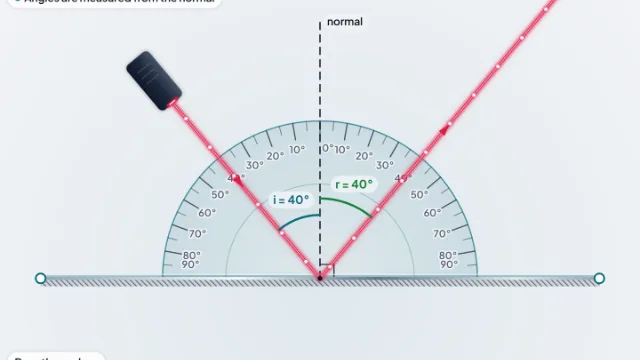
Reflection is light bouncing off a surface. Whatever angle a ray arrives at, measured from the normal, it leaves at that same angle: i = r. A plane mirror gives an image that is upright, the same size, sitting at an equal depth behind the glass, laterally inverted and virtual.

Loading simulation…

Symbols match your course. Open the full reflection in a plane mirror simulation for more presets and teacher tools.

Why you can see this page

Most things around you give out no light of their own. You see a wall, a book or a friend's face because light from the Sun or a lamp lands on them and bounces off into your eyes. That bouncing back from a surface is reflection. Section 14.1 sets out the rules it follows and uses them to explain the image in a flat mirror.

The words you need

Picture one narrow ray of light striking a mirror.

  • The incident ray is the ray arriving at the surface.
  • The point of incidence is where it lands.
  • The normal is a line drawn at 90° to the surface through the point of incidence. It is a construction line, usually dashed.
  • The reflected ray is the ray that heads away again afterwards.
  • The angle of incidence, ii, is the angle that the incident ray makes with the normal.
  • The angle of reflection, rr, is the angle that the reflected ray makes with the normal.

Both angles are always taken from the normal, never from the mirror itself.

The two laws of reflection

  1. First law: the incident ray, the normal and the reflected ray all lie in one plane (think of them all drawn flat on the same sheet of paper).
  2. Second law: the two angles match:
∠i=∠r\angle i = \angle r

These rules hold for every reflecting surface: a glass mirror, polished steel or the still surface of a pond. A ray sent in along the normal (i=0°i = 0°) comes straight back along its own path.

Smooth and rough surfaces

  • Regular (specular) reflection happens at a very smooth surface such as a mirror. A parallel beam stays parallel after reflection, so you see a sharp image.
  • Diffused (irregular) reflection takes place at an uneven surface: paper, cloth or a painted wall. Every tiny part of the surface faces a slightly different way, so the rays of a parallel beam go off in many directions and no image forms.

The second law is still obeyed at each tiny patch of a rough surface. Only the normals change from one patch to the next. Diffuse reflection is helpful too: thanks to it, a printed page can be read from almost anywhere in the room without glare.

Locating the image in a plane mirror

Stand a plane mirror upright on a sheet of white paper and draw a line along its back edge. Place a small object, such as a pin, a few centimetres in front of it.

  1. Look into the mirror from one side and line up two more pins with the image of the object. Join them with a ruler: this is one reflected ray.
  2. Repeat from a different viewing position to get a second reflected ray.
  3. Remove the mirror and continue both reflected rays backwards behind the mirror line with dotted lines. Where they cross is the position of the image.
  4. Measure the distance from the object to the mirror line and from the mirror line to the image. They come out equal.

No light really travels along the dotted lines. To your eye the reflected light merely appears to spread out from that point behind the glass.

What the image is like

The image in a plane mirror is:

  • erect: not upside down;
  • equal in size to the object;
  • at an equal distance: the image is exactly as deep behind the glass as the object is in front;
  • laterally inverted: left and right appear swapped, so writing looks backwards;
  • virtual: it cannot be caught on a screen, because the reflected rays never actually meet there.

Lenses and curved mirrors can also form real images that do show up on a screen; the difference is compared in the notes on real and virtual images from lenses and mirrors.

Worked numerical 1: the angle from the surface

A ray strikes a mirror making an angle of 25° with the mirror's surface. Find ii and rr, then the full angle between the two rays.

The normal makes 90° with the glass, so

i=90°−25°=65°i = 90° - 25° = 65°

By the second law, r=65°r = 65°. The angle between the two rays is

i+r=65°+65°=130°i + r = 65° + 65° = 130°

Worked numerical 2: walking towards a mirror

Sana waits 1.5 m from a wall mirror.

  • Her image sits 1.5 m on the far side of the glass, so it is 1.5+1.5=3.0 m1.5 + 1.5 = 3.0\ \text{m} from her.
  • She steps 0.5 m closer. She is now 1.0 m from the mirror, her image is 1.0 m behind it, and the gap between Sana and her image is 2.0 m.

Moving 0.5 m forward shortened the gap to her image by 1.0 m, because the image moves too.

Worked numerical 3: from the angle between the rays

The incident and reflected rays at a mirror are 80° apart. Since i=ri = r and i+r=80°i + r = 80°,

i=80°2=40°i = \frac{80°}{2} = 40°

A periscope uses two plane mirrors set parallel, each at 45° to the tube. Light turns through 90° at the top mirror and back through 90° at the bottom one, so it comes out travelling the same way as it went in, only lower down. The next section of the book, on refraction of light, looks at what happens when light passes into a surface instead of bouncing off it.

Reflection in the simulation

  1. In Ray mode, pick the Ray at 30° set-up and drag the Angle of incidence slider. The Angle of reflection card always shows the same value.
  2. Tick Trap: angle to the mirror. The extra angle it marks equals ii only when the ray lands at 45°.
  3. Choose Image of a pin and move the Pin distance from the mirror slider: the Pin to mirror and Mirror to image cards stay equal.
  4. Compare the Smooth mirror and Rough paper set-ups to see a parallel beam stay together or spread out.
Common mistakes

  • Measuring the angles from the mirror's surface instead of from the normal. A ray at 30° to the glass has an angle of incidence of 60°.
  • Saying a rough surface breaks the law of reflection. Each tiny patch still gives i = r; the normals just point in different directions.
  • Calling a plane-mirror image real because it looks solid. No light reaches the point behind the mirror, so it cannot be caught on a screen.
  • Thinking you see a smaller image when you step back from a mirror. The image stays the same size; it only looks smaller because it is farther away.
  • Giving the distance from a person to their image as the distance to the mirror. The image is behind the mirror, so the gap is twice as big.
  • Leaving the normal out of a ray diagram, or drawing it along the mirror instead of at 90° to it.

Exam practice

Exam-style questions

Original questions written in the style of Punjab board exams. Try each one before you reveal the answer.

  1. 1.In a lab, Ayesha aims a narrow beam at a flat mirror lying on her desk. Her protractor shows that the beam and the glass surface are 35° apart.

    1. (a)What is meant by the normal?

      1 mark
      Show the answer

      Answer: A line at right angles to the reflecting surface at the point where the ray strikes it.

      Marking points

      • Line perpendicular to the surface at the point of incidence
    2. (b)Calculate the angle of reflection.

      2 marks
      Show the answer

      Answer: Angle of incidence = 90° − 35° = 55°. Reflection keeps i and r equal, so r is 55° too.

      Marking points

      • i = 90° − 35° = 55°
      • r = i = 55°
    3. (c)State the law of reflection that is not about the size of the angles.

      1 mark
      Show the answer

      Answer: Incoming ray, outgoing ray and normal are all drawn in one flat plane.

      Marking points

      • All three lines in one plane
  2. 2.Usman is getting ready for school, 2.0 m away from a long mirror on his bedroom wall.

    1. (a)How far is Usman from his image?

      2 marks
      Show the answer

      Answer: The image is 2.0 m behind the mirror, so it is 2.0 + 2.0 = 4.0 m from him.

      Marking points

      • Image as far behind the mirror as he is in front
      • 4.0 m
    2. (b)He walks 0.5 m towards the mirror. By how much does the distance between him and his image change?

      2 marks
      Show the answer

      Answer: He is now 1.5 m from the mirror and the image 1.5 m behind it, so the gap is 3.0 m. It has fallen by 1.0 m.

      Marking points

      • New separation 3.0 m
      • Decrease of 1.0 m
    3. (c)Give three properties of the image he sees, apart from its distance.

      3 marks
      Show the answer

      Answer: Any three of: upright (erect); the same size as Usman; laterally inverted; virtual.

      Marking points

      • Upright / erect
      • Same size
      • Laterally inverted or virtual
  3. 3.A student shines a parallel beam of light first onto a mirror and then onto a sheet of white paper.

    1. (a)Name the type of reflection from each surface.

      2 marks
      Show the answer

      Answer: Mirror: regular (specular) reflection. Paper: diffused (irregular) reflection.

      Marking points

      • Mirror gives regular reflection
      • Paper gives diffuse reflection
    2. (b)Explain why the paper does not form an image even though each ray obeys the law of reflection.

      2 marks
      Show the answer

      Answer: The paper is rough, so the normal points a different way at each small patch. The reflected rays leave in many directions instead of staying parallel, so they cannot form an image.

      Marking points

      • Rough surface: normals in different directions
      • Reflected rays scattered, not parallel, so no image

Quiz

Quick check

6 questions

  1. 1.You find the angle of incidence by measuring from which line?
  2. 2.A beam grazes a flat mirror, making only 20° with the glass. What is r?
  3. 3.Which of these describes the image formed by a plane mirror?
  4. 4.Light hits a mirror head-on, travelling exactly along the normal. Afterwards it:
  5. 5.Light falling on a sheet of paper gives no image because:
  6. 6.The incident and reflected rays at a plane mirror make 110° with each other. The angle of incidence is:

Related articles

Next step

Now see it move

Open the full reflection in a plane mirror simulation for every preset, graphs and the teacher tools, then test yourself.

Reflection in a plane mirror simulation: aim a ray box at a plane mirror and read both angles from the normal on a protractor