Skip to content

Punjab Board Class 10 Physics · Chapter 13: Sound

Acoustic protection of buildings

Section 13.7

Hard, smooth surfaces reflect sound and soft, porous ones absorb it. Too many reflections cause reverberation that blurs speech, so halls and classrooms use carpets, curtains and panels to absorb some sound, and sound boards and curved ceilings to send the rest evenly to listeners.

Loading simulation…

Symbols match your course. Open the full speed of sound and echoes simulation for more presets and teacher tools.

Why some rooms sound better than others

Speak in an empty classroom with bare walls and a tiled floor and your voice seems to ring on after you stop. Say the same words in a bedroom full of curtains, cushions and a carpet and they sound soft and clear. Nothing about your voice has changed. What changed is how much of the sound the room reflects back at you and how much it absorbs.

Acoustics is the study of how sound behaves inside a space. Acoustic protection means designing and furnishing a building so that wanted sound is heard clearly and unwanted sound, including excess reflections and noise from outside, is kept down.

Reflection and absorption

When sound reaches a wall, ceiling or floor, its energy is shared in two ways:

  • some is reflected back into the room;
  • some is absorbed by the material, which takes the energy of the vibrations and converts it, mostly into a tiny rise in temperature.

The surface decides the balance.

SurfaceExamplesEffect on sound
Hard and smoothconcrete, plaster, glass, marble, tilesreflects most of it
Soft and porouscarpets, curtains, cushioned seats, acoustic ceiling tiles, felt and foam panelsabsorbs much of it

Porous materials work because they are full of small air spaces. The sound makes the air in these pockets vibrate against the fibres, and friction turns the energy of the vibrations into heat.

Reverberation

In a closed room, sound does not reflect just once. It bounces from wall to ceiling to floor many times, getting weaker at each bounce. These many reflections reach a listener a little after the direct sound and overlap with it. The sound that lingers on after the source has stopped is called reverberation.

Reverberation: the persistence of sound in an enclosed space caused by many repeated reflections from its surfaces.

Reverberation is different from a distinct echo. In a small room the reflections all return in well under 0.1 s, so the ear cannot separate them. They blend together and smear one word into the next. In a very long hall with a hard back wall, a reflection can take more than 0.1 s to come back and be heard as a separate echo.

Some reverberation is useful: it makes music sound full and lets the sound build up so it is loud enough everywhere. Too much makes speech muddy and hard to follow. Too little makes a room sound flat or "dead", and the people at the back struggle to hear. Good design aims for a balance between reflection and absorption that suits what the room is used for.

Designing for good acoustics

Architects use the properties of sound in several ways:

  • Soft materials to cut excess reflection. Carpets, curtains, padded seats and absorbing panels on the back wall reduce echoes and reverberation in classrooms, lecture theatres, mosques, cinemas and other places where many people gather.
  • Reflectors to send sound where it is needed. A hard panel or sound board behind or above the speaker or stage directs reflected sound out towards the audience instead of letting it escape upwards or backwards.
  • Shaped ceilings. Curved and angled ceiling panels spread the sound evenly over the seats, so a listener in the last row still hears clearly.
  • The right amount of absorption. Too many soft surfaces weaken the sound, so designers mix reflecting and absorbing surfaces instead of covering everything.
  • Keeping outside noise out. Thick, heavy walls, double-glazed windows, well-sealed doors and rows of trees between a building and a busy road all reduce the noise that gets in.

Worked numerical 1: an echo in a long hall

A school hall is 35 m long, with a bare concrete wall at the back. A speaker on the stage claps. Use 340 m s−1340\ \text{m s}^{-1} for the speed of sound. When does the reflection from the back wall return to the stage?

Data: S=35 mS = 35\ \text{m}, v=340 m s−1v = 340\ \text{m s}^{-1}

The sound travels to the back wall and back, 2S=70 m2S = 70\ \text{m}:

t=2Sv=70340=0.21 st = \frac{2S}{v} = \frac{70}{340} = 0.21\ \text{s}

This is more than 0.1 s, so the speaker hears a separate echo of every word, which is distracting. Covering the back wall with absorbing panels or heavy curtains cures it.

Worked numerical 2: a small classroom

In a classroom the far wall is 10 m from the teacher.

t=2×10340=0.059 st = \frac{2 \times 10}{340} = 0.059\ \text{s}

This is less than 0.1 s, so there is no distinct echo. Instead, with bare walls, many quick reflections overlap and cause reverberation. Soft boards, curtains and acoustic ceiling tiles make the teacher's words clearer.

Room acoustics in the simulation

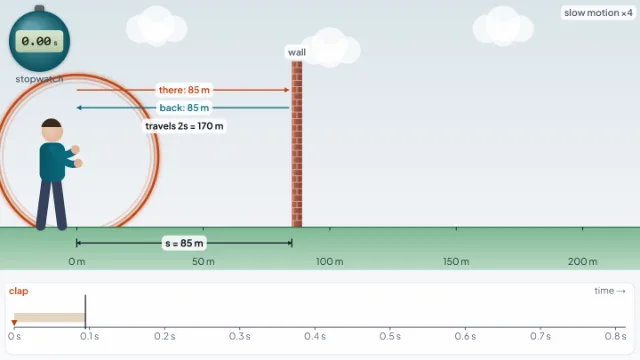
Here the simulation times a single echo from a wall, which shows when a room's reflections become separate echoes.

  1. In the Wall echo scene, set the Distance to the wall to 35 m, like the back wall of a long hall, and press Clap. The Echo time is about 0.2 s: long enough to be heard as a separate echo.
  2. Now choose the Too close set-up, or slide the distance down to 10 m, the size of a classroom. The reflection comes back in less than 0.1 s and blends into the clap, the situation in which reverberation, not a distinct echo, is the problem.
  3. Step the distance up from 10 m, clapping each time. At 15 m the echo still runs into the clap; at 20 m it is separate. That agrees with the rule that a distinct echo needs a surface about 17 m or more away.
Common mistakes

  • Saying soft materials 'block' or 'stop' sound in a room. They absorb it: the energy of the vibrations is turned into heat in the material.
  • Thinking that more absorption is always better. Too much makes a room sound dead and the sound too weak at the back; a balance is needed.
  • Confusing reverberation with a single echo. Reverberation is many overlapping reflections that make sound linger; an echo is one distinct repeat.
  • Believing that hard, shiny surfaces absorb sound well because they are dense. Smooth, hard surfaces send most of the incoming sound back into the room.
  • Forgetting the factor of 2 when working out how long a reflection from the back of a hall takes to return.
  • Thinking acoustic design is only about stopping sound. Reflectors and shaped ceilings are also used to send sound towards the audience.

Exam practice

Exam-style questions

Original questions written in the style of Punjab board exams. Try each one before you reveal the answer.

  1. 1.A new lecture hall has bare concrete walls and a polished stone floor. Students complain that the lecturer's words run into each other.

    1. (a)What is meant by reverberation?

      1 mark
      Show the answer

      Answer: The lingering of sound in a closed space after the source stops, caused by many repeated reflections from the surfaces.

      Marking points

      • Sound persists because of many repeated reflections
    2. (b)Explain why the words are hard to follow in this hall.

      2 marks
      Show the answer

      Answer: The bare concrete and stone send back most of the sound energy, so many reflections arrive just after the direct sound. They overlap with the next words and blur the speech.

      Marking points

      • Hard surfaces reflect most of the sound / too much reverberation
      • Reflections overlap later words and blur them
    3. (c)Suggest three changes that would improve the hall, and say how they work.

      3 marks
      Show the answer

      Answer: Any three, with reasons: lay carpet on the floor, hang heavy curtains, fit padded seats, or put absorbing panels or acoustic tiles on the back wall and ceiling. Soft, porous materials absorb sound energy, so fewer reflections are produced.

      Marking points

      • Names one soft or porous material or fitting
      • Names a second
      • These absorb sound, reducing reflections
  2. 2.A hall is 30 m from the stage to its hard back wall. Sound moves through the air at 340 m s⁻¹. The human ear separates two sounds only if they are at least 0.1 s apart.

    1. (a)Calculate the time for sound from the stage to reach the back wall and return.

      2 marks
      Show the answer

      Answer: Path = 2 × 30 = 60 m. t = 60 ÷ 340 = 0.18 s.

      Marking points

      • Uses 60 m (there and back)
      • 0.18 s
    2. (b)Will a speaker on the stage hear a distinct echo? Explain, and state how this could be prevented.

      3 marks
      Show the answer

      Answer: Yes: 0.18 s is longer than 0.1 s, so the reflection is heard separately. Covering the back wall with absorbing material such as thick curtains or acoustic panels would reduce it.

      Marking points

      • Yes, a distinct echo
      • 0.18 s is more than 0.1 s
      • Absorbing material on the back wall
  3. 3.In a large conference hall, a curved board is fixed behind and above the speaker and the ceiling is made of curved panels.

    1. (a)State the purpose of the board behind the speaker.

      1 mark
      Show the answer

      Answer: It reflects the speaker's sound forward, towards the audience.

      Marking points

      • Reflects sound towards the audience
    2. (b)Explain how the curved ceiling helps listeners at the back of the hall.

      2 marks
      Show the answer

      Answer: It reflects sound downwards and spreads it evenly over the seats, so people at the back receive enough sound to hear clearly.

      Marking points

      • Ceiling reflects sound down to the audience
      • Spreads it evenly so the back rows hear clearly

Quiz

Quick check

6 questions

  1. 1.Which material would best reduce reverberation in a classroom?
  2. 2.Reverberation is caused by:
  3. 3.Why do architects avoid covering every surface of a concert hall with absorbing material?
  4. 4.A sound board is placed behind a speaker in a large hall in order to:
  5. 5.The back wall of a hall is 25 m from the stage. With sound at 340 m s⁻¹, its reflection returns to the stage after about:
  6. 6.Soft, porous materials reduce reflected sound mainly because:

Related articles

Next step

Now see it move

Open the full speed of sound and echoes simulation for every preset, graphs and the teacher tools, then test yourself.

Speed of sound and echoes simulation: time echoes from a wall with a stopwatch, a clapping rhythm or a microphone and timer