Sound behaves like every other wave
You already know that sound bounces off cliffs as an echo. Being a wave, sound can do two more things that all waves do. It can change direction when its speed changes (refraction), and it can spread out round obstacles and through openings (diffraction). Both explain everyday puzzles: why a train horn seems so clear on a still winter morning, and why you can hear a friend calling from round a corner even though you cannot see them.
Refraction of sound
Refraction of sound: the change in the direction of travel of a sound wave caused by a change in its speed, as it moves into a different medium or into a region where the medium's conditions (such as temperature) are different.
The speed of sound depends on what it travels through and on the state of that material. It is roughly 340 in air at room temperature, about 1500 in water and several thousand in metals. Even in air alone, sound goes a little faster where the air is warmer.
When the speed changes, three things happen together:
- the frequency stays the same, because it is fixed by the source that is vibrating;
- the wavelength changes in step with the speed, because ;
- if the wave meets the boundary at an angle, its direction changes. A wave front that crosses at a slant has one end in the new region before the other, so one end speeds up or slows down first and the front swings round.
From air into water
Sound passing at an angle from air into water speeds up more than four times, so it bends away from the normal and its wavelength becomes more than four times longer. This is why sound behaves so differently on the two sides of a water surface. A swimmer with their head under the water hears the clicks and knocks of sounds made in the water sharply, while someone standing on the bank hears very little of them.
Layers of warm and cool air
The air near the ground is often at a different temperature from the air higher up, so sound crossing these layers keeps changing speed and its path curves. Sound bends towards the region where it travels more slowly, that is, towards the cooler air.
- On a hot afternoon the ground is warm, so the air next to it is warmer than the air above. Sound from a source on the ground bends upwards, away from listeners, and does not carry far.
- At night and in the early morning the ground cools quickly, so a layer of cool air lies under warmer air. Sound that starts to head upwards bends back down towards the ground. Distant sounds such as a train horn, a call to prayer or a dog barking in the next village can be heard clearly from far away.
Diffraction of sound
Diffraction of sound: the spreading of sound waves as they pass through an opening or round the edge of an obstacle, so that sound reaches places that are out of the direct line from the source.
How much a wave diffracts depends on how its wavelength compares with the size of the gap or obstacle:
- if the gap is much wider than the wavelength, the wave goes through mostly in a straight beam, with a little spreading at the edges;
- if the gap is close to one wavelength wide, or narrower still, the wave spreads out widely on the far side.
Sounds people can hear have wavelengths from about 17 mm (at 20 000 Hz) up to about 17 m (at 20 Hz). Doorways, windows, walls and people are in this range, so sound diffracts strongly round them. That is why:
- you hear a teacher speaking in the corridor through an open door, even from a seat that has no view of the door;
- voices from behind a wall or round the corner of a building still reach you.
Light has wavelengths of less than a thousandth of a millimetre, far smaller than a door, so light passes through almost in a straight line. You hear round the corner, but you cannot see round it.
Worked numerical 1: which note spreads through a door?
A band practises in a room with an open door 0.90 m wide. Compare a low note of 170 Hz with a high note of 3400 Hz. Take the speed of sound as .
The low note's wavelength is bigger than the doorway, so it spreads widely into the corridor. The high note's wavelength is only a ninth of the width of the door, so it spreads much less. Down the corridor, the bass is heard far more than the high notes.
Worked numerical 2: a note crossing into water
A 500 Hz sound travels from air () into water (). Find its wavelength in each.
In air:
In water: the frequency is still 500 Hz.
The speed and the wavelength both rise by the same factor, about 4.4, while the frequency does not change.
Refraction and diffraction in the simulation
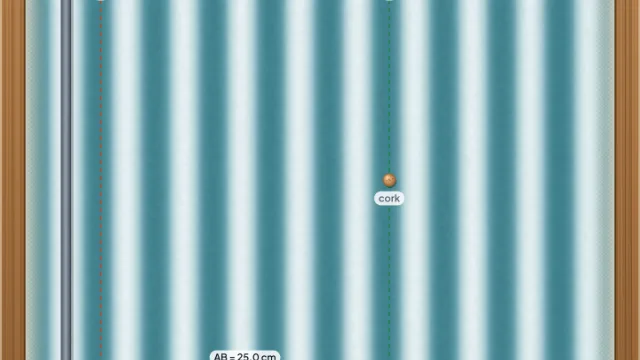
This simulation is a ripple tank, so the waves are ripples on water rather than sound. Ripples show the same refraction and diffraction as sound does, and they are slow and large enough to watch.
- Choose the Refraction set-up. Over the glass plate the water is shallower, the ripples slow down, their wavelength shrinks and their direction changes. Compare the Deep water and Over the plate columns of the table: the frequency is the same in both. Change the Angle of incidence at the plate to see the bending grow.
- Choose Diffraction through a gap. Make the Gap width about one wavelength, then much wider, and watch the Gap ÷ wavelength card: the narrower the gap compared with the wavelength, the more the ripples fan out.
- Choose Diffraction at an edge and lower the Frequency. Longer wavelengths bend further round the end of the barrier, just as low notes bend round a wall more than high ones. Press Strobe to freeze the pattern.