Thunder arrives late
During a storm you see the lightning first and hear the thunder afterwards, even though both are made at the same instant. Light covers a few kilometres in a tiny fraction of a millisecond, but sound in air needs about three seconds to cover a kilometre. Sound is fast, but it is nowhere near as fast as light, and its speed depends a great deal on what it is travelling through.
Speed of sound in air
In air, sound travels at roughly 330 to 350 m s⁻¹. At a typical room temperature of about 21 °C the value is close to 343 m s⁻¹. For quick calculations, 340 m s⁻¹ is a sensible round figure unless a question gives you a different one.
Two things about the air change this speed:
- Temperature. Sound goes faster in warmer air. Warm molecules move about more quickly, so they hand on each push to their neighbours sooner.
- Humidity. Damp air carries sound slightly faster than dry air at the same temperature.
Solids, liquids and gases
Sound is passed along by particles nudging their neighbours. How quickly this happens depends on how close the particles are and how strongly they are held together. In a solid the particles are packed tightly and firmly bonded, so a push at one end is felt at the next particle almost at once. In a gas the molecules are far apart and only loosely linked.
So, in general:
sound moves quickest through solids, less quickly through liquids, and slowest of all through gases.
Some typical speeds:
| Material | Speed of sound (m s⁻¹) |
|---|---|
| oxygen gas, at 0 °C | about 317 |
| air, at 25 °C | about 346 |
| hydrogen gas, at 0 °C | about 1290 |
| pure water, at 25 °C | about 1500 |
| sea water | about 1530 |
| flint glass | about 4000 |
| iron and steel | about 5950 |
| aluminium | about 6400 |
Roughly speaking, sound in water is four to five times as fast as in air, and in iron about seventeen times as fast. Your book rounds these to about 5 and 15 times. Exact values differ from one sample to another, so treat them as guides.
Notice that hydrogen, a gas, carries sound much faster than oxygen. Its molecules are very light, so they respond more quickly. The order solid, liquid, gas is a general rule, not a law that every single material obeys.
The wave equation for sound
Sound is a wave, so its speed, frequency and wavelength are linked by the same equation as every other wave:
Here (m s⁻¹) is the speed of sound, (Hz) its frequency and (m) its wavelength.
An important point: the frequency is fixed by whatever is vibrating, while the speed is fixed by the material the sound moves through. When a sound passes from air into water, the frequency stays the same because the vibrations are still arriving at the same rate. The speed increases, so the wavelength must increase too.
Worked numerical 1: speed from frequency and wavelength
A whistle gives a note of 2500 Hz. Its wavelength in the air of a sports ground is 13.6 cm. Find the speed of sound.
Data: ,
That is a normal value for air on a mild day.
Worked numerical 2: the same note under water
The same 2500 Hz note is played by an underwater speaker in a pool, where sound travels at 1498 m s⁻¹. What is its wavelength now?
The frequency does not change, so
The wavelength in water is more than four times the wavelength in air.
Worked numerical 3: a hammer on a railway line
A worker strikes an iron rail with a hammer. A second worker, 1190 m along the track, puts an ear close to the rail and later hears the sound through the air as well. Take the speed of sound as 5950 m s⁻¹ in iron and 346 m s⁻¹ in air. Find the time gap between the two sounds.
Using :
The sound through the rail arrives more than three seconds before the sound through the air.
Measuring the speed in the simulation
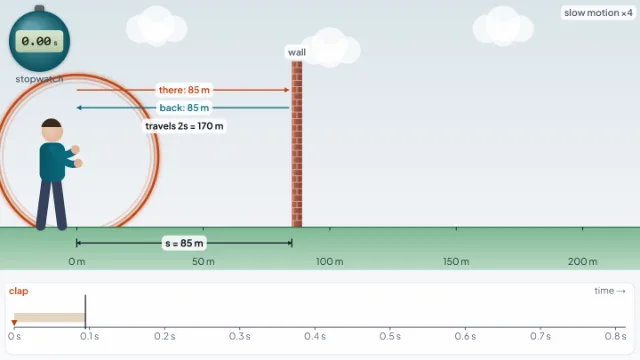
Above is a lab for timing sound. Your book measures the speed of sound with echoes from a wall; here you can also time it directly, with no reflection at all.
- Choose the Two mics set-up. A clap reaches microphone A first and microphone B a moment later. Press Clap and read the Time from A to B card.
- Divide the Distance between the microphones by that time. Your answer should match the Speed of sound card. Change the gap and repeat: the speed stays the same.
- Now move the Air temperature slider and clap again. Warmer air gives a shorter time over the same distance, so a higher speed, as the notes above predict.