Shouting at a hillside
Stand in an open valley facing a steep rock face and shout your name. A moment later the rock seems to shout it back. Nobody is answering: the sound you made has bounced off the rock and travelled back to you. That returning sound is an echo.
What an echo is
Sound is a wave, and like every wave it can be reflected. When sound travelling through air meets a large, hard surface, such as a cliff, a tall building or a wall, much of its energy is sent back into the air instead of passing into the surface.
Echo: the sound heard again after it has been reflected from a distant surface back into the medium it came from.
Reflection of sound obeys the same rule as light and water waves: . The reflected sound leaves the surface making the same angle with the normal as the incoming sound made when it arrived. Hard, smooth surfaces reflect sound well. Soft, porous materials such as curtains, cushions and thick carpets soak up much of it instead.
Checking reflection with two tubes
A simple bench test shows the angle rule for sound.
- Lay two long tubes (cardboard or plastic) on a table so that they point at the same spot on a hard wall, making a V shape.
- Put a quietly ticking clock at the outer end of one tube and listen at the outer end of the other. A board between the tubes stops sound going straight across.
- Swing the listening tube until the ticking is loudest. Measure the angle each tube makes with the normal to the wall. The two angles come out roughly equal.
- Tilt the listening tube upwards, out of line, and the ticking fades: the reflected sound is now going somewhere else.
Why you need some distance
Your ear and brain keep the impression of a sound for about 0.1 s. If the reflected sound returns sooner than that, it merges with the original and you hear one slightly longer sound, not two. For a separate echo the sound must take at least 0.1 s for its journey to the surface and back.
Taking the speed of sound in air as , the shortest total path is
That path is there and back, so the reflecting surface must be at least half of it away: about 17 m. Stand closer than 17 m to a wall and you will not hear a distinct echo, although the reflected sound is still there. Several surfaces at different distances, or two facing cliffs, can give multiple echoes, one after another.
The key idea: there and back
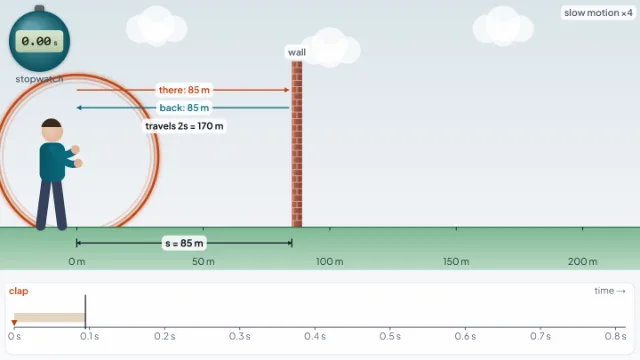
Whenever you use an echo, remember that the time measured covers two journeys: out to the reflector and back again. If the reflector is a distance away and the echo arrives a time after the sound was made, then
Measuring the speed of sound with echoes
You need a large flat wall with open ground in front of it, a measuring tape and a stopwatch.
- Measure a distance of 50 m or more from the wall and stand there.
- Clap once and listen for the echo. Make sure no other building is sending back a second echo.
- Now clap steadily, adjusting the rhythm until each clap is made at the very instant the echo of the previous one arrives. In that rhythm, the time between claps equals the time for one there-and-back journey.
- A partner starts the stopwatch on one clap, counted as zero, and stops it on clap number 20. Dividing by 20 gives the time between claps.
- In each interval the sound travels , so the speed is .
Timing many intervals at once makes the reaction-time error of the stopwatch a much smaller fraction of the total, which is why the method uses a rhythm instead of a single clap.
Worked numerical 1: the echo method
A student stands 85 m from a school wall and claps in time with the echoes. The time from clap 0 to clap 20 is 10.0 s. Find the speed of sound.
Data: , 20 intervals in 10.0 s
Every interval covers a round trip to the wall, :
Worked numerical 2: how far is the cliff?
A climber shouts and hears the echo from a cliff 1.5 s later. The speed of sound is . How far away is the cliff?
Forgetting to halve would give 510 m, which is the whole there-and-back path, not the distance to the cliff.
Worked numerical 3: a mountain on a cold morning
A shepherd claps near a mountain and the echo comes back after 4.0 s. On that day sound travels at .
Echoes in the simulation
The simulation above puts you in front of a wall with a stopwatch, a microphone and a results table.
- In the Wall echo scene, press Clap and read the Echo time card. Set the Distance to the wall slider to twice the value and press Clap again: the echo time doubles.
- Choose the Too close set-up. The echo returns in less than 0.1 s, so it runs into the clap and no separate echo can be timed by ear.
- Under Timing, compare Stopwatch with Clap ×20. Repeat each a few times and look at the scatter in the Results table: the 20-clap rhythm gives a far steadier speed of sound.
- Try the Hot day set-up and see the speed rise a little as the Air temperature goes up.