Skip to content

Punjab Board Class 10 Physics · Chapter 13: Sound

Audible frequencies, ultrasound and infrasound

Section 13.6

Human hearing covers about 20 Hz up to 20 kHz. Infrasound is below 20 Hz: elephants use it, and it helps monitor earthquakes and volcanoes. Ultrasound is above 20 kHz: it is used for body scans, finding cracks, cleaning and SONAR, where depth = speed × echo time ÷ 2.

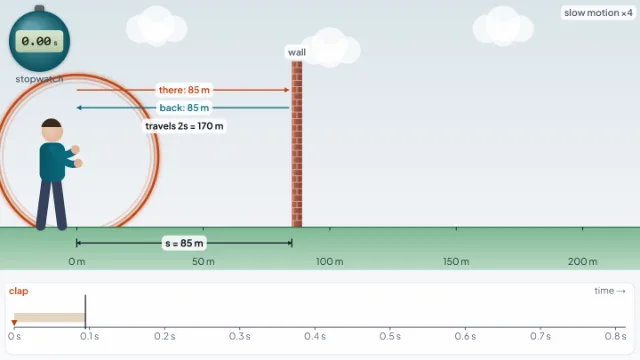
Loading simulation…

Symbols match your course. Open the full speed of sound and echoes simulation for more presets and teacher tools.

Sounds you cannot hear

A dog whistle seems silent to its owner, yet the dog's ears prick up at once. An elephant's deep rumble can be felt more than heard. Both are real sound waves: vibrations travelling through a medium as compressions and rarefactions. They simply lie outside the range of frequencies that the human ear can detect.

The audible range

Audible frequency range: the frequencies of sound that a person with normal hearing can detect, stretching from roughly 20 Hz up to 20 000 Hz (20 kHz).

This range is a guide, not a sharp limit. It varies between people, and the upper end falls with age. Young children may hear almost to 20 kHz, while many older adults hear little above about 15 kHz.

Sound outside this range has names of its own:

NameFrequencyCan people hear it?
Infrasoundbelow 20 HzNo, though very strong infrasound may be felt as a vibration
Audible sound20 Hz to 20 kHzYes
Ultrasoundabove 20 kHzNo

All three travel at the same speed in a given medium. Only their frequency, and so their wavelength, is different.

Infrasound

Infrasound: sound with a frequency below 20 Hz.

Infrasound has very long wavelengths and loses little energy as it travels, so it can be detected hundreds or even thousands of kilometres from where it was made. Natural sources include earthquakes, volcanic eruptions, storms and large waterfalls. Heavy machinery, large engines and explosions also produce it.

Uses of infrasound:

  • Animal communication. Elephants call to each other with low rumbles that carry for kilometres through the air and the ground. They pick up these vibrations not only with their ears but through their feet and trunks. Large whales send low calls across whole ocean basins.
  • Monitoring earthquakes. Sensitive detectors record the low-frequency waves from earthquakes, helping scientists locate them and issue warnings to more distant areas.
  • Watching volcanoes. An erupting volcano gives out a distinctive pattern of infrasound, which helps scientists judge how it is behaving and how risky it is.
  • Detecting explosions. A worldwide network of infrasound stations listens for large explosions, including nuclear tests.

Ultrasound

Ultrasound: any sound whose frequency is higher than 20 000 Hz, too high for humans to hear. It is also called ultrasonics.

Bats and dolphins make and hear ultrasound naturally. People make it with special transducers that vibrate very fast, and it has many uses.

Medical scanning

A probe held against the skin (with gel to keep air out) sends pulses of ultrasound into the body. At every boundary between different tissues, such as between fat and muscle or at the wall of an organ, part of the pulse is reflected. The machine times each echo and uses the delays to build a picture on a screen. This is called ultrasonography.

  • Prenatal scanning lets doctors check a baby's growth and position in the womb.
  • Doctors also use it to examine the heart, liver, kidneys and thyroid gland.

Ultrasound used for scanning is non-ionising: unlike X-rays, it cannot knock electrons out of atoms and harm cells, and no cutting is needed. This makes it the usual choice for pregnancy scans.

Industry

  • Finding hidden cracks. An ultrasound pulse sent into a metal part, such as a turbine blade, ship's engine part or aircraft wing, reflects from any crack inside it. If an echo turns up before the one from the back surface of the part, there is a flaw.
  • Cleaning. Objects placed in a liquid bath are shaken clean by high-intensity ultrasound, which loosens dirt from jewellery, lenses and surgical tools. Strong ultrasound can also destroy bacteria in liquids.

SONAR

SONAR (Sound Navigation and Ranging) uses ultrasound to find the depth of the sea and to locate objects under water such as shoals of fish, wrecks and submarines. A transducer under a ship sends a pulse downwards and listens for the echo. As with any echo, the time measured is for the trip down and back, so

d=v×t2d = \frac{v \times t}{2}

where dd is the depth or distance, vv is the speed of sound in water (about 1500 m s−11500\ \text{m s}^{-1}) and tt is the time from sending the pulse to receiving its echo.

Worked numerical 1: depth of the sea

A ship's sonar receives the echo from the seabed 0.80 s after the pulse is sent. Sound travels at 1500 m s−11500\ \text{m s}^{-1} in sea water.

d=vt2=1500×0.802=600 md = \frac{vt}{2} = \frac{1500 \times 0.80}{2} = 600\ \text{m}

Worked numerical 2: fish above the seabed

The same kind of sonar gets two echoes from one pulse: one after 0.12 s and one after 0.40 s.

  • Fish: d=1500×0.12÷2=90 md = 1500 \times 0.12 \div 2 = 90\ \text{m}
  • Seabed: d=1500×0.40÷2=300 md = 1500 \times 0.40 \div 2 = 300\ \text{m}

The earlier echo comes from the nearer reflector, so the shoal is 90 m down and the seabed is 300 m down.

Worked numerical 3: a crack in a steel shaft

Ultrasound travels at about 6000 m s−16000\ \text{m s}^{-1} in steel. A pulse sent into a shaft returns from a crack after 8.0 μs8.0\ \mu\text{s}.

d=6000×8.0×10−62=0.024 m=2.4 cmd = \frac{6000 \times 8.0 \times 10^{-6}}{2} = 0.024\ \text{m} = 2.4\ \text{cm}

The crack is 2.4 cm below the surface.

Worked numerical 4: very long and very short waves

Using λ=v/f\lambda = v/f with v=340 m s−1v = 340\ \text{m s}^{-1} in air:

  • an elephant's 15 Hz rumble: λ=340÷15≈23 m\lambda = 340 \div 15 \approx 23\ \text{m}
  • a 40 kHz ultrasound pulse: λ=340÷40 000=0.0085 m=8.5 mm\lambda = 340 \div 40\,000 = 0.0085\ \text{m} = 8.5\ \text{mm}

Ultrasound in the simulation

The simulation above times echoes in water, in the body and in steel.

  1. Choose the Sonar set-up and press Pulse. Read the echo time and the Seabed depth card, and check that depth = speed × time ÷ 2. Change the Depth of the seabed and pulse again.
  2. That set-up also has a Shoal of fish under the ship. The Echoes from one pulse table lists two echoes, the fish first, because they are nearer.
  3. Compare the Sonar and Sonar 1 kHz set-ups. The audible pulse is long, so echoes from the fish and the seabed can run together; the 50 kHz ultrasound pulse keeps them apart.
  4. Try Body scan and Steel crack, and slide the Probe position to find where the hidden boundaries lie. To see sound below 20 Hz and above 20 kHz on an oscilloscope (it is not played, because you could not hear it anyway), try the Infrasound and Ultrasound set-ups in the sound waves and oscilloscope simulation.
Common mistakes

  • Mixing up the prefixes. 'Infra' means below (under 20 Hz); 'ultra' means beyond (over 20 kHz).
  • Forgetting to divide by 2 in sonar questions. The echo time is for the pulse to reach the seabed and come back.
  • Using the speed of sound in air (about 340 m s⁻¹) for sonar. Under water, sound travels at about 1500 m s⁻¹.
  • Thinking ultrasound is faster than ordinary sound. In the same medium, all frequencies of sound travel at the same speed.
  • Saying ultrasound scans are harmful like X-rays. Scanning ultrasound is non-ionising, which is why it is used in pregnancy.
  • Writing 20 kHz as 2000 Hz. 1 kHz = 1000 Hz, so 20 kHz = 20 000 Hz.

Exam practice

Exam-style questions

Original questions written in the style of Punjab board exams. Try each one before you reveal the answer.

  1. 1.A fishing boat uses SONAR. A pulse of ultrasound is sent straight down and two echoes are received, after 0.060 s and 0.24 s. In the sea here, sound moves at 1500 m s⁻¹.

    1. (a)Define ultrasound.

      1 mark
      Show the answer

      Answer: Sound above 20 kHz (20 000 Hz) in frequency, which is beyond the range of human hearing.

      Marking points

      • Frequency above 20 kHz
    2. (b)Calculate the depth of the seabed.

      3 marks
      Show the answer

      Answer: The later echo comes from the seabed. d = vt/2 = 1500 × 0.24 ÷ 2 = 180 m.

      Marking points

      • Uses the later echo (0.24 s)
      • d = vt/2
      • 180 m
    3. (c)Suggest what caused the earlier echo, and find how deep it is.

      2 marks
      Show the answer

      Answer: A shoal of fish (or another object) between the boat and the seabed. d = 1500 × 0.060 ÷ 2 = 45 m.

      Marking points

      • Fish or object above the seabed
      • 45 m
  2. 2.Ultrasound is used in hospitals to check the health of a baby before birth.

    1. (a)Describe how an ultrasound scanner forms an image.

      3 marks
      Show the answer

      Answer: A probe sends pulses of ultrasound into the body. Part of each pulse reflects at boundaries between different tissues. The scanner measures the time each echo takes to return and uses these times to build up an image on a screen.

      Marking points

      • Pulses sent into the body
      • Partly reflected at tissue boundaries
      • Echo times used to make the image
    2. (b)Give one reason ultrasound, rather than X-rays, is used for this.

      1 mark
      Show the answer

      Answer: It does not ionise, so the cells of the mother and of the developing baby are not harmed.

      Marking points

      • Non-ionising / does not harm cells or the baby
    3. (c)State two other uses of ultrasound outside medicine.

      2 marks
      Show the answer

      Answer: Any two of: detecting cracks in metal parts, cleaning objects in a liquid bath, SONAR for depth or locating objects, killing bacteria in liquids.

      Marking points

      • First correct use
      • Second correct use
  3. 3.Elephants in a forest keep in touch with calls at frequencies around 14 Hz.

    1. (a)Name this kind of sound and explain why people cannot hear it.

      2 marks
      Show the answer

      Answer: Infrasound. Its frequency is below 20 Hz, the lower limit of human hearing.

      Marking points

      • Infrasound
      • Below 20 Hz, outside the audible range
    2. (b)The speed of sound in air is 336 m s⁻¹. Calculate the wavelength of a 14 Hz call.

      2 marks
      Show the answer

      Answer: λ = v/f = 336 ÷ 14 = 24 m.

      Marking points

      • λ = v/f
      • 24 m
    3. (c)Give one use people make of infrasound.

      1 mark
      Show the answer

      Answer: Monitoring earthquakes or volcanoes, or detecting large explosions such as nuclear tests.

      Marking points

      • Earthquake or volcano monitoring, or explosion detection

Quiz

Quick check

6 questions

  1. 1.The audible frequency range for a person with normal hearing is about:
  2. 2.A sound of frequency 35 kHz is:
  3. 3.A ship's echo sounder hears the seabed echo 2.0 s after sending its pulse. With sound at 1500 m s⁻¹ in sea water, the depth is:
  4. 4.Which animal is known for communicating with infrasound?
  5. 5.Ultrasound can find a crack inside a metal rail because:
  6. 6.Why is the speed of sound in sea water, not in air, used in sonar calculations?

Related articles

Next step

Now see it move

Open the full speed of sound and echoes simulation for every preset, graphs and the teacher tools, then test yourself.

Speed of sound and echoes simulation: time echoes from a wall with a stopwatch, a clapping rhythm or a microphone and timer