Pleasant sound and unwanted sound
A qawwali performance and a traffic jam are both full of sound, yet one is something people pay to hear and the other is something they try to escape. Physics gives a simple way to describe the difference, and it also explains why too much unwanted sound is treated as a kind of pollution.
Musical sounds
A musical sound comes from a source that vibrates in a regular, repeating way. A plucked sitar string, a blown flute or a struck tuning fork each settles into a steady vibration, so the note has a definite pitch, and its loudness and quality can be controlled by the player. Such sounds are usually pleasant to listen to.
On an oscilloscope, a musical sound shows a pattern that repeats at regular time intervals. The shape inside each repeat may be smooth or complicated, depending on the instrument, but the same shape keeps coming back.
Noise
Noise is sound that is unpleasant, unwanted or harsh. It is usually produced by irregular vibrations that start and stop suddenly or change at random: a door slamming, a hammer drill, a rickshaw engine, a pressure horn. With no steady repeating vibration, noise often has no clear pitch.
On an oscilloscope, noise shows a jagged, irregular trace with no pattern that repeats.
Noise pollution
When unwanted sound becomes loud enough, or lasts long enough, to harm people or other living things, it is called noise pollution. Common sources include:
- road traffic, especially horns and vehicles with damaged silencers;
- factory machinery, generators and construction equipment;
- aircraft near airports;
- loudspeakers at public events and markets.
Effects on people
Living or working with too much noise can cause:
- hearing loss, which may become permanent after long exposure;
- stress and irritability, sometimes leading to aggressive behaviour;
- difficulty concentrating, which affects learning and work;
- disturbed sleep and tiredness;
- high blood pressure (hypertension) over time.
Effects on the environment
Noise affects animals too. Birds near busy roads may have to sing louder or at different times to be heard by their mates. Some animals leave noisy areas altogether, and ship engines and underwater construction disturb whales and dolphins, which rely on sound to communicate and find food.
Measuring how loud: the decibel
Sound levels are measured in decibels (dB) with a sound level meter. Your book gives a guide for workplaces: noise of about 85 to 90 dB should be the most a person is exposed to over an eight-hour working day.
Controlling noise pollution
Noise can be tackled at the source, along its path, or at the listener.
- At the source: use quieter machines, maintain engines and fit silencers, and avoid needless horn use.
- Along the path: build sound barriers and walls beside motorways, keep factories away from homes, and plant rows of trees and hedges, whose leaves and branches absorb and scatter sound.
- At the listener: wear ear plugs or ear defenders where noise cannot be avoided, and use soft furnishings and well-sealed windows indoors.
Worked numerical 1: is it a musical note?
A microphone near a flute is connected to an oscilloscope set at 0.5 ms per division. The trace repeats every 5 divisions. Find the frequency of the note.
The trace repeats regularly, so the flute is producing a musical note with a definite pitch.
A trace from a slamming door would show no repeat length to measure at all.
Worked numerical 2: how long is safe? (beyond the book)
Many health agencies use the rule that every 3 dB above 85 dB halves the safe daily exposure, starting from 8 hours at 85 dB. A workshop measures 94 dB. How long can a worker safely stay in it each day without hearing protection?
94 dB is 9 dB above 85 dB, which is three steps of 3 dB:
So the safe time is about 1 hour a day. After that, ear defenders are needed.
Worked numerical 3: comparing levels (beyond the book)
A quiet street measures 60 dB and a busy junction 80 dB. How many times more intense is the sound at the junction?
The difference is 20 dB, which is two steps of 10 dB, and each step multiplies the intensity by 10:
The sound at the junction is about 100 times as intense, though to the ear it seems only about four times as loud.
Noise and loudness on screen
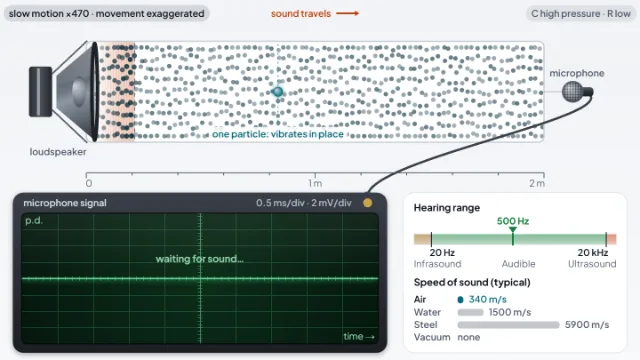
Above, an oscilloscope displays a loudspeaker's note. The speaker produces a pure musical tone, so you can compare it with what noise would look like.
- With the Start: 500 Hz set-up, notice that the trace repeats exactly, wave after wave. That regular repeat is the mark of a musical sound; noise would give a scribble with no pattern.
- Choose Louder and then Quieter from the Set-up list, or drag the Amplitude slider. The peaks grow and shrink. A bigger amplitude means bigger pressure changes reaching the ear, which is what makes loud sounds harmful.
- If you turn on Play the sound, keep your volume low, as the warning beside it suggests. Protecting your hearing starts with your own headphones.