Every sound starts with a vibration
Rest your fingers lightly on the front of your throat and hum. You can feel a buzz: your vocal cords are moving rapidly to and fro. Stop humming and the buzz stops too. The same is true of every sound you will ever hear. A plucked sitar string, the skin of a dhol, the cone of a phone speaker and the wings of a mosquito all make sound by vibrating.
Some vibrations are too quick or too small to see. A struck tuning fork looks perfectly still, yet it is shaking hundreds of times every second. Two classroom tests make that motion visible:
- Hang a light table tennis ball on a thread and touch it with a prong of a sounding tuning fork. The ball is knocked away again and again.
- Dip the prongs of a sounding fork into a beaker of water. The surface sprays and splashes.
Once the prongs stop moving, the note fades away. Sound and vibration go together.
How a vibration becomes a wave
A vibrating object does not throw air at your ear. Instead, it passes its motion on to the layers of air next to it, which pass it on to the next layers, and so on.
Think about one prong of a tuning fork:
- As the prong moves outwards, it shoves the neighbouring air molecules closer together. This crowded region, where the pressure rises slightly above normal, is a compression.
- As the prong swings back, it leaves extra room behind it. The molecules there spread out, making a region of slightly lower pressure, a rarefaction.
- The prong keeps repeating this, so a steady train of compressions and rarefactions moves away from it in every direction.
Each air molecule only jiggles back and forth about its own average position. What travels outwards is the pattern of squashing and stretching, and with it, energy. When that pattern reaches your ear, the changing pressure pushes the eardrum in and out, matching the frequency of the source, and your brain hears a sound.
Sound is a longitudinal wave
Because the air molecules vibrate along the same line that the sound travels, sound is a longitudinal wave. A stretched slinky shows this well: move one end sharply to and fro along the axis of the spring and bunched-up coils (compressions) and spread-out coils (rarefactions) race along it, while each coil just shuffles back and forth.
The wavelength of a sound is the distance between the middles of two neighbouring compressions (or from one rarefaction to the next). Halfway between them is the rarefaction, so a compression and the next rarefaction are apart.
Sound needs a medium
Sound can only travel where there are particles to pass on the vibration: a gas, a liquid or a solid. This material is called the medium. In a vacuum there is nothing to squash or stretch, so sound cannot cross it. That makes sound a mechanical wave, unlike light, which is an electromagnetic wave and crosses empty space easily.
The bell-in-a-jar test
The classic demonstration uses an electric bell hung inside a glass bell jar that stands on the plate of a vacuum pump.
- Switch the bell on with air in the jar. You hear it ringing clearly.
- Start the pump. As more and more air is removed, the ringing grows fainter, although you can see the hammer still striking the gong.
- With most of the air gone, the sound is barely heard at all.
- Let the air back in. The ringing returns.
The bell kept vibrating throughout, and you kept seeing it through the glass, because light needs no medium. Only the sound faded, because its medium was being taken away. (In practice a pump never removes every molecule, and the bell's supports also carry a little sound to the base, so a faint ring may remain.)
This is also why astronauts outside a spacecraft talk by radio: their voices cannot cross the vacuum between their helmets, but radio waves can.
Worked numerical 1: wavelength from a tuning fork
A tuning fork of frequency 256 Hz sounds in air, where sound travels at 340 m s⁻¹. Find (a) the wavelength, and (b) the distance from a compression to the nearest rarefaction.
Data: ,
(a)
(b) A compression and the next rarefaction are half a wavelength apart:
Worked numerical 2: how often the prong pushes
A tuning fork marked 512 Hz is struck. How many compressions does one prong send out each second, and how long is one complete vibration?
Each complete vibration (out and back) sends out one compression and one rarefaction, so the prong makes 512 compressions per second. The time period is
Worked numerical 3: spacing of compressions
A loudspeaker cone vibrates 1000 times a second. How far apart are the compressions it sends through air at 340 m s⁻¹?
So the compressions leave the speaker 34 cm apart.
Watching sound travel in the simulation
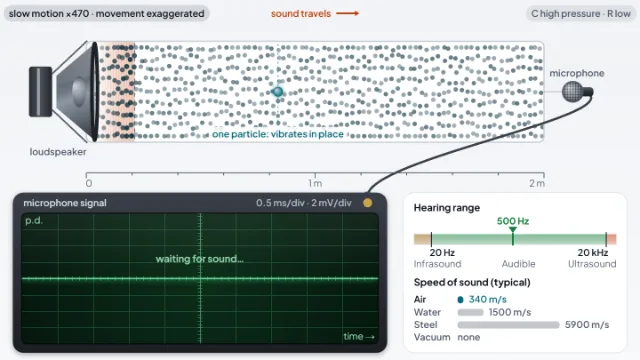
Above, a loudspeaker sends sound through a row of particles to a microphone, and an oscilloscope draws the signal underneath.
- Start with Air and press Play. Turn on Label compressions, rarefactions, λ and one period. Watch the particle marked as vibrating in place: it moves to and fro along the line the sound moves, but never drifts towards the microphone.
- Choose the Vacuum set-up from the Set-up list. The cone still moves, but there are no particles, the microphone picks up nothing and the trace stays flat. This is the bell jar with all of its air removed.
- Switch back to Air and change the Frequency. A higher frequency packs the compressions closer together, so the wavelength shrinks, just as predicts.