Telling sounds apart
Close your eyes in a busy bazaar and you can still pick out a great deal: a shopkeeper shouting over a soft conversation, a child's squeaky voice beside a man's deep one, a flute you would never mistake for a harmonium even when both play the same note. Your ears are separating sounds by three features: loudness, pitch and quality. Each one is linked to something you can see on an oscilloscope trace.
Loudness
Loudness is how strong or faint a sound seems to a listener. It is what lets you tell a shout from a whisper. Three things affect it.
1. Amplitude of the vibration
The bigger the amplitude of the vibrating source, the bigger the pressure changes in the sound, and the louder it seems. Pluck a guitar string gently and it moves only a little, giving a quiet note; pull it further before releasing and the same note comes out much louder. A drum hit hard sounds louder than one tapped.
On an oscilloscope, a louder sound gives taller peaks. The number of waves across the screen does not change.
2. Area of the vibrating surface
A large vibrating surface pushes on more air at once. A big dhol sounds louder than a small tabla struck just as hard. A tuning fork held in the air is faint, but press its stem onto a wooden bench and the note suddenly fills the room: the bench top is forced to vibrate as well, and its large surface sets far more air moving.
3. Distance from the source
Sound spreads out as it travels, so its amplitude shrinks with distance and it seems quieter the further away you are.
Loudness and intensity
Loudness also depends on the listener. A sound that seems loud to one person may seem quiet to someone with damaged hearing. Scientists therefore use intensity, the amount of sound energy reaching each unit area every second, which can be measured with instruments and does not depend on anyone's ears. Greater intensity generally means a louder sound.
Pitch
Pitch is how high (shrill) or low (deep) a sound seems. It depends on the frequency of the vibration:
- a higher frequency gives a higher pitch;
- a lower frequency gives a lower pitch.
A mosquito's wings beat hundreds of times a second, so its whine is shrill. The deep hum of a transformer comes from a much lower frequency. Children's and women's voices usually have higher frequencies than men's, which is why they sound higher, even when everyone speaks equally loudly. Tightening a guitar string makes it vibrate faster, raising its pitch; that is how musicians tune.
On an oscilloscope with the same timebase, a higher-pitched sound shows more waves squeezed across the screen, because each wave takes less time. The heights of the peaks are unaffected.
Quality (timbre)
Suppose a violin and a flute play the same note (same frequency) equally loudly (same amplitude). You can still tell which is which. The feature that makes this possible is the quality, or timbre, of the sound.
Real instruments do not vibrate in a perfectly smooth way. Along with the main frequency, they produce weaker vibrations at higher frequencies at the same time. Each instrument mixes these in its own proportions, so each produces its own waveform shape. On an oscilloscope:
- a tuning fork gives an almost perfectly smooth, regular curve;
- a flute gives a fairly simple, gently rounded trace;
- a violin, trumpet or oboe gives a more complicated, jagged trace that still repeats at the same rate.
Same pitch means the same time period on the trace; same loudness means the same height. Different quality means a different shape within each repeat. This is also how you recognise friends' voices on the phone.
Worked numerical 1: frequency from a trace
An oscilloscope is set to a timebase of 0.5 ms per division. One complete wave of a note covers 4 divisions. Find the time period and the frequency.
Worked numerical 2: comparing pitch
Note A has a frequency of 440 Hz. Note B has a time period of 1.25 ms. Which note has the higher pitch?
Note B has the higher frequency, so it has the higher pitch.
Worked numerical 3: reading the height
The same oscilloscope has its Y-gain set to 20 mV per division. The peaks of a trace reach 3 divisions above the centre line. What amplitude does this show, and what would happen to it if the sound were made louder?
A louder sound at the same pitch would make the peaks taller, giving a larger amplitude, while the number of divisions for one wave stayed at its old value.
Loudness and pitch in the simulation
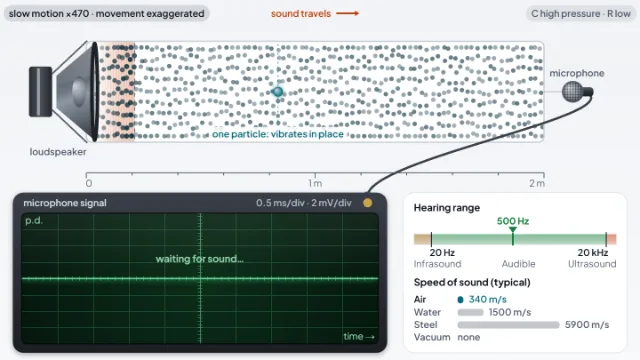
The simulation above connects a microphone to an oscilloscope while a loudspeaker plays a pure note.
- Choose Start: 500 Hz from the Set-up list, then Louder and Quieter. Only the height of the peaks changes; the Frequency card does not.
- Pick Higher pitch. The waves crowd together on the screen while the peaks stay the same height. Try Low hum and Whistle as well.
- Drag the Amplitude and Frequency sliders yourself and use the Reading the trace card to check your period and frequency. With Play the sound turned on (volume down first), you can hear each change.
This loudspeaker makes a pure tone, so every trace is a smooth curve. Quality differences show up only with real instruments, whose traces have more complicated shapes.