Lenses without glass
Everything else in this chapter bends light with a curved piece of glass or plastic. Section 14.7 meets two stranger "lenses". One is not an object you could hold at all: it is a whole galaxy, or a black hole, whose gravity bends passing starlight. The other bends sound rather than light. Neither works exactly like a glass lens, but both do the same basic job of redirecting waves so that they come together or spread apart.
Gravitational lensing
A very massive object, such as a black hole, a galaxy or a cluster of galaxies, has an extremely strong gravitational field. Light from a more distant star or galaxy that travels close past it does not keep to a straight line: its path is bent towards the massive object.
To an astronomer on Earth, the massive object between us and the distant source behaves rather like a huge lens. This is called gravitational lensing, and the massive object is a gravitational lens. Depending on how the three (the source, the lens and the Earth) are lined up, the distant object may appear:
- magnified, brighter and bigger than it would otherwise look;
- distorted, stretched into curved arcs;
- multiplied, seen as two, four or more separate images of the same galaxy around the lens.
Why astronomers value it
- It works like a natural telescope, magnifying galaxies so far away that they would otherwise be too faint to study.
- The amount of bending depends on the total mass of the lens, including dark matter, which gives out no light. Mapping the bending lets scientists map where that unseen mass is.
- It helps scientists study the large-scale structure of the universe.
Acoustic lenses
An acoustic lens is a device that controls sound waves in the way an optical lens controls light. It is made of a material in which sound travels at a different speed from the surrounding air, water or body tissue, and it is shaped so that sound crossing it is redirected.
- A focusing acoustic lens gathers sound into a narrow beam or onto one point, for example onto a microphone or a sensor.
- A diverging acoustic lens spreads sound out over a wider area.
Where acoustic lenses are used
- Medical imaging. The probe of an ultrasound scanner has a lens on its face that focuses the ultrasound beam, giving sharper and more accurate scans.
- SONAR. Ships and submarines use focused sound pulses to detect and locate objects under water.
- Noise control. Sound can be concentrated where it is wanted or kept away from areas that should stay quiet.
Gravitational and acoustic lenses together show that "lens" is a general idea in physics: any arrangement that bends waves in a controlled way can focus or spread them, whether the waves are light or sound.
Worked numerical 1: light from a lensed galaxy
Astronomers study a galaxy, magnified by a lensing cluster, that is 5.0 billion light-years away. One light-year is the distance light travels in a year, m. How far away is the galaxy in metres, and how long ago did the light leave it?
The light set out 5.0 billion years ago, before the Earth had formed. A gravitational lens lets us see such old, distant light more clearly.
Worked numerical 2: the wavelength in an ultrasound scan
An ultrasound probe sends out waves of frequency 3.0 MHz into soft tissue, where the speed of sound is about 1540 m/s. Find the wavelength, using the wave equation from Chapter 12.
Such short waves can be focused by a lens on the probe into a narrow beam, which is why ultrasound can show small details.
Worked numerical 3: sound slowing down in a gas lens
A 1000 Hz note passes from air (speed 343 m/s) into a balloon of carbon dioxide (speed about 270 m/s). Compare its wavelengths.
The frequency stays the same, so the slower speed gives a shorter wavelength. The change of speed at the balloon's curved surface is what bends the sound, just as the change in the speed of light bends it at a glass surface.
The lens idea in the simulation
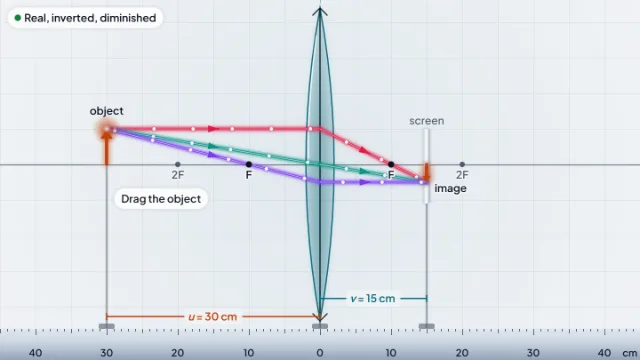
The bench above shows an ordinary glass lens, the model that both of these lenses are compared with.
- Set the Lens to Convex and switch on Moving light under Show. Follow the ray that starts at the object's tip and runs alongside the principal axis: the lens bends it through F, and the rays from the tip come together again at the image. Bending waves so that they meet is what "focusing" means, for light in glass, for sound in an acoustic lens or for starlight passing a galaxy.
- Change the Focal length. A shorter focal length bends the rays more strongly, as a more massive gravitational lens bends light more.
- Set the Lens to Concave to see waves spread out instead, the job of a diverging acoustic lens.