A camera you carry everywhere
Your eye works much like the camera of section 14.5. Light enters through the clear, curved front window called the cornea, passes through the pupil and then the eye lens, and lands on the retina, a layer of light-sensitive cells at the back of the eyeball. The cornea and the lens together act as one strong convex lens. The retina plays the part of the film or sensor, and the optic nerve carries its signals to the brain.
How a normal eye forms an image
In a healthy eye, rays from a point at the top of an object and rays from a point at its bottom are each brought together at a single point on the retina. The picture formed there is real, inverted and diminished, just like the image a convex lens forms of something far beyond 2F. The brain takes care of the upside-down picture, so we see the world the right way up.
The nearest point at which an object can be seen sharply is the near point. For a normal eye of a young person it is about 25 cm away. A normal eye can also see very distant objects clearly, so its range of clear vision runs from about 25 cm out to infinity.
Short-sightedness (myopia)
A short-sighted person sees things near them clearly, but distant objects look blurred.
What goes wrong: rays arriving from far away meet in front of the retina, part-way through the eyeball. After crossing there they spread apart again before reaching the retina, so each point of the object makes a small blurred patch.
Two causes:
- The eye lens is too strong: it is too curved, so it bends light more than it should.
- The eyeball is too long: the retina is too far behind the lens for the focus to reach it.
Correction: a concave (diverging) lens in spectacles or contact lenses. It makes the rays spread out slightly before they reach the eye, so the eye's own lens can now bring them to a focus exactly on the retina.
Long-sightedness (hypermetropia)
A long-sighted person can see far-away things clearly, but near objects, such as the words in a book, look blurred. Their near point is further away than 25 cm.
What goes wrong: rays from a near object are not bent enough, so the point where they would meet lies behind the retina.
Two causes:
- The eye lens is too weak: it does not bend the light enough.
- The eyeball is too short: the retina sits too near the lens.
Correction: a convex (converging) lens. It adds extra bending before the light enters the eye, so the rays from a near object meet on the retina.
| Short sight (myopia) | Long sight (hypermetropia) | |
|---|---|---|
| Sees clearly | Near objects | Distant objects |
| Blurred | Distant objects | Near objects |
| Rays focus | Before reaching the retina | Behind the retina |
| Causes | Lens too strong or eyeball too long | Lens too weak or eyeball too short |
| Correcting lens | Concave (diverging), negative power | Convex (converging), positive power |
Worked numerical 1: reading a prescription
An optician's slip says +2.5 D. What kind of lens is it, and what is its focal length?
Power and focal length are linked by with in metres, so
A positive power means a convex lens: a prescription for long sight.
Worked numerical 2: glasses for reading
A long-sighted man's near point is 50 cm from his eye. He wants to read a newspaper held at 25 cm. The lens must take the newspaper () and form a virtual image at his near point, so .
So , and the power is : a convex lens, as expected.
Worked numerical 3: glasses for distance
A short-sighted student can see clearly only up to 2.0 m. Light from a very distant object must leave the spectacle lens as if it came from 2.0 m away, so the lens needs a virtual focus 2.0 m in front of it: .
The negative power confirms a concave lens. (Spectacles sit a little in front of the eye; that small gap is ignored here.)
Correcting sight in the simulation
The bench above has two set-ups built for this topic.
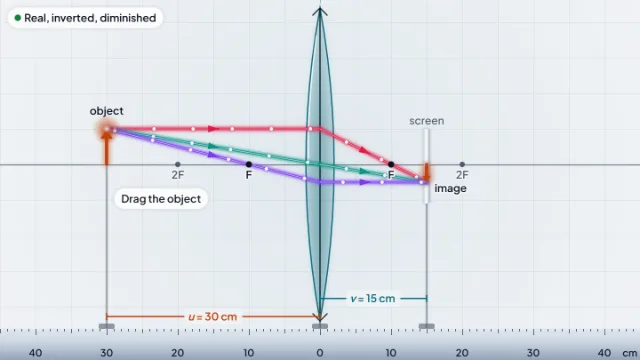
- Choose Short sight. The object is far away and the Lens is set to Concave (diverging): the spectacle lens. Read the Nature of the image: an upright, virtual image much nearer the eye, close enough for a short-sighted eye to focus on.
- Choose Long sight. The object is near and the Lens is Convex (converging). This time the virtual image forms further from the eye than the object, beyond the near point of a long-sighted eye.
- Change the Focal length in each set-up and watch the Image distance card: the image shifts as the lens changes, which is why each person needs a lens of the right power for their own eyes.