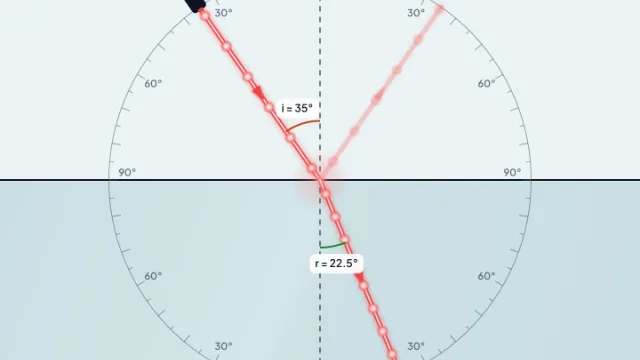
When glass becomes a perfect mirror
Look up at the surface from under water in a swimming pool and, beyond a certain slant, the surface stops being a window to the sky. It shines like silver, reflecting the bottom of the pool. No mirror is involved: the light is trapped by the water surface itself. Section 14.2 explains this trapping and gives the angle at which it starts.
Light splitting at a boundary
When a ray inside glass or water reaches the boundary with air, it usually does two things at once:
- most of it refracts out, speeding up as it reaches the air and so leaning away from the normal;
- a weaker part reflects back inside. This is ordinary partial reflection, called internal reflection because it happens on the inside of the denser medium.
Because the light bends away from the normal on the way out, the angle of refraction is always the larger of the two angles. Each degree you add to tips the escaping ray over towards the surface by more than a degree.
The critical angle
Keep increasing . At one particular value the refracted ray leaves at exactly 90° to the normal, skimming along the boundary. That value of is the critical angle, .
Critical angle: the value of , measured inside the denser medium, for which the refracted ray comes out at 90° to the normal.
At the critical angle the reflected part has already become much brighter, and the skimming ray carries very little light.
Total internal reflection
Go past the critical angle and refraction stops completely. All of the light now turns back into the denser medium, obeying as at a mirror. This is total internal reflection (TIR).
Two conditions must both be true:
- the light is travelling from an optically denser medium towards a rarer one (glass to air, water to air, glass to water);
- is bigger than .
Light going the other way, from air towards glass, is never trapped like this: it can always bend towards the normal and get in.
The formula for the critical angle
Start from the general form of Snell's law, written for light leaving medium 1 (index ) into medium 2 (index ):
Now put and . Since ,
A real angle needs below 1, which is why must be larger than . When the second medium is air, and the denser medium's index is just :
The higher the index, the smaller becomes, and the wider the range of rays that cannot escape.
| Medium (into air) | n | Critical angle C |
|---|---|---|
| Ice | 1.31 | 49.8° |
| Water | 1.33 | 48.8° |
| Perspex | 1.49 | 42.2° |
| Crown glass | 1.52 | 41.1° |
| Flint glass | 1.66 | 37.0° |
| Diamond | 2.42 | 24.4° |
Each value here comes from , rounded to one decimal place. The textbook's Table 14.1 lists 41.2° for crown glass and 42.0° for Perspex; working out and gives 41.1° and 42.2°, so the small gaps are only rounding. Diamond's tiny critical angle is why a cut diamond sparkles: light entering the top is bounced around inside by TIR several times before it escapes, flashing out of the cut faces.
Watching TIR with a semi-circular block
Put a semi-circular Perspex block on paper and aim a narrow beam at the curved side, straight towards the centre of the flat side. Entering along a radius, the beam crosses the curved face along the normal and does not bend, so the only refraction you see is at the flat face.
- With a small angle at the flat face, most light refracts out and a faint ray reflects back.
- Turn the beam to increase . The emerging ray swings towards the flat face and the reflected ray brightens.
- At about 42° the emerging ray grazes the flat face: that is the critical angle for Perspex.
- Beyond it, no light leaves the flat face; it all reflects back through the block.
Worked numerical 1: critical angle for glass
Find for glass of refractive index 1.5 in air.
Worked numerical 2: refractive index from C
For a certain clear resin, is measured as 40°. Find .
Worked numerical 3: does the light escape?
Light in water (, ) hits the surface at . Since 45° is less than , it refracts out. In air,
At instead, more than , the light is totally internally reflected.
Worked numerical 4: glass under water
Using for glass () against water ():
With water instead of air outside, the critical angle is much larger, so TIR is harder to get.
The most important use of TIR is the optical fibre that carries internet data, section 14.3. Snell's law itself, and the bending of light at smaller angles, are covered in the refraction and refractive index notes for this chapter.
Critical angle in the simulation
- Set Light starts in to Glass and Light goes into to Air. The Critical angle card reads about 41.8°.
- Drag the Angle of incidence slider upwards past that value. The Angle of refraction card changes to Total internal reflection and the escaping ray disappears.
- Keep Reflected ray switched on and watch it brighten as you approach the critical angle.
- Try Diamond to Air, then Air to Glass: in the second case the card shows None, because light entering a denser medium cannot be trapped.
For the same effect along a bent glass thread, open the optical fibre simulation in 3D.