A pencil that seems to snap
Stand a pencil in a glass of water and look from the side: it seems broken at the water line. The pencil is fine. The light coming from its lower part changes direction as it leaves the water and enters the air, so your eye is fooled about where that part is. This change of direction at a boundary is refraction, the first idea in section 14.2.
What refraction is and why it happens
Refraction: light changing its direction where it crosses, at a slant, from one transparent medium to the next.
The speed of light depends on what it is passing through. Nothing beats its speed in empty space, metres every second; air slows it hardly at all; water, glass and diamond slow it more and more. When one side of a beam enters the new material before the other side, that side changes speed first, and the beam swings round.
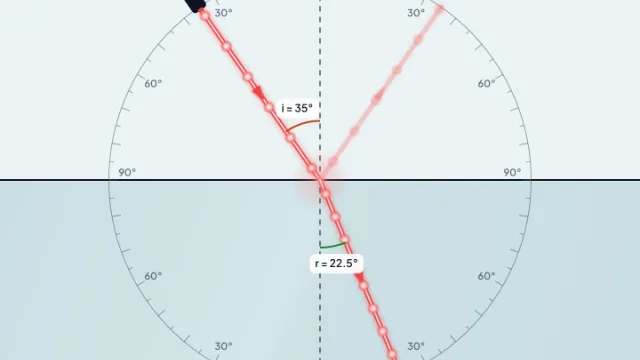
- Going from a rarer medium into a denser one (air into glass), light loses speed and swings towards the normal.
- Going from a denser medium into a rarer one (glass into air), light gains speed and swings away from the normal.
- Arriving along the normal (), it changes speed but not direction.
"Denser" here means optically denser: a medium in which light goes slower. As in the laws of reflection, the normal is the dashed line at 90° to the boundary, and the angle of refraction is the angle between the refracted ray and that normal.
The laws of refraction
- First law: where the light crosses the boundary, the normal, the incoming ray and the bent ray can all be drawn in a single plane.
- Second law (Snell's law): for a given pair of media, divided by always gives the same number. That number is the refractive index of the medium the light enters, compared with the one it left:
Double and you will find does not simply double; it is the ratio of the sines that stays fixed.
Refractive index and the speed of light
A second way to find compares two speeds:
Here is how fast light goes in a vacuum (air is almost the same) and is how fast it goes in the medium. Because is always less than , is always greater than 1, and it has no unit. Water has , ordinary glass about 1.5 and diamond 2.42. The larger is, the slower the light and the more sharply a ray bends on entering at a slant.
When light crosses straight from medium 1 into medium 2, neither of them air, the book's Fig. 14.5 labels the two angles and and the two indices and ; the rule then reads for any two media. With air as medium 1 () this turns back into .
Seeing refraction with Perspex blocks
You need a laser pointer or ray box, a protractor, a ruler, white paper, and Perspex blocks of three shapes: rectangular, semi-circular and triangular (a prism).
- Put the rectangular block flat on the sheet and trace its outline in pencil. Mark a normal at a point on one long side.
- Aim the beam at that point at about 40° to the normal. Mark the beam going in and coming out with small crosses.
- Remove the block and join the crosses. The ray inside bends towards the normal; the ray leaving bends away again.
- The block's long faces are parallel, so the bends at the two faces undo each other: the emerging ray runs parallel to the incident ray, only shifted sideways.
- Repeat with the semi-circular block and the prism. Through the prism the two faces are tilted, so the emerging ray is turned off course by an angle of deviation, as explained in our notes on how a prism spreads white light.
Worked numerical 1: into glass
A ray in air strikes a glass block () with . Find .
The ray bends towards the normal, from 50° to about 31°.
Worked numerical 2: light inside a diamond
How fast does light travel in diamond, ?
That is well under half its speed in air.
Worked numerical 3: finding n from a block experiment
A student measures in air and inside a Perspex block.
Slightly above the usual value of 1.49 for Perspex, which is fair for angles read to the nearest degree.
Push the angle of incidence high enough while light is leaving glass or water, and something new happens: no light gets out at all. That is total internal reflection, the second half of section 14.2: see critical angle and TIR.
Refraction in the simulation
- Leave Light starts in on Air and set Light goes into to Glass. Drag the Angle of incidence slider and read the Angle of refraction card: it is always the smaller angle.
- Watch the Snell check card. However you change the angle, its two sides stay equal.
- Change Light goes into to Water and then Diamond, and compare the Speed of light in reading under the cards.
- Press Swap so the light starts in glass. This time the ray leans further from the normal once it is in the air.