One lens, four jobs
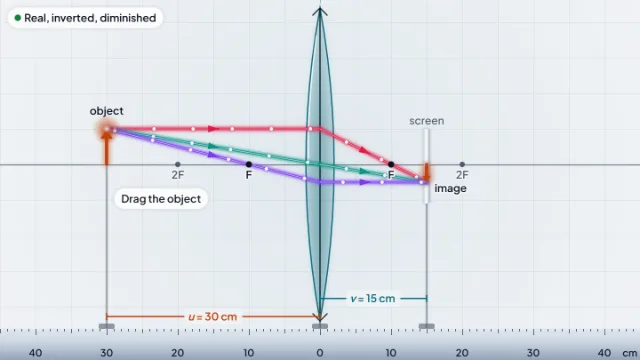
A camera, a magnifying glass, a slide projector and a photograph enlarger look like very different machines, yet each one is built around a single convex lens. What makes them different is simply where the object sits relative to F and 2F. Put the object in one region and the lens shrinks it onto a film; move it to another and the lens throws a huge picture onto a wall. Section 14.5 looks at all four, and each one is an example of a line in the image table of section 14.4.
1. The magnifying glass
This is just a convex lens held close to the thing you want to look at, so that the object is nearer to the lens than its focal length ().
- After passing through the lens, the rays from each point of the object are still spreading out. They never meet, so no real image forms.
- Your eye traces the rays back to a point further away than the object. There you see a virtual, upright and magnified image.
- The image cannot be caught on a screen; you see it only by looking through the glass.
Used this way, a single convex lens is also called a simple microscope. A lens with a shorter focal length (a fatter, more strongly curved lens) magnifies more.
2. The camera
A camera is a light-tight box with a convex lens at the front and a film or electronic sensor at the back.
- The scene being photographed is usually far beyond 2F.
- The lens forms a real, inverted and diminished image on the film or sensor, between F and 2F and in practice very close to F.
- In the simplest cameras the distance from lens to film is fixed and equal to the focal length, which keeps distant scenes sharp. Better cameras let the lens move a little to focus on nearer objects.
3. The slide projector
A projector does the opposite of a camera: it turns a small picture into a big one.
- A bright lamp is placed at the centre of curvature of a concave mirror, which sends back the light that would otherwise be lost behind the lamp.
- A condenser, made of two plano-convex lenses, gathers the light and spreads it evenly over the slide.
- The projection lens, a convex lens, has the slide between F and 2F. So it forms a real, inverted and enlarged image on a distant screen. Moving the projection lens a little brings the picture into focus.
- Because the image is inverted, the slide is loaded upside down, and the picture on the screen comes out the right way up.
4. The photograph enlarger
An enlarger works like a projector pointing downwards. The film negative is the object, placed between F and 2F of a convex lens, and a sheet of photographic paper on the baseboard plays the part of the screen. The lens forms a real, inverted, enlarged image on the paper, so a small negative becomes a large print. Raising the lamp head further from the baseboard gives a bigger print.
The four devices side by side
| Device | Object position | Image |
|---|---|---|
| Magnifying glass | Inside F (p less than f) | Virtual, upright, magnified; seen through the lens |
| Camera | Well beyond 2F | Real, inverted, smaller; on the film or sensor |
| Slide projector | Between F and 2F | Real, inverted, much larger; on a screen |
| Photograph enlarger | Between F and 2F | Real, inverted, larger; on photographic paper |
Worked numerical 1: reading with a magnifier
A watch repairer holds a lens of focal length 8.0 cm at 6.0 cm from a tiny gear. Where is the image?
Data: ,
So . The image is virtual, 24 cm from the lens on the gear's side, and times as large.
Worked numerical 2: focusing a projector
A projection lens of focal length 10 cm must throw a sharp picture onto a screen 4.0 m away. How far from the lens should the slide be, and how big is the picture of a 3.5 cm slide?
Data: ,
The slide sits just beyond F, between F and 2F. The picture is times bigger, so a 3.5 cm slide gives a picture about , roughly 1.4 m across.
Worked numerical 3: a camera focused on a friend
A camera lens of focal length 50 mm is focused on a person 5.0 m away. Find the distance from the lens to the sensor.
The sensor is only half a millimetre further back than F, which is why a fixed-focus camera set at still takes sharp pictures of distant scenes.
Worked numerical 4: making a print five times bigger
An enlarger lens has . A print five times the size of the negative is wanted, so the image distance must be five times the object distance: .
The negative is 90 mm from the lens, between F (75 mm) and 2F (150 mm), as expected.
Optical devices in the simulation
The bench above lets you load each device as a ready-made set-up.
- Choose Magnifying glass: the object sits inside F and the Nature of the image card reads virtual and upright. Drag the object towards F and watch the image grow and move away.
- Choose Camera: the image lands just beyond F, small and inverted, at the screen.
- Choose Projector: the slide is between F and 2F and a large inverted image forms far beyond 2F. Compare the Magnification card for the camera and the projector.