Skip to content

Punjab Board Class 10 Physics · Chapter 14: Light

Thin lenses and power of a lens

Section 14.4

A convex lens bulges in the middle and brings parallel rays to a real focus F; a concave lens, thin in the middle, spreads them as if from a virtual focus. Focal length f is the distance from lens to F. Power is 1/f, f in metres, in dioptres: positive for convex, negative for concave.

Loading simulation…

Symbols match your course. Open the full lenses and ray diagrams simulation for more presets and teacher tools.

Burning paper with a lens

On a sunny day, hold a magnifying glass over a sheet of paper and move it up and down. At one height the sunlight squeezes into a tiny, dazzling spot, and the paper soon starts to smoke. The lens has gathered a wide beam of parallel rays and brought it together at one point. Section 14.4 names that point, measures how far away it is, and explains why some lenses spread light out instead.

What a lens is

A lens is a piece of transparent material, usually glass or plastic, with two surfaces of which at least one is curved. Light refracts as it enters and leaves, and because the surfaces are curved, different parts of a beam are bent by different amounts. Lenses are at the heart of spectacles, cameras, microscopes, telescopes and projectors.

Two families of lens

Convex (converging) lenses are thicker at the middle than at the edges. They bring a parallel beam together. Three shapes are common:

  • double convex: both faces bulge outwards;
  • plano-convex: one face flat, one bulging;
  • concavo-convex (a meniscus): one face curved in and the other curved out more strongly, so the middle is still the thickest part.

Concave (diverging) lenses are thinner at the middle than at the edges. They spread a parallel beam apart. The matching shapes are double concave, plano-concave and convexo-concave.

A quick test: if a lens makes nearby print look bigger, it is converging; if it makes print look smaller, it is diverging.

Key terms

  • Optical centre (O): the point at the middle of the lens. A ray passing through it goes straight on without changing direction.
  • Principal axis: the imaginary straight line through the optical centre, at right angles to the lens. A ray travelling along it is not bent.
  • Principal focus (F): for a convex lens, the spot on the principal axis at which rays that came in parallel to that axis all cross once they are through the glass. For a concave lens, the point on the axis from which such rays appear to spread out after passing through.
  • Focal length (f): the distance from the optical centre to the principal focus. A lens has a principal focus on each side, both the same distance away.

Ray diagrams also mark 2F on each side, two focal lengths out from the optical centre. Your book links this point with the centre of curvature, the centre of the imaginary sphere a lens surface is part of. (Strictly, that match is exact only for curved mirrors, where the radius is twice the focal length. For a lens the centres of curvature depend on the glass, so in exam work treat 2F simply as "twice the focal length".)

What each lens does to a parallel beam

Convex lens. Rays parallel to the principal axis bend towards the axis at both surfaces. Beyond the lens they meet at F, on the side away from the light source. Light really passes through this point, so it is a real focus, and a screen placed there shows a bright spot. That is the burning spot in the opening example. The focal length of a convex lens is taken as positive.

Concave lens. Parallel rays bend away from the axis, so after the lens they fan out. Extend them backwards with dashed lines and they all seem to come from one point in front of the lens, on the side the light arrived from. This is a virtual focus: no light actually passes through it and a screen cannot show it. The focal length of a concave lens is taken as negative.

The ray rules and the images lenses form, with the lens formula (written in your book with pp for the object distance and qq for the image distance), are worked through on the page about ray diagrams for convex and concave lenses.

Power of a lens

A lens that bends light sharply brings a parallel beam to a focus close by, so it has a short focal length. The power PP of a lens measures this bending strength:

P=1fP = \frac{1}{f}

with ff in metres. The unit of power is the dioptre (D), where 1 D=1 m−11\ \text{D} = 1\ \text{m}^{-1}.

  • With ff positive, a convex lens always has a positive power.
  • With ff negative, a concave lens always has a negative power.
  • The shorter the focal length, the larger the power. A fatter, more strongly curved lens has more power than a thin, gently curved one.

Opticians write the power of spectacle lenses in dioptres; see how short and long sight are corrected in the notes on glasses for short and long sight.

Worked numerical 1: power from focal length

A converging lens focuses sunlight 20 cm from its centre. What is its power?

f=20 cm=0.20 mP=10.20 m=+5.0 Df = 20\ \text{cm} = 0.20\ \text{m} \qquad P = \frac{1}{0.20\ \text{m}} = +5.0\ \text{D}

Worked numerical 2: focal length from power

A lens in an optician's trial set is labelled −1.25 D. Is it converging or diverging, and how long is its focal length?

The power is negative, so it is a concave (diverging) lens.

f=1P=1−1.25 D=−0.80 m=−80 cmf = \frac{1}{P} = \frac{1}{-1.25\ \text{D}} = -0.80\ \text{m} = -80\ \text{cm}

Worked numerical 3: finding f with a window

Hamid focuses a sharp image of a distant window onto a card held 12.5 cm behind a convex lens. Light from something far away reaches the lens almost parallel, so the image forms at the principal focus.

f≈12.5 cm=0.125 mP=10.125=+8.0 Df \approx 12.5\ \text{cm} = 0.125\ \text{m} \qquad P = \frac{1}{0.125} = +8.0\ \text{D}

Worked numerical 4: which lens bends more?

Lens A is +4 D and lens B is +10 D. Their focal lengths are 1/4=0.251/4 = 0.25 m and 1/10=0.101/10 = 0.10 m. Lens B, with the shorter focal length, bends light more strongly.

These same lenses are put to work in the magnifying glass, camera, projector and enlarger, as shown in the notes on lenses inside optical devices.

Lenses in the simulation

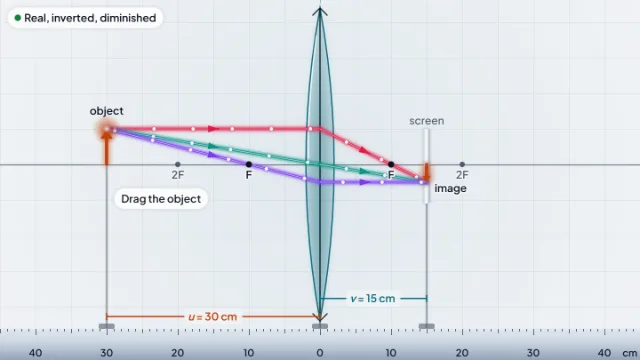
  1. Choose Convex and pick the Object at F set-up. The rays leave the lens parallel, which is a parallel beam focused at F run backwards.
  2. Move the Focal length slider. A shorter focal length puts F closer to the lens, which means a more powerful lens.
  3. Switch to Concave. The note under the slider gives the focal length as a negative number, and the rays spread out as if from F on the object's side.
  4. Turn on Distances on the bench and compare the marked F and 2F points as you change the focal length.
Common mistakes

  • Using centimetres in P = 1/f. A 25 cm lens has P = 1 ÷ 0.25 = 4 D, not 1 ÷ 25.
  • Mixing up the names: the convex lens is the converging one, the concave lens the diverging one.
  • Drawing the rays from a concave lens meeting at a focus on the far side. They spread out; only their backward extensions meet, on the side the light came from.
  • Forgetting the minus sign for a concave lens. Its focal length and its power are both negative.
  • Thinking a bigger focal length means a stronger lens. The shorter the focal length, the greater the power.
  • Measuring the focal length from the edge of the lens rather than from its optical centre.

Exam practice

Exam-style questions

Original questions written in the style of Punjab board exams. Try each one before you reveal the answer.

  1. 1.A beam of parallel rays, travelling parallel to the principal axis, falls first on lens X and then on lens Y. After lens X the rays meet at a point 15 cm beyond it. After lens Y they spread out.

    1. (a)Name each type of lens.

      2 marks
      Show the answer

      Answer: X is a convex (converging) lens; Y is a concave (diverging) lens.

      Marking points

      • X convex / converging
      • Y concave / diverging
    2. (b)What name is given to the point where the rays meet after lens X, and how far is it from the lens?

      2 marks
      Show the answer

      Answer: The principal focus (focal point). It is 15 cm from the optical centre, which is the focal length.

      Marking points

      • Principal focus
      • Focal length 15 cm
    3. (c)Explain why the focus of lens Y is called virtual.

      2 marks
      Show the answer

      Answer: The rays leaving Y never really meet. Traced backwards, they look as if they started from a point on the incoming side, so no light passes through it and it cannot be shown on a screen.

      Marking points

      • Backward extensions of the rays meet there
      • No light actually passes through it / cannot be caught on a screen
  2. 2.An optician has two lenses: a convex lens of focal length 50 cm and a concave lens of power −2.0 D.

    1. (a)Define the power of a lens and give its unit.

      2 marks
      Show the answer

      Answer: Power is the reciprocal of the focal length, P = 1/f, with f in metres. Its unit is the dioptre (D), equal to m⁻¹.

      Marking points

      • P = 1/f (f in metres)
      • Dioptre, D
    2. (b)Calculate the power of the convex lens.

      2 marks
      Show the answer

      Answer: f = 0.50 m, so P = 1 ÷ 0.50 = +2.0 D.

      Marking points

      • Converts 50 cm to 0.50 m
      • +2.0 D
    3. (c)Find the focal length of the concave lens.

      2 marks
      Show the answer

      Answer: f = 1/P = 1 ÷ (−2.0) = −0.50 m, i.e. −50 cm.

      Marking points

      • f = 1/P
      • −0.50 m (negative sign needed)
  3. 3.Rabia is given an unlabelled lens and a metre rule, and works near a window on the far side of the room.

    1. (a)Describe how she can find the focal length of the lens if it is converging.

      3 marks
      Show the answer

      Answer: Hold the lens so that light from the distant window passes through it onto a white card or wall. Move the card until the image of the window is sharp. The distance from the lens to the card is approximately the focal length, because rays from a distant object are nearly parallel.

      Marking points

      • Forms an image of a distant object on a screen
      • Adjusts until the image is sharp
      • Lens-to-screen distance ≈ f (distant object gives near-parallel rays)
    2. (b)Suggest a quick way to tell whether the lens is converging or diverging without a screen.

      1 mark
      Show the answer

      Answer: Look through it at nearby print: a converging lens makes it look bigger, a diverging lens makes it look smaller. (Feeling for a thick or thin middle also works.)

      Marking points

      • Magnifies close print: converging; shrinks it: diverging

Quiz

Quick check

6 questions

  1. 1.A lens that is thicker at its edges than at its centre is a:
  2. 2.The focal length of a lens is the distance from:
  3. 3.What power does a convex lens with f = 40 cm have?
  4. 4.Which lens bends light most strongly?
  5. 5.A ray passing through the optical centre of a thin lens:
  6. 6.Rays parallel to the principal axis leave a concave lens:

Related articles

Next step

Now see it move

Open the full lenses and ray diagrams simulation for every preset, graphs and the teacher tools, then test yourself.

Lenses and ray diagrams simulation: move an object along an optical bench in front of a convex or concave lens