Skip to content

Punjab Board Class 10 Physics · Chapter 14: Light

Optical fibre

Section 14.3

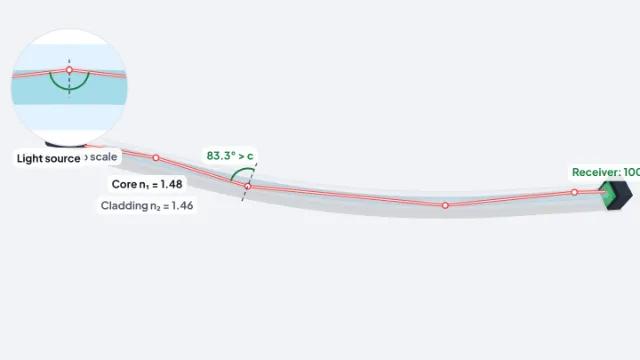
An optical fibre is a hair-thin glass strand: a higher-index core inside lower-index cladding. Light meets their boundary beyond the critical angle, so total internal reflection holds it in, even round bends. Fibres beat copper on data rate and distance, and ignore electrical interference.

Loading simulation…

Symbols match your course. Open the full optical fibres simulation for more presets and teacher tools.

Light that follows a curve

Light normally goes in straight lines, yet a video call from Lahore to a relative abroad crosses oceans as flashes of light inside glass threads lying on the sea bed, bending gently with the cable the whole way. Section 14.3 shows how a thread of glass manages to steer light like this, and why phone and internet companies have replaced so much copper wire with it.

What an optical fibre is made of

An optical fibre is a very thin, flexible strand of extremely pure glass or plastic, about as thick as a human hair. In cross-section it has layers:

  • the core, at the centre, which carries the light. It is made of glass with a higher refractive index;
  • the cladding, a layer of glass with a slightly lower refractive index wrapped tightly round the core;
  • a plastic coating (buffer) that protects the glass from moisture and scratches;
  • in a cable, strength members and a tough outer jacket round many fibres together.

How the light stays inside

A light pulse enters one end of the core almost parallel to the fibre's axis. Each time it reaches the boundary between core and cladding, it strikes it at a large angle of incidence, beyond the critical angle for that boundary. Since it is going from the higher-index core towards the lower-index cladding, both conditions for total internal reflection are met, and none of it leaks into the cladding.

The pulse zig-zags along the core from one reflection to the next, many hundreds of times in every metre of a thin fibre, and comes out at the far end with very little energy lost. Gentle bends do not matter: the angle of incidence stays above the critical angle. Only a very sharp kink can make it fall below, letting light escape.

Why bother with cladding?

Bare glass in air would also trap light, since glass has a critical angle of only about 42° against air. But any scratch, drop of oil or touching neighbour fibre on that bare surface would let light out. The cladding keeps the reflecting boundary sealed inside the fibre, clean and undamaged, so every fibre in a bundle works independently.

Sending information along a fibre

  1. At the transmitter, a sound, picture or computer file is first coded as an electrical signal.
  2. A tiny laser or LED turns that signal into very rapid pulses of light: on for 1, off for 0.
  3. The pulses travel along the core by repeated total internal reflection, perhaps for many kilometres. Long routes have repeaters that boost the signal on the way.
  4. At the receiver, a light detector turns the pulses back into an electrical signal, which is decoded into the original sound, picture or data.

Advantages over copper cables

  • High bandwidth. Bandwidth is the amount of data a link can carry each second. A single fibre can move vastly more data than copper of the same thickness, which is why fast home broadband uses fibre.
  • Speed. The data move as light pulses close to the speed of light in glass, and they can be switched on and off billions of times a second.
  • Long distance. The signal weakens very little along the glass, so fibres can link cities and continents, including the undersea cables that join Pakistan to the rest of the world.
  • Low power use. Less energy is needed to send a signal, and fibres last a long time and need less repair.
  • No electrical interference. Light is not disturbed by nearby motors, power lines or lightning, which often add noise to signals in copper wires.

Worked numerical 1: the critical angle at the core

Take a core of index 1.48 wrapped in cladding of index 1.46. What is CC where the two glasses meet?

sin⁡C=n2n1=1.461.48=0.9865C=sin⁡−1(0.9865)≈80.6°\sin C = \frac{n_2}{n_1} = \frac{1.46}{1.48} = 0.9865 \qquad C = \sin^{-1}(0.9865) \approx 80.6°

Only rays meeting the boundary at more than 80.6° to the normal, which means rays running almost parallel to the axis, stay trapped.

Worked numerical 2: kept in, or lost?

In the same fibre, one ray meets the boundary at 85° and another at 75°. The 85° ray is above CC, so it is totally internally reflected and carries on. The 75° ray is below CC, so part of it refracts into the cladding at every hit and it soon fades.

Worked numerical 3: how long across an ocean?

A pulse crosses an undersea fibre 6000 km long. The core has n=1.5n = 1.5. How long does the journey take?

vcore=cn=3.0×1081.5=2.0×10⁸ m s−1v_\text{core} = \dfrac{c}{n} = \dfrac{3.0 \times 10^{8}}{1.5} = 2.0 \times 10^{8}\ \text{m s}^{-1} t=sv=6.0×10⁶ m2.0×108 m s−1=0.030 st = \frac{s}{v} = \frac{6.0 \times 10^{6}\ \text{m}}{2.0 \times 10^{8}\ \text{m s}^{-1}} = 0.030\ \text{s}

Just 30 milliseconds, quicker than the blink of an eye.

The fibre in the simulation

  1. With Cladding on and the fibre Straight, move the Entry angle (to the fibre's axis) slider and read the Critical angle and Smallest angle of incidence cards.
  2. Switch the bend from Gentle to Tight and Sharp. Watch the Light reaching the far end card fall as light starts to escape at the outside of the bend.
  3. Turn to Cladding off to see the bare core in air: the critical angle drops to about 42.5° for this glass, and the Total internal reflections card counts the bounces.

For the critical angle in a flat block, use the refraction and critical angle simulation.
Common mistakes

  • Giving the cladding the higher refractive index. The core must be the optically denser part, or total internal reflection cannot happen at their boundary.
  • Saying light travels straight down the middle of the fibre. Most rays bounce off the core–cladding boundary again and again.
  • Explaining the fibre with ordinary reflection or with refraction. The key words are total internal reflection, at angles greater than the critical angle.
  • Thinking the cladding is just a protective cover. Its lower refractive index makes the trapping boundary, and keeps it clean.
  • Claiming signals in a fibre travel at 3 × 10⁸ m s⁻¹. In glass the pulses move at about c/n, roughly 2 × 10⁸ m s⁻¹.
  • Believing any bend lets light out. Gentle bends are fine; only a sharp kink makes the angle of incidence drop under C.

Exam practice

Exam-style questions

Original questions written in the style of Punjab board exams. Try each one before you reveal the answer.

  1. 1.Internet data reach a school in Multan through a cable of optical fibres. Each fibre has a glass core surrounded by cladding.

    1. (a)Explain how light stays inside the core even where the cable curves.

      3 marks
      Show the answer

      Answer: The core has a higher refractive index than the cladding. Light reaches the boundary between them at an angle bigger than C, so each time it is wholly reflected back, and it keeps to the core round gentle curves.

      Marking points

      • Core has the higher refractive index
      • Angle of incidence exceeds C at the boundary
      • Total internal reflection, repeated along the fibre
    2. (b)Give two advantages of fibres over copper wires for this link.

      2 marks
      Show the answer

      Answer: Any two of: much higher bandwidth (more data per second); signals travel long distances with little loss; no electrical interference; less power needed; fast signal speed.

      Marking points

      • First valid advantage
      • Second valid advantage
  2. 2.In one design of fibre the core's index is 1.50 and the cladding's is 1.45.

    1. (a)Work out C where core and cladding meet.

      3 marks
      Show the answer

      Answer: sin C = n₂ ÷ n₁ = 1.45 ÷ 1.50 = 0.967, so C ≈ 75.2°.

      Marking points

      • sin C = n₂/n₁
      • 0.967
      • C ≈ 75°
    2. (b)A ray meets the boundary at 70° to the normal. Is it trapped? Explain.

      2 marks
      Show the answer

      Answer: No. 70° is less than the critical angle of about 75°, so part of the light refracts into the cladding and escapes from the core.

      Marking points

      • Not trapped
      • 70° is below C, so light refracts out
    3. (c)How fast do the pulses travel in the core?

      2 marks
      Show the answer

      Answer: Speed = c ÷ n = (3.0 × 10⁸) ÷ 1.50 = 2.0 × 10⁸ m s⁻¹.

      Marking points

      • Divides c by n
      • Speed of 2.0 × 10⁸ m s⁻¹
  3. 3.A telephone company sends a voice call along a fibre between two cities.

    1. (a)Describe how the sound of a voice is carried by the fibre from the caller to the listener.

      3 marks
      Show the answer

      Answer: The voice is turned into an electrical signal, which a laser or LED converts into rapid light pulses. The pulses travel along the fibre by total internal reflection, and at the other end a detector turns them back into an electrical signal and then sound.

      Marking points

      • Electrical signal turned into light pulses by a laser or LED
      • Pulses carried by total internal reflection
      • Detector at the receiver turns light back into an electrical signal
    2. (b)Explain why the fibre's signal is not spoiled by a nearby electric railway line.

      1 mark
      Show the answer

      Answer: The signal is light, not an electric current, so electrical disturbances from the railway do not affect it.

      Marking points

      • Light signals are unaffected by electrical interference

Quiz

Quick check

6 questions

  1. 1.Light is kept inside an optical fibre by:
  2. 2.Compared with the core, the cladding of a fibre has:
  3. 3.Bandwidth means:
  4. 4.Which is NOT an advantage of optical fibres over copper cables?
  5. 5.A fibre has core index 1.48 and cladding index 1.46. Its critical angle at the boundary is about:
  6. 6.In the transmitter of a fibre-optic link, the electrical signal is turned into light by:

Related articles

Next step

Now see it move

Open the full optical fibres simulation for every preset, graphs and the teacher tools, then test yourself.

Optical fibres simulation: a glass fibre in 3D with its core, cladding, light source and receiver3D