Steering a beam you cannot touch
Inside an old television or a school oscilloscope, a thin beam of electrons races down a glass tube and paints a glowing spot on the screen. Nothing solid ever touches the beam, yet it can be swung up, down and sideways thousands of times a second. The steering is done by fields: an electric field between charged plates, or a magnetic field from magnets or coils.
What cathode rays are
An electron gun heats a metal cathode until electrons escape from its surface, then a high positive voltage on nearby anodes pulls them away at high speed. The result is a narrow beam of fast electrons, historically called cathode rays because they stream from the cathode. Each electron carries a negative charge, so the beam behaves like a tiny moving current that fields can push on. (How the gun and screen fit together is covered with the oscilloscope.)
Deflection by an electric field
Let the beam pass between two parallel metal plates connected to a high-voltage supply. One plate becomes positive and the other negative, with an electric field between them.
- Every electron is attracted by the positive plate and repelled by the negative plate.
- So the beam bends towards the positive plate.
- While the electrons are between the plates, the sideways push acts on them all the time, so the path is a smooth curve. Once they leave the plates they carry on in a straight line in their new direction.
- Swapping the connections swaps which plate is positive, so the beam bends the other way. A larger voltage across the plates gives a stronger field and a bigger deflection.
This is exactly how the Y-plates of an oscilloscope move the spot up and down: the voltage being measured is put across them. The idea of a field pushing on charges comes from the electric field in Chapter 15.
Deflection by a magnetic field
A magnetic field exerts a force on a charge only while the charge is moving across the field. A beam of electrons is a stream of moving charges, so a magnetic field can bend it too.
To find the direction of the force, use Fleming's left-hand rule, the same rule used for the force on a conductor carrying current. Spread your left hand so the thumb and the first two fingers are all mutually perpendicular:
- First finger: points along the field, north to south;
- seCond finger: shows the current (conventional);
- thuMb: the motion, or force, of the wire or beam.
The electron twist. Conventional current is the direction positive charge would flow. Electrons are negative, so the current they make points opposite to the way they are moving. Point your second finger backwards along the beam, then read the force from your thumb.
Example. Electrons move from left to right across the page, and the magnetic field points into the page (drawn as crosses). The current points left. With the first finger pointing into the paper and the second finger aimed left, the thumb ends up pointing down the page. The beam curves downwards.
Why the path becomes a circle (beyond the book)
The magnetic push always acts sideways to the electrons’ direction of travel. A force like that cannot speed them up or slow them down; it can only turn them. As the beam turns, the force turns with it, always pointing sideways to the motion. If the electrons stay inside a uniform field that is at right angles to their motion, they keep turning at the same rate and travel round a circle.
If the electrons move along the field lines, there is no force at all and the beam is not deflected.
Comparing the two
| Electric field (charged plates) | Magnetic field | |
|---|---|---|
| Force direction | Towards the positive plate | Given by Fleming's left-hand rule |
| Acts on electrons at rest? | Yes | No: only on moving charges |
| Effect on speed | Can change it | None: changes direction only |
| Shape of path inside the field | A curve bending towards + (a parabola) | Part of a circle |
The word "parabola" goes slightly beyond the book; it is the same curved shape as the path of a thrown ball.
Worked example 1: which way does it bend?
An electron beam travels upwards on the page. The magnetic field points out of the page (drawn as dots). Which way is the beam pushed?
- The electrons move up, so the conventional current points down the page.
- First finger: out of the page. Second finger: down the page.
- The thumb then points to the left.
The beam curves to the left.
Worked example 2: the force from charged plates (beyond the book)
The force on a charge in an electric field of strength is . An electron () is between plates where .
That is a tiny force, but an electron's mass is only about , so its acceleration is enormous, around . That is why a modest voltage can swing the beam so quickly.
Worked example 3: the force from a magnetic field (beyond the book)
For a charge crossing a magnetic field of flux density at 90°, the force is . An electron moves at m s⁻¹ across a field of 0.020 T.
Seeing deflection on the oscilloscope simulation
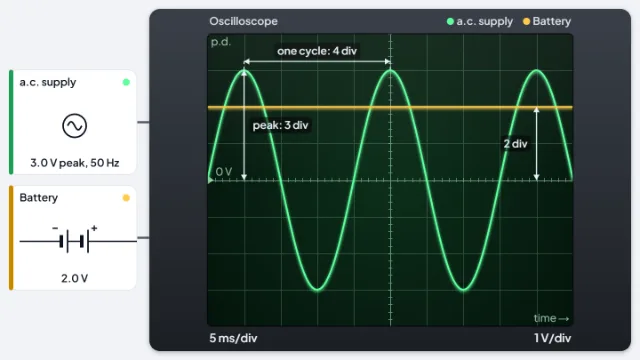
The oscilloscope simulation above does not draw the tube itself, but every trace on its screen is an electron beam being deflected by the voltage across the Y-plates.
- Choose Battery (DC). A steady voltage on the Y-plates pushes the spot a fixed distance up, so the trace is a flat line above 0 V.
- Tick Connect the battery the other way round. The plates swap polarity and the beam is pushed down instead: the line drops below 0 V.
- Change Volts/div. This only changes how much the signal is amplified before it reaches the plates, so the same battery gives a bigger or smaller deflection on the screen.
- Choose the AC supply. The voltage on the plates now reverses again and again, so the beam is swung up and down and draws a wave.