Skip to content

Punjab Board Class 10 Physics · Chapter 17: Electromagnetism

Relays and loudspeakers

Section 17.5

In a relay, a weak current through a coil makes an electromagnet, which tilts an iron armature and closes contacts in a second, high-current circuit. In a loudspeaker, a.c. flows round a coil placed between magnetic poles; the changing force makes the coil and cone vibrate and give out sound.

Loading simulation…

Symbols match your course. Open the full loudspeakers and microphones simulation for more presets and teacher tools.

Putting the magnetic effect to work

Pass a current through a coil and it turns into a magnet; put a current-carrying wire between magnetic poles and it gets pushed. Two everyday devices put these effects to work: the relay, which lets one circuit switch another, and the loudspeaker, which turns an electrical signal into sound.

The relay: a switch worked by a magnet

Many circuits need a small, safe current to control a large or dangerous one. A car's dashboard switch carries only a tiny current, yet the starter motor it controls needs well over a hundred amperes. A sensor in a fire alarm can supply only milliamperes, yet the siren needs much more. Running heavy currents through small switches and thin wires would melt them, and bringing mains-voltage wiring to a hand-held switch would be dangerous. The relay solves both problems.

A mechanical relay has these parts:

  • Coil and core. A coil of fine insulated wire wound on a soft iron core. A current in the coil turns the core into an electromagnet.
  • Armature. A small piece of soft iron on a pivot, close to the end of the core.
  • Return spring. It holds the armature away from the core while no current flows, and pulls it back when the current stops.
  • Contacts. A moving contact, fixed to the armature, and a stationary contact. They belong to the second, output circuit.

How a relay switches a lamp on

  1. Input switch off. No current flows in the coil, so the core is not magnetised. The spring holds the armature up, the contacts are apart and the lamp circuit is broken: the lamp is off.
  2. Input switch on. A small current flows in the coil and the core becomes an electromagnet. It attracts the armature, which tips on its pivot and presses the moving contact against the fixed contact. The output circuit is complete and the lamp lights.
  3. Input switch off again. The core loses its magnetism at once (soft iron does not stay magnetised), the spring pulls the armature back and the lamp goes out.

The two circuits are linked only by magnetism; there is no electrical connection between them. So the input side can run from a 6 V cell while the output side carries mains current safely. This type, which closes when energised, is called normally open.

Uses include starting car engines, switching heavy machines and pumps, electric door locks, automatic street lights (where an LDR circuit drives the relay), and control boards in factories.

The loudspeaker: current into sound

A moving-coil loudspeaker has:

  • a strong permanent magnet, shaped so there is a narrow circular gap with a radial magnetic field;
  • a light coil of wire sitting in that gap, free to move in and out;
  • a paper or plastic cone (diaphragm) fixed to the coil and held at its rim by a flexible surround.

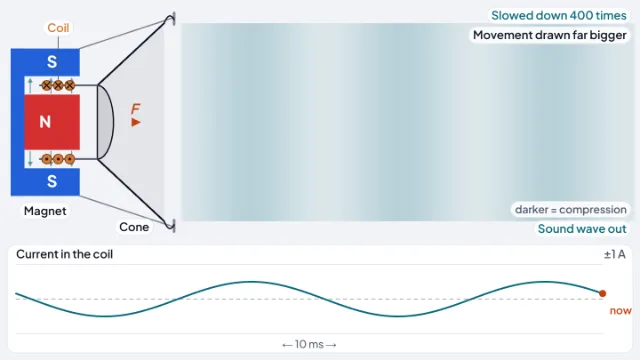
The signal from an amplifier is an alternating current that follows the pattern of the sound to be produced. Every turn of the coil cuts squarely across the radial field in the gap, so the motor effect gives the coil a force along its axis. When the current flows one way the coil is pushed out; when it reverses, the coil is pulled in. The coil and cone therefore vibrate back and forth at the same frequency as the current. The vibrating cone pushes and pulls on the air, sending out compressions and rarefactions: sound waves.

  • A higher frequency of current makes the cone vibrate faster, giving a higher pitch.
  • A larger current gives a larger force and larger vibrations, giving a louder sound.
  • A steady d.c. would push the cone out once and hold it there: no vibration, so no sound.

Loudspeakers are found in phones, radios, televisions, public address systems and headphones. A moving-coil microphone has the same parts but works the other way round: sound moves the coil in the field, and a small alternating current is induced.

Worked example: why use a relay?

A 12 V car starter motor draws 150 A. The ignition switch circuit uses a current of 0.20 A. Compare the power handled by the switch circuit and by the motor circuit.

Pswitch=IV=0.20×12=2.4 WP_{\text{switch}} = IV = 0.20 \times 12 = 2.4\ \text{W} Pmotor=150×12=1800 WP_{\text{motor}} = 150 \times 12 = 1800\ \text{W}

The relay lets a circuit handling a few watts control one handling nearly two kilowatts, through thin, cheap wires and a small switch.

The loudspeaker in the simulation

The simulation above shows a coil in the gap of a magnet, fixed to a cone, slowed down so that you can see it move.

  1. With Loudspeaker chosen and an a.c. signal, watch the Force on the coil card. The force reverses with the current, and the cone vibrates at the frequency of the current.
  2. Try the Double I guided set-up: twice the current gives twice the force and a louder sound.
  3. Choose Switch to d.c.. The cone moves once and then stays put, so no sound comes out.
  4. Raise the Frequency to hear (and see) a higher pitch.

To see a relay switching a motor on, open the simulation of the field around a wire and a solenoid and choose Relay.
Common mistakes

  • Saying that a relay makes a small current bigger. It does not amplify; a small current switches a separate circuit that has its own large current.
  • Thinking the input and output circuits of a relay are joined by wires. They are linked only through the magnetic effect.
  • Forgetting the return spring. Without it, the armature would not move back and the output circuit would stay closed.
  • Saying a loudspeaker works with d.c. A steady current just pushes the cone out once; only a changing current makes it vibrate.
  • Mixing up which effect each device uses. The relay depends on an electromagnet; the loudspeaker depends on the motor effect.
  • Thinking a higher current gives a higher pitch. Pitch follows the frequency of the current; a larger current makes the sound louder.

Exam practice

Exam-style questions

Original questions written in the style of Punjab board exams. Try each one before you reveal the answer.

  1. 1.A relay allows a 6 V circuit with a push switch to turn on a powerful 220 V water pump.

    1. (a)Name the main parts of a mechanical relay.

      2 marks
      Show the answer

      Answer: A coil wound on a soft iron core; a pivoted iron armature; a return spring; a pair of contacts (moving and fixed).

      Marking points

      • Coil on soft iron core
      • Armature, spring and contacts
    2. (b)Describe how pressing the push switch turns the pump on.

      3 marks
      Show the answer

      Answer: Current now passes through the relay's coil and its iron core becomes magnetic. The armature is pulled towards the core, tilts about its pivot and closes the contacts, completing the 220 V pump circuit.

      Marking points

      • Current in coil magnetises the core
      • Armature is attracted and moves
      • Contacts close, completing the pump circuit
    3. (c)Give two advantages of using the relay rather than a mains switch at the push button.

      2 marks
      Show the answer

      Answer: The person only touches a safe low-voltage circuit; the small switch and thin wires carry only a small current, while the heavy current flows in a separate circuit.

      Marking points

      • Safety: user is isolated from the high-voltage circuit
      • Small current in switch circuit controls a large current
  2. 2.A moving-coil loudspeaker is connected to an amplifier playing a musical note.

    1. (a)Explain how the loudspeaker produces sound.

      3 marks
      Show the answer

      Answer: From the amplifier comes an alternating current, which passes through a coil placed in the field of a permanent magnet. The current experiences a force that reverses each time the current reverses, so the coil and the cone attached to it vibrate. The cone pushes the air back and forth, producing sound waves.

      Marking points

      • Alternating current in coil in a magnetic field
      • Force reverses, so coil and cone vibrate
      • Cone makes the air vibrate: sound waves
    2. (b)How does the sound change if (a) the frequency of the current is raised, (b) the size of the current is increased?

      2 marks
      Show the answer

      Answer: (a) The pitch becomes higher. (b) The sound becomes louder.

      Marking points

      • Higher frequency: higher pitch
      • Larger current: louder
    3. (c)Explain why no sound is heard if a steady d.c. is passed through the loudspeaker.

      1 mark
      Show the answer

      Answer: With d.c. the force never changes direction, so the cone is shifted to one position and held there instead of vibrating.

      Marking points

      • Steady force, no vibration
  3. 3.The ignition switch circuit of a car carries 0.25 A from the 12 V battery. The starter motor it controls through a relay takes 160 A.

    1. (a)Calculate the power in the ignition switch circuit.

      1 mark
      Show the answer

      Answer: P = IV = 0.25 × 12 = 3.0 W.

      Marking points

      • 3.0 W
    2. (b)Calculate the power taken by the starter motor and comment on your answers.

      2 marks
      Show the answer

      Answer: P = 160 × 12 = 1920 W. The relay lets a circuit handling only 3 W switch one handling about 640 times as much power.

      Marking points

      • 1920 W
      • Small power controls a much larger power

Quiz

Quick check

6 questions

  1. 1.In a relay, the part that is attracted by the electromagnet is the:
  2. 2.A relay is mainly used to:
  3. 3.The core of a relay is made of soft iron because soft iron:
  4. 4.In a loudspeaker, the coil vibrates because:
  5. 5.Which change makes the note from a loudspeaker higher in pitch?
  6. 6.A loudspeaker depends mainly on:

Related articles

Next step

Now see it move

Open the full loudspeakers and microphones simulation for every preset, graphs and the teacher tools, then test yourself.

Loudspeakers and microphones simulation: a coil sits in the gap of a magnet and is fixed to a cone