Skip to content

Punjab Board Class 10 Physics · Chapter 16: Electricity

Electric power and Joule's law

Section 16.8Section 16.9

Electric power is the rate of transferring electrical energy: P = W/t = IV, in watts. For a resistor P = I²R = V²/R. The energy transferred is W = IVt. Joule's law says the heat produced in a resistance is H = I²Rt. Components must have power ratings high enough for the power they handle.

Loading simulation…

Symbols match your course. Open the full charge, current, energy and power simulation for more presets and teacher tools.

What we use electricity for

Look around any home in Lahore or Multan and you can sort the appliances into a few groups by what they do with electrical energy:

  • heating: geysers, irons, kettles, room heaters and electric stoves;
  • lighting: LED bulbs, tube lights and torches;
  • charging batteries: phones, laptops, power banks and UPS batteries;
  • driving motors: fans, washing machines, water pumps, fridges and the motors in electric vehicles;
  • running electronics: televisions, routers, computers.

Two appliances may run for the same time and yet use very different amounts of energy. What separates them is their power.

Electric power

Electric power measures how quickly a circuit or appliance uses electrical energy: the number of joules changed into other forms each second.

P=WtP = \frac{W}{t}

Its unit is the watt: 1 W=1 J s−11\ \text{W} = 1\ \text{J s}^{-1}.

To link power with circuit quantities, recall two facts. When a charge QQ passes through a p.d. VV, the energy transferred is W=QVW = QV. And the charge is Q=ItQ = It. Putting these together:

W=IVtW = IVt

Dividing by tt gives the most useful formula in this chapter:

P=IVP = IV

Power in watts equals current in amperes times p.d. in volts. For a resistor we can also substitute V=IRV = IR or I=V/RI = V/R:

P=I2RP=V2RP = I^2 R \qquad P = \frac{V^2}{R}

Joule's law: heat from a current

Every conductor with resistance gets warm when a current passes. The drifting electrons keep colliding with the metal ions and hand them energy, so the ions vibrate harder and the wire's temperature rises. Joule's law gives the heat produced:

The heat produced in a resistance equals the square of the current, multiplied by the resistance and the time for which the current flows.

H=I2RtH = I^2 R t

Since I2RI^2 R is the power, this is the same as H=PtH = Pt. A 100 W heating element produces 100 J of heat every second; in 10 s it produces 1000 J.

Notice the square. Double the current in a wire and four times as much heat is produced each second. That is why cables carrying large currents must be thick, and why an overloaded extension board can become dangerously hot.

Power ratings

Every appliance and component has a power rating: the power it is designed to handle, such as "220 V, 1500 W" on an iron or "0.25 W" on a small resistor. Choosing parts with a suitable rating matters:

  • a component made to work at a lower power than it is given will overheat, melt its insulation or burn out;
  • a much larger, more costly part than necessary wastes space and money;
  • cables, plugs and switches must be rated for at least the current the appliance draws.

Worked numerical 1: an electric kettle

A kettle connected to a 220 V supply draws a current of 8.0 A. Find its power and the energy it transfers in 3.0 minutes.

P=IV=8.0 A×220 V=1760 WP = IV = 8.0\ \text{A} \times 220\ \text{V} = 1760\ \text{W} W=Pt=1760 W×180 s=316 800 J≈3.2×10⁵ JW = Pt = 1760\ \text{W} \times 180\ \text{s} = 316\,800\ \text{J} \approx 3.2 \times 10^{5}\ \text{J}

Worked numerical 2: heat in a resistor

For 5.0 minutes, a 120 Ω resistor carries a steady 0.50 A. How much heat is produced?

H=I2Rt=(0.50)2×120×300=9000 JH = I^2 R t = (0.50)^2 \times 120 \times 300 = 9000\ \text{J}

Worked numerical 3: is the resistor big enough?

A 1.0 kΩ resistor will have 15 V across it. Resistors of this value are sold with ratings of 0.125 W and 0.25 W. Which should be used?

P=V2R=1521000=0.225 WP = \frac{V^2}{R} = \frac{15^2}{1000} = 0.225\ \text{W}

The 0.125 W resistor would overheat. The 0.25 W resistor is suitable, though only just.

Power in the simulation

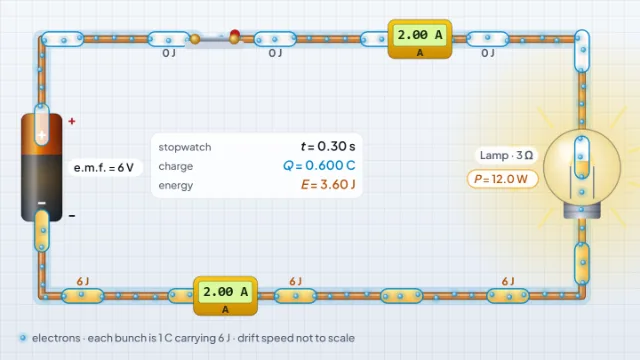
One loop holds a battery, two ammeters and a lamp, heater, motor or resistor.

  1. Select the example called 12 V, 36 W heater, then run it. The cards show 3.0 A and 36 W. The Working panel calculates the power three ways, from IVIV, from I2RI^2R and from V2/RV^2/R, and all three agree.
  2. Run the 6 V example that gives 2 A for 30 s, then pick The same resistor on 12 V. Doubling the p.d. on an unchanged resistance doubles the current, from 2 A to 4 A, and the power rises fourfold, from 12 W to 48 W.
  3. Try Motor on 6 V. For a motor, IVIV gives the total power, but I2RI^2R with the coil's resistance gives only the part that heats the coil; the rest turns the fan.
Formula sheet

Equations

  • Electrical power (P = IV)

    Learn this

    P=VI

    power = potential difference × current

  • Electrical power (P = I²R)

    Learn this

    P=I2R

    power = (current)² × resistance

  • Electrical energy (E = IVt)

    Learn this

    E=IVt

    energy transferred = current × potential difference × time

Common mistakes

  • Forgetting to square the current in H = I²Rt or P = I²R. Doubling the current gives four times the heating.
  • Using time in minutes or hours with W = IVt. The answer is in joules only when t is in seconds.
  • Treating I²R as the total power of a motor. For a motor, IV is the total; I²R with the coil's resistance is only the part wasted as heat.
  • Writing the watt as J s. A watt is a joule per second, 1 W = 1 J s⁻¹.
  • Choosing a component whose power rating is lower than the power it will dissipate. It will overheat and may burn out.
  • Confusing power with energy. Power says how fast energy is transferred; energy also depends on how long the appliance runs.

Exam practice

Exam-style questions

Original questions written in the style of Punjab board exams. Try each one before you reveal the answer.

  1. 1.Electric power can be written in several forms.

    1. (a)What is electric power? Name its SI unit.

      2 marks
      Show the answer

      Answer: Electrical energy converted into other forms per unit time. Unit: watt, W (1 W = 1 J s⁻¹).

      Marking points

      • Rate of transfer of electrical energy
      • Watt
    2. (b)Starting from W = QV and Q = It, show that P = IV.

      2 marks
      Show the answer

      Answer: W = QV = (It)V = IVt. Power P = W/t = IVt/t = IV.

      Marking points

      • W = IVt
      • P = W/t = IV
    3. (c)Use V = IR to show that P = I²R.

      1 mark
      Show the answer

      Answer: P = IV = I × IR = I²R.

      Marking points

      • Substitutes V = IR to obtain I²R
  2. 2.A water geyser element is rated 220 V, 2200 W.

    1. (a)Calculate the current it draws.

      2 marks
      Show the answer

      Answer: I = P/V = 2200 ÷ 220 = 10 A.

      Marking points

      • I = P/V
      • 10 A
    2. (b)Find the resistance of the element when working.

      2 marks
      Show the answer

      Answer: R = V/I = 220 ÷ 10 = 22 Ω (or V²/P = 48 400 ÷ 2200 = 22 Ω).

      Marking points

      • Correct method
      • 22 Ω
    3. (c)How much heat does it produce in 20 minutes? Give your answer in MJ.

      2 marks
      Show the answer

      Answer: t = 1200 s. H = Pt = 2200 × 1200 = 2 640 000 J = 2.64 MJ.

      Marking points

      • t = 1200 s
      • 2.64 MJ
  3. 3.A 33 Ω resistor in a circuit board carries a current of 0.15 A.

    1. (a)State Joule's law.

      1 mark
      Show the answer

      Answer: The heat produced in a resistance is equal to the product of the square of the current, the resistance and the time: H = I²Rt.

      Marking points

      • H = I²Rt (heat ∝ I², R and t)
    2. (b)Calculate the power dissipated in the resistor.

      2 marks
      Show the answer

      Answer: P = I²R = 0.15² × 33 = 0.0225 × 33 = 0.74 W.

      Marking points

      • P = I²R with values
      • 0.74 W
    3. (c)The resistor is rated 0.5 W. Explain what will happen and what should be done.

      2 marks
      Show the answer

      Answer: 0.74 W is more than its 0.5 W rating, so it will overheat and may burn out. A resistor rated 1 W (or more) should be used instead.

      Marking points

      • Power exceeds rating, so it overheats
      • Use a higher-rated resistor (e.g. 1 W)

Quiz

Quick check

6 questions

  1. 1.A lamp draws 0.25 A from a 12 V supply. Its power is:
  2. 2.The current through a resistor is doubled. The rate at which heat is produced becomes:
  3. 3.Which expression does NOT give the power in a resistor?
  4. 4.A 60 W bulb is left on for 10 minutes. The electrical energy it uses is:
  5. 5.Joule's law relates the heat H produced in a resistor to:
  6. 6.Why are the cables to an electric cooker much thicker than those to a table lamp?

Related articles

Next step

Now see it move

Open the full charge, current, energy and power simulation for every preset, graphs and the teacher tools, then test yourself.

Charge, current, energy and power simulation: a lamp, heater, motor or resistor in one loop with two ammeters