Physics7 min read
How to Memorise Physics Equations: Methods That Work, and Where Formula Triangles Fail
Which equations AQA, Cambridge IGCSE and Punjab students must recall, how to build and test equation flashcards, a four-week plan, why formula triangles break on equations like P = I²R, and how unit checks and calculators catch a half-remembered equation.
Published
On this page
- Which physics equations do you have to memorise?
- How do you make equation flashcards that work?
- How often should you test yourself on equations?
- A four-week plan for the recall list
- Do formula triangles work?
- How do unit checks catch a wrong equation?
- Should you use an equation calculator?
- Common mistakes
- Do I need to memorise the equations on the AQA equation sheet?
- Are formula triangles allowed in exams?
- How long does it take to memorise all the physics equations?
- What if I forget an equation in the exam?
In short
To memorise physics equations, test yourself on them from memory in short sessions spread over several weeks, using cards with the quantities in words on one side and the symbols and units on the other. Learn only the equations your exam board expects you to recall, know what every symbol means, and use a quick unit check to catch an equation you have only half remembered.
Here is something many students only find out late: you may not need to memorise every equation. AQA GCSE Physics prints 12 of its equations on a sheet in the exam. Cambridge IGCSE students get no such help. So the first step is finding out which group you are in.
Which physics equations do you have to memorise?
| Course | Equation sheet in the exam? | What to memorise |
|---|---|---|
| AQA GCSE Physics (8463) | Yes, for some equations | The 23 equations the specification says to recall. The other 12 are on the sheet: you pick the right one and use it. |
| Cambridge IGCSE Physics (0625) | The syllabus mentions none | Every equation the syllabus says to "recall and use": the Core ones, plus the Supplement ones if you take the Extended papers. |
| Punjab Class 9 and 10 Physics | We have not found an official formula sheet | Plan to recall every equation in your textbook chapters. |
AQA students can see the full recall list, with units and tiers, in our GCSE physics equations to learn guide. This article is about how to get those equations into your memory and keep them there.
How do you make equation flashcards that work?
Make one card per equation. On the front, write a question in words, not the symbols:
Which equation links power, current and resistance?
On the back, write three things:
- the equation in symbols, such as ;
- each quantity with its unit: power in watts (W), current in amps (A), resistance in ohms (Ω);
- one clue about when it is used, such as "heating effect of a current".
Then make a reverse card for the hardest ones: the symbols on the front, and you say the words and units. Exam questions come both ways round. Sometimes you are told the quantities and must find the equation. Sometimes you see a letter in a mark scheme and must know what it stands for.
Learn one form of each equation. You can rearrange it in the exam, so three cards for , and only triple the work.
How often should you test yourself on equations?
Saying an equation once from memory does more than reading it five times. That is the testing effect, explained in our retrieval practice guide. The catch is timing. Test too soon and it is too easy; leave it too long and it has gone.
A simple box system works well:
- every card starts in box 1, tested every day;
- a card you get right moves up a box: box 2 every 2 days, box 3 every 4 days, box 4 once a week;
- a card you get wrong goes back to box 1.
This is a version of the Leitner box. Our spaced repetition guide explains why the gaps grow. Once a week, also do a blank-page test: write every equation you need from memory, then mark it against the list.
A four-week plan for the recall list
| Week | What to do (10 to 15 minutes a day) |
|---|---|
| 1 | Make the cards, about six new ones a day. Test all the cards made so far, every day. |
| 2 | No new cards. Run the box system. End the week with a blank-page test. |
| 3 | Use the equations: mixed calculation questions with no notes, where you choose the equation yourself. |
| 4 onwards | Box system for the weak cards only, plus one blank-page test a week until the exam. |
Week 3 matters. Knowing by heart does not help if you cannot tell when a question needs it. Mixing different calculations together trains that choice, as our interleaving guide shows.
Do formula triangles work?
A formula triangle puts the three quantities of an equation such as in a triangle: on top, and below. Cover the one you want, and the other two show whether to multiply or divide. For simple three-quantity equations, it gets the rearranging right.
The trouble is that many equations do not fit:
- more than three quantities: , and ;
- squares: and ;
- sums and differences: ;
- fractions in the equation: the in kinetic energy.
A triangle also hides what the equation means, and a triangle drawn the wrong way round gives a wrong answer that feels right. Use triangles as a stepping stone if they help, but learn to rearrange with algebra: do the same thing to both sides until the quantity you want is on its own.
Worked example. A 12 Ω resistor transfers energy at 3.0 W. What is the current?
No triangle can do the square root step for you.
How do unit checks catch a wrong equation?
The units on both sides of a correct equation always match. That gives you a test for any equation you half remember.
Is kinetic energy or ? Energy is in joules, and a joule is a newton metre: kg m/s² × m = kg m²/s².
- gives kg × m/s = kg m/s. That is not a joule. It is the unit of momentum.
- gives kg × m²/s² = kg m²/s². That matches, so the square belongs there. (The has no unit, so units cannot check it.)
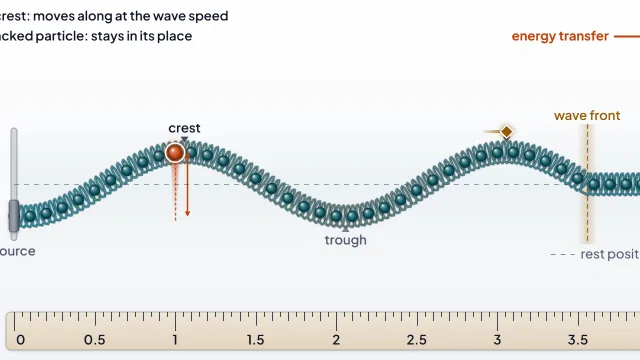
Is wave speed or ? Frequency is per second (1/s) and wavelength is in metres. gives m/s, a speed. gives 1/(s m), which is not. You can see this on the slinky wave simulation: keep the wave speed fixed, double the frequency, and each wavelength halves.
Units can even rebuild a simple equation you have forgotten. Power is in watts, and a watt is a joule per second, so power = energy ÷ time.
Should you use an equation calculator?
Yes, to check your work, not to replace it. Do the calculation by hand first, then compare. Our calculators rearrange each equation for any quantity and show the steps, so they are good for checking an algebra slip. Try the electrical power (P = I²R) calculator, the kinetic energy calculator or the wave speed calculator.
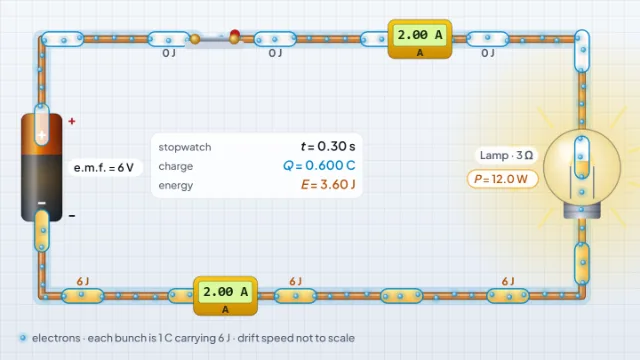
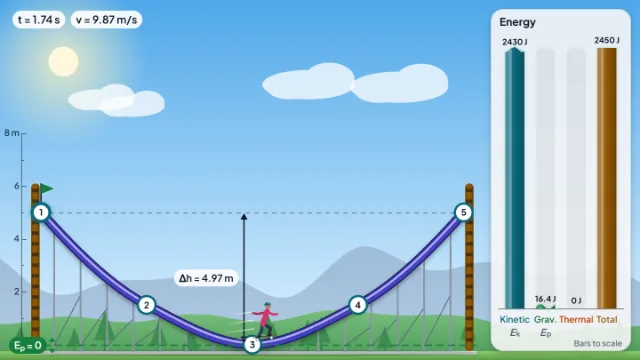
Pictures help too. In the energy skate track simulation, the skater loses height and gains speed, so turning into becomes something you can see. The circuit energy simulation lets you test and live as you change the battery voltage.
Common mistakes
- Learning the symbols without the words. Write on a card without "momentum" and you may later read as pressure.
- Learning the printed equations by heart. If your board gives you a sheet, spend that time on choosing and using them.
- Leaving out units. An equation you cannot give units for is half learned.
- Learning every rearranged form. One form plus algebra is less to remember and safer.
- Stopping once you know it. Equations you never test again fade. Keep them in the box system until the exam.
Do I need to memorise the equations on the AQA equation sheet?
No, but you need to know them well enough to choose the right one quickly and know what each symbol means. Read through the sheet before the exam and practise questions that use it.
Are formula triangles allowed in exams?
Nothing stops you sketching one in your working. Examiners give credit for the equation, the substitution and the answer you write, so write the equation itself first.
How long does it take to memorise all the physics equations?
There is no fixed time. About 10 to 15 minutes a day over three or four weeks is enough for many students to know the AQA recall list well, if most of that time is self-testing.
What if I forget an equation in the exam?
Try the units. If you need power from energy and time, watts are joules per second, so divide energy by time. For the rest of your revision plan, see the study skills page.