Skip to content

Punjab Board Class 10 Physics · Chapter 12: Waves

Wave terms and the wave equation

Section 12.3

Amplitude is the largest displacement from the rest position; wavelength λ is the distance from one crest (or compression) to the next; frequency f counts how many waves go past a point every second, in hertz; time period T = 1/f. In one period a wave moves one wavelength, so v = fλ.

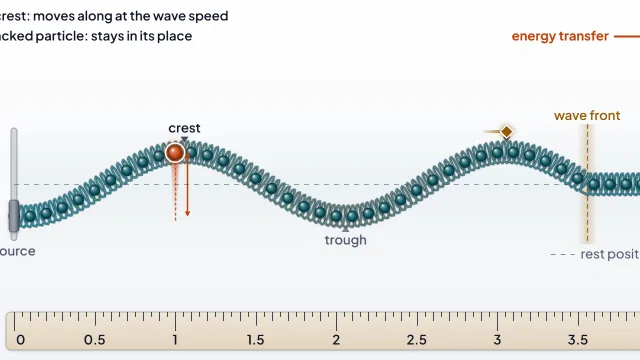
Loading simulation…

Symbols match your course. Open the full transverse and longitudinal waves simulation for more presets and teacher tools.

Describing a wave with numbers

Saying "a big, fast wave" is fine on a beach but no use in physics. To compare a ripple with a sea wave, or a low note with a high one, we need a small set of measurable quantities. This section gives the names of the parts of a wave, the quantities that describe it, and the one equation that ties them together.

Parts of a wave

Crest: the part of a transverse wave above the rest (mean) position, the "hill". Its top is the highest point.

Trough: the part of a transverse wave below the rest position, the "valley".

Compression: a stretch of a longitudinal wave in which the particles are packed more tightly than usual, which raises the pressure there.

Rarefaction: a stretch of a longitudinal wave in which the particles sit further apart than usual, which lowers the pressure there.

The quantities

Amplitude (AA): how far, at most, any point of the wave moves away from its rest position. It runs from the rest line up to a crest; crest-to-trough would be double. A wave with a larger amplitude carries more energy: a louder sound, a taller sea wave. Unit: metre.

Wavelength (λ\lambda): the distance between two neighbouring points that are vibrating in exactly the same way, for example from one crest to the next crest, one trough to the next trough, or one compression to the next compression. Unit: metre (m).

Frequency (ff): the number of complete waves passing a fixed point in one second. Unit: hertz (Hz), where 1 Hz means one wave per second. A radio station on 88.0 MHz sends out 88 million waves each second.

Time period (TT): the time taken for one complete wave to pass a fixed point. Unit: second (s). Frequency and time period are reciprocals of each other:

T=1fandf=1TT = \frac{1}{f} \qquad\text{and}\qquad f = \frac{1}{T}

Wavefront: an imaginary line or surface joining points of a wave that are all vibrating in step (in the same phase), for example every point along one crest. In a ripple tank the bright lines you see are wavefronts. Straight bars make straight wavefronts; a dipper touching one point makes circular ones.

Wave speed (vv): how far the wave travels each second. Unit: metre per second (m s⁻¹).

Deriving the wave equation

Speed is distance divided by time. Watch a single crest. In the time of one period TT, exactly one complete wave passes, so the crest moves forward by exactly one wavelength λ\lambda:

v=St=λTv = \frac{S}{t} = \frac{\lambda}{T}

Because 1/T=f1/T = f, this becomes the wave equation:

v=fλv = f\lambda

wave speed (m s⁻¹) = frequency (Hz) × wavelength (m). It works for every kind of wave: ripples, sound, light and radio.

An important consequence. The medium decides how fast a wave travels, while the source decides its frequency. In one medium, if the source vibrates faster (higher ff), the waves must come out closer together (smaller λ\lambda). That is why, of two sounds in the same air, the higher-pitched one has the shorter wavelength.

Worked numerical 1: waves at the harbour

A boat at anchor rises and falls as 12 waves pass it in 8.0 s. Neighbouring crests are 6.0 m apart. Find (a) the frequency, (b) the time period and (c) the wave speed.

Data: 12 waves, t=8.0 st = 8.0\ \text{s}, λ=6.0 m\lambda = 6.0\ \text{m}

(a)

f=number of wavestime=128.0 s=1.5 Hzf = \frac{\text{number of waves}}{\text{time}} = \frac{12}{8.0\ \text{s}} = 1.5\ \text{Hz}

(b)

T=1f=11.5 Hz≈0.67 sT = \frac{1}{f} = \frac{1}{1.5\ \text{Hz}} \approx 0.67\ \text{s}

(c)

v=fλ=1.5 Hz×6.0 m=9.0 m s−1v = f\lambda = 1.5\ \text{Hz} \times 6.0\ \text{m} = 9.0\,\mathrm{m\,s^{-1}}

Worked numerical 2: tuning in to FM

An FM station broadcasts at 100 MHz, and its radio waves move at the speed of light, cc. Find the wavelength.

f=100 MHz=1.0×10⁸ Hzf = 100\ \text{MHz} = 1.0 \times 10^{8}\ \text{Hz} λ=cf=300 000 000100 000 000 m=3.0 m\lambda = \frac{c}{f} = \frac{300\,000\,000}{100\,000\,000}\ \text{m} = 3.0\ \text{m}

Worked numerical 3: the wavelength of a whistle

A whistle sounds a 680 Hz note. The speed of sound in the air is 340 m s⁻¹ that day.

λ=vf=340 m s−1680 Hz=0.50 m\lambda = \dfrac{v}{f} = \dfrac{340\,\mathrm{m\,s^{-1}}}{680\,\mathrm{Hz}} = 0.50\,\mathrm{m}

Worked numerical 4: from period to frequency

A ripple tank motor makes one wave every 0.040 s. Find the frequency.

f=1T=10.040 s=25 Hzf = \frac{1}{T} = \frac{1}{0.040\ \text{s}} = 25\ \text{Hz}

If the ripples move at 0.30 m s⁻¹, their wavelength is

λ=vf=0.3025=0.012 m=1.2 cm\lambda = \frac{v}{f} = \frac{0.30}{25} = 0.012\ \text{m} = 1.2\ \text{cm}

Where next

The same equation explains why sound has wavelengths of metres while light has wavelengths far smaller than a millimetre: see the speed of sound and mechanical and electromagnetic waves. Our article on the wave equation and its unit traps has more practice.

Measuring a wave in the simulation

  1. Press Play. Read the Frequency, Time period, Wavelength and Wave speed cards, and check that frequency × wavelength gives the speed.
  2. Press Ruler and drag Marker A and Marker B onto two neighbouring crests. The distance between them is one wavelength.
  3. Track a particle, then press Count. The stopwatch counts waves passing that particle; share the stopwatch reading out among the waves counted and you have the time period.
  4. Raise the Frequency while the Wave speed stays put. The new waves come out closer together: a higher frequency means a shorter wavelength. Then change the Wave speed and see the wavelength stretch.

The ripple tank simulation lets you do the same measurements on water waves, with a strobe to freeze the pattern.
Formula sheet

Equations

Common mistakes

  • Measuring the amplitude from a crest down to a trough. Amplitude is measured from the rest (mean) position to a crest, so it is half the crest-to-trough height.
  • Forgetting to convert units before using v = fλ: kHz to Hz, MHz to Hz, cm to m.
  • Believing that raising the frequency speeds a wave up. In a given medium the speed stays the same, so a higher frequency gives a shorter wavelength.
  • Writing the period as the number of waves per second. That is the frequency; the period is how long a single wave takes to pass, T = 1/f.
  • Using the number of crests instead of the number of complete waves when finding a wavelength from a diagram. Count the gaps between crests, not the crests.
  • Confusing a wavefront with a wavelength. A wavefront is a line (or surface) joining points vibrating in step, such as along one crest; a wavelength is a distance.

Exam practice

Exam-style questions

Original questions written in the style of Punjab board exams. Try each one before you reveal the answer.

  1. 1.A fishing boat bobs up and down at anchor as waves pass. A fisherman counts 15 waves passing the boat in 6.0 s. The crests are 4.0 m apart.

    1. (a)Work out the wave frequency.

      2 marks
      Show the answer

      Answer: f = number of waves ÷ time = 15 ÷ 6.0 = 2.5 Hz.

      Marking points

      • f = number of waves ÷ time
      • 2.5 Hz
    2. (b)Calculate the time period.

      1 mark
      Show the answer

      Answer: T = 1/f, so T = 1 ÷ 2.5 Hz = 0.40 s.

      Marking points

      • 0.40 s
    3. (c)Find how fast the waves travel.

      2 marks
      Show the answer

      Answer: v = fλ = 2.5 × 4.0 = 10 m s⁻¹.

      Marking points

      • v = fλ used
      • 10 m s⁻¹
  2. 2.Define the following terms for a wave.

    1. (a)Amplitude.

      1 mark
      Show the answer

      Answer: The largest distance any point of the wave is moved from its rest (mean) position.

      Marking points

      • Maximum displacement from the rest position
    2. (b)Wavelength.

      1 mark
      Show the answer

      Answer: The distance between two neighbouring points vibrating in the same way, e.g. crest to next crest or compression to next compression.

      Marking points

      • Distance between neighbouring corresponding points (crest to crest)
    3. (c)Wavefront.

      1 mark
      Show the answer

      Answer: A line or surface through points of the wave that move in step with each other (in phase), e.g. along one crest.

      Marking points

      • Points vibrating in phase / with the same displacement and motion
  3. 3.An FM station transmits on 100 MHz. Its signal travels at 3.0 × 10⁸ m s⁻¹, the speed of light.

    1. (a)Work out the wavelength of this signal.

      3 marks
      Show the answer

      Answer: f = 100 MHz = 1.0 × 10⁸ Hz. λ = v ÷ f = (3.0 × 10⁸ m s⁻¹) ÷ (1.0 × 10⁸ Hz) = 3.0 m.

      Marking points

      • Converts 100 MHz to 1.0 × 10⁸ Hz
      • λ = v/f
      • 3.0 m
    2. (b)A second station uses a higher frequency. State and explain how its wavelength compares.

      2 marks
      Show the answer

      Answer: Shorter. All radio waves travel at the same speed, so by λ = v/f a higher frequency gives a smaller wavelength.

      Marking points

      • Shorter wavelength
      • Same speed, so λ is inversely proportional to f

Quiz

Quick check

6 questions

  1. 1.The SI unit of frequency is the:
  2. 2.A wave has a frequency of 40 Hz. Its time period is:
  3. 3.Sound of frequency 850 Hz travels through air at 340 m s⁻¹. Its wavelength is:
  4. 4.Which quantity tells us about the energy carried by a wave?
  5. 5.Two waves travel through the same medium. Wave X has twice the frequency of wave Y. Compared with Y, wave X has:
  6. 6.In 0.50 s, 20 complete waves pass a point. Their wavelength is 0.15 m. The wave speed is:

Related articles

Next step

Now see it move

Open the full transverse and longitudinal waves simulation for every preset, graphs and the teacher tools, then test yourself.

Transverse and longitudinal waves simulation: send transverse or longitudinal waves along a slinky