Skip to content

Punjab Board Class 10 Physics · Chapter 12: Waves

Transverse and longitudinal waves

Section 12.2

Transverse waves shake the medium across their path, perpendicular to their motion, giving crests and troughs (rope, water surface, light). Longitudinal waves shake it to and fro along their path, giving compressions and rarefactions (sound, P-waves, a slinky pushed and pulled).

Loading simulation…

Symbols match your course. Open the full transverse and longitudinal waves simulation for more presets and teacher tools.

Two ways to shake a slinky

Hold one end of a slinky spring stretched along the floor, with a friend holding the other end. Flick your end sideways across the floor and a wiggle runs along the spring. Now give your end a sharp push towards your friend instead, and a bunch of squeezed coils runs along it. Both are waves carrying energy to your friend's hand, but the coils moved in completely different directions. That difference is the whole idea of this topic.

Sorting by the direction of vibration

Every mechanical wave makes the particles of its medium vibrate. Compare the direction the particles vibrate with the direction the wave (and its energy) travels:

  • at right angles to each other: a transverse wave;
  • along the same line as each other: a longitudinal wave.

Transverse waves

Transverse wave: a wave whose particles vibrate across its path, perpendicular to its direction of motion.

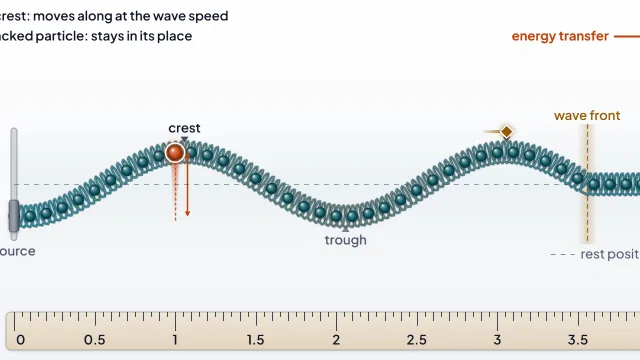
Move the end of a rope up and down and the wave runs horizontally along the rope while each bit of rope moves vertically. The places pushed highest above the rest line are the crests, and the places pulled lowest below it are the troughs.

Examples:

  • a wave on a rope or a stretched string;
  • ripples and waves on the surface of water, where the water at any one spot mostly bobs up and down as the wave sweeps past;
  • electromagnetic waves (light, radio waves, X-rays and the rest). Nothing material vibrates in these: an electric field and a magnetic field oscillate across the path, at 90° to it, so they count as transverse too;
  • seismic S-waves from earthquakes (see the callout below).

To draw one, sketch a smooth up-and-down curve along a straight dashed rest line, label a crest and a trough, and add an arrow along the rest line for the direction of travel and a short double-headed arrow across it for the vibration.

Longitudinal waves

Longitudinal wave: a wave whose particles vibrate to and fro in line with its path, along the same line as the wave is moving.

Push and pull the end of a slinky along its length and each coil shuffles forward and back in line with the spring. Where coils are squeezed together there is a compression, a region of higher pressure; where they are pulled apart there is a rarefaction, a region of lower pressure. The compressions and rarefactions travel along the spring while each coil stays near its own place.

Examples:

  • sound: a clap squeezes the air in front of the hands into a compression, and the air then springs back and thins into a rarefaction. A train of these passes through the air to your ear;
  • seismic P-waves, which squash and stretch the rock along their path;
  • a slinky pushed and pulled along its length.

To draw one, show a row of vertical lines, bunched close together in some places (label C for compression) and spaced widely in others (label R for rarefaction). Add one arrow showing which way the wave goes and, parallel to it, a double-headed arrow for the vibration.

Side by side

FeatureTransverseLongitudinal
Particle vibrationAcross the path (at 90°)In line with the path
One wavelengthCrest to next crestCompression to next compression
Parts of the waveCrests and troughsCompressions and rarefactions
ExamplesRope, water surface, light, S-wavesSound, P-waves, slinky pushed and pulled

Worked numerical 1: a wave on a slinky

A longitudinal wave is set up on a slinky. The centres of two neighbouring compressions are 30 cm apart, and the wave travels 1.5 m along the spring in 2.5 s.

(a) One wavelength spans neighbouring compressions:

λ=30 cm=0.30 m\lambda = 30\ \text{cm} = 0.30\ \text{m}

(b) The speed of the wave:

v=St=1.5 m2.5 s=0.60 m s−1v = \frac{S}{t} = \frac{1.5\ \text{m}}{2.5\ \text{s}} = 0.60\,\mathrm{m\,s^{-1}}

(c) How far is a compression from the nearest rarefaction? Half a wavelength: 15 cm.

Worked numerical 2: reading a rope snapshot

A photo of a transverse wave on a rope shows a crest 0.40 m along the rope from the next trough. The crest is 0.20 m higher than the trough.

From crest to the neighbouring trough is half a wavelength:

λ=2×0.40 m=0.80 m\lambda = 2 \times 0.40\ \text{m} = 0.80\ \text{m}

The rest line lies halfway between crest and trough, and the amplitude is measured from it:

A=0.20 m2=0.10 mA = \frac{0.20\ \text{m}}{2} = 0.10\ \text{m}

Where next

Both kinds of wave spread from the same basic idea, covered in the nature of waves. Sound, the longitudinal wave in Chapter 13, starts with how sound is produced and travels. Our longer guide to transverse and longitudinal waves also explains how to read the two kinds of wave graph.

The two kinds in the simulation

  1. Under Type of wave, choose Transverse and turn on Label crests and troughs. Press Play, then Track a particle: it moves up and down while the crests travel sideways.
  2. Switch to Longitudinal and turn on Label compressions and rarefactions and Shade where particles crowd together. The tracked particle now moves back and forth along the chain.
  3. Press Ruler, then drag Marker A onto one compression and Marker B onto the next. Compare that distance with the Wavelength card.
  4. Brain teaser: which of the two settings matches pushing a slinky, and which matches shaking it sideways?
Common mistakes

  • Describing a transverse wave as one where the particles move along with the wave. They move across the direction of travel, up and down if the wave runs sideways.
  • Calling sound transverse just because books plot it as a smooth curve. That curve shows how pressure or displacement varies; the air molecules really swing to and fro in line with the path of the sound.
  • Saying a compression is a place where particles stop moving. Particles keep vibrating everywhere; a compression is just where they happen to be crowded together at that moment.
  • Labelling crests and troughs on a longitudinal wave. Crests and troughs belong to transverse waves; longitudinal waves have compressions and rarefactions.
  • Taking the gap between a compression and the rarefaction beside it as the wavelength. It is just half of one; measure between two compressions instead.
  • Thinking light is a longitudinal wave because it travels in straight lines. Light, radio waves and X-rays are all transverse.

Exam practice

Exam-style questions

Original questions written in the style of Punjab board exams. Try each one before you reveal the answer.

  1. 1.A slinky spring is laid along the floor. A student moves one end in two different ways.

    1. (a)First she waggles the end sideways over the floor several times. Name the type of wave produced and describe how the coils move.

      2 marks
      Show the answer

      Answer: A transverse wave: every coil swings sideways, perpendicular to the line along which the wave runs.

      Marking points

      • Transverse
      • Coils swing perpendicular to the line the wave runs along
    2. (b)Next she pushes and pulls the end along the length of the spring. Name the type of wave produced and describe how the coils move.

      2 marks
      Show the answer

      Answer: A longitudinal wave. Each coil moves back and forth parallel to the direction the wave travels.

      Marking points

      • Longitudinal
      • Coils vibrate parallel to the direction of travel
    3. (c)Name the two kinds of region seen in the second wave.

      2 marks
      Show the answer

      Answer: Compressions, where the coils bunch up, and rarefactions, where the coils open out.

      Marking points

      • Compression: coils close together
      • Rarefaction: coils spread apart
  2. 2.Waves can be sorted by the direction in which the particles vibrate.

    1. (a)Sort these into transverse and longitudinal: ripples on a pond, sound in air, light from a lamp, seismic P-waves.

      2 marks
      Show the answer

      Answer: Transverse: ripples on a pond, light. Longitudinal: sound in air, seismic P-waves.

      Marking points

      • Ripples and light transverse
      • Sound and P-waves longitudinal
    2. (b)In light waves no particles vibrate. State what does vibrate.

      1 mark
      Show the answer

      Answer: Electric and magnetic fields; they oscillate across the light’s path.

      Marking points

      • Electric and magnetic fields (oscillating across the path)
  3. 3.A transverse wave is sent along a rope. In a photo of the rope, a crest and the trough next to it are 0.40 m apart measured along the rope, and the crest is 0.20 m above the trough.

    1. (a)Work out the wavelength.

      2 marks
      Show the answer

      Answer: Crest to the next trough is half a wavelength, so λ = 2 × 0.40 = 0.80 m.

      Marking points

      • Crest to neighbouring trough is half a wavelength
      • 0.80 m
    2. (b)Find the amplitude of the wave.

      2 marks
      Show the answer

      Answer: The amplitude is measured from the rest position, which lies halfway between crest and trough, so A = 0.20 ÷ 2 = 0.10 m.

      Marking points

      • Amplitude measured from the rest position (half the crest-to-trough height)
      • 0.10 m

Quiz

Quick check

6 questions

  1. 1.In a longitudinal wave, the particles of the medium vibrate:
  2. 2.Which one of these waves is longitudinal?
  3. 3.The highest point of a transverse wave above its rest position is called a:
  4. 4.A rarefaction is a region of a longitudinal wave where the particles are:
  5. 5.In a sound wave, a compression is 20 cm from the rarefaction next to it. The wavelength is:
  6. 6.Electromagnetic waves such as light and X-rays are transverse because:

Related articles

Next step

Now see it move

Open the full transverse and longitudinal waves simulation for every preset, graphs and the teacher tools, then test yourself.

Transverse and longitudinal waves simulation: send transverse or longitudinal waves along a slinky