Silent explosions, bright light
In films, spaceships explode with a huge bang. In real space there would be no bang at all: the flash of light would reach a watching astronaut, but the sound never would. The reason is that light and sound belong to two different families of waves, and only one of them can cross empty space.
Mechanical waves
Mechanical wave: a wave that needs a material medium, a solid, liquid or gas, to travel through.
A mechanical wave moves because particles of the medium vibrate and push on their neighbours. Take the particles away and there is nothing to pass the energy on, so mechanical waves cannot travel through a vacuum. Each particle still only vibrates about its own position; it is the energy that moves along.
Examples:
- sound waves, in air, water or solids;
- water waves and ripples;
- waves on a rope, a string or a spring;
- seismic waves, which travel through the rock of the Earth after an earthquake.
Electromagnetic waves
Electromagnetic waves: waves that need no material medium and can travel through a vacuum.
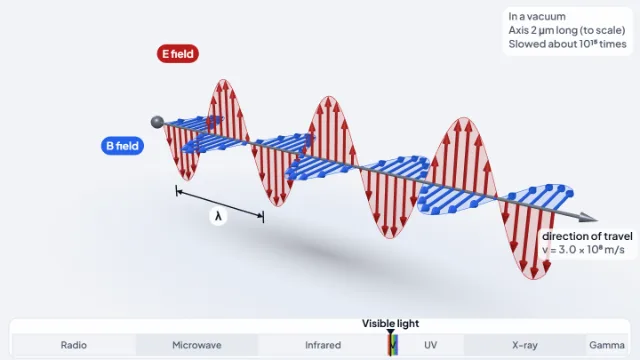
Sunlight reaches us after travelling roughly 150 million km through space that is nearly empty: the clearest everyday proof. In an electromagnetic wave nothing material vibrates: electric and magnetic fields oscillate across the path of the wave, which is why these waves are transverse.
All electromagnetic waves travel through a vacuum at the same speed, the speed of light:
That is 300 000 kilometres every second. In air they are only very slightly slower.
The electromagnetic spectrum
The complete family of electromagnetic waves, arranged by wavelength, is the electromagnetic spectrum. The groups merge into each other with no sharp borders. Starting at the long-wavelength, low-frequency end and moving to the short-wavelength, high-frequency end:
| Group | An everyday example |
|---|---|
| Radio waves | FM radio and television broadcasts |
| Microwaves | Microwave ovens, mobile phone signals |
| Infrared | Heat given off by warm objects, TV remote controls |
| Visible light | The only part our eyes detect, red to violet |
| Ultraviolet | Part of sunlight that causes sunburn |
| X-rays | Images of bones in hospitals |
| Gamma rays | Given out by radioactive nuclei |
The examples in the second column go a little beyond this section of the book; the order of the groups is what you must know. Infrared means "below red": its frequency is lower than that of red light. Ultraviolet means "beyond violet".
Since every group moves equally fast through a vacuum, they differ only in wavelength and frequency. A shorter wavelength always goes with a higher frequency (see the wave equation).
Comparing the two families
| Mechanical waves | Electromagnetic waves |
|---|---|
| Need a solid, liquid or gas | Need no medium |
| Cannot cross a vacuum | Cross a vacuum, e.g. sunlight |
| Particles of the medium vibrate | Electric and magnetic fields vibrate |
| Can be transverse or longitudinal | Always transverse |
| Speed depends on the medium (sound in air about 340 m s⁻¹) | All at 3 × 10⁸ m s⁻¹ in a vacuum |
Worked numerical 1: sunlight's journey
The Sun is about from the Earth. How long does its light take to reach us?
So the Sun you see is the Sun as it was about eight minutes ago.
Worked numerical 2: a radio message to the Moon
A radio signal is sent from the Earth to a spacecraft near the Moon, away.
A reply would take the same again, so a conversation has a gap of about 2.6 s.
Worked numerical 3: lightning first, thunder later
Lightning strikes 1020 m away. The air that day carries sound at 340 m s⁻¹.
The flash arrives almost instantly; the thunder, a mechanical wave, takes three seconds.
The wave in the simulation
The 3D simulation above sends an electromagnetic wave across empty space.
- Press Play and choose the Side view. The arrows of the E field and B field grow and shrink across the path while the wave crosses the screen: a transverse wave with nothing material moving.
- Switch to the Front view, which looks straight down the path of the wave. Every arrow points across the path, none along it.
- Under Jump to an example in each region, step from FM radio to Gamma ray. The Wavelength card changes enormously, but the Speed card stays at 3.0 × 10⁸ every time.
- For the full spectrum with every group in order, open the electromagnetic spectrum simulation and try its order quiz.