What waves do when they meet something
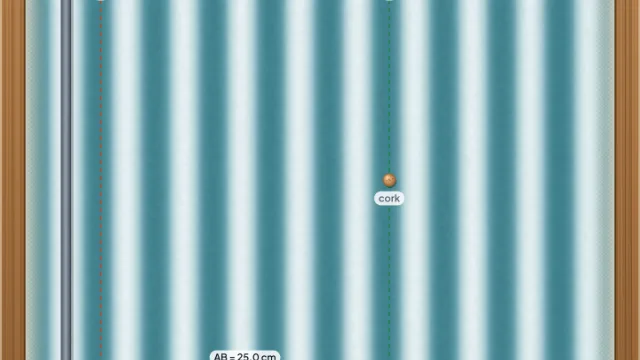
A wave crossing open water simply carries on. The interesting physics starts when it meets something: a wall, a change in depth, a gap in a harbour wall. Three behaviours turn up for every kind of wave, from ripples to sound to light: reflection, refraction and diffraction. A ripple tank shows all three clearly, because the wavefronts appear as bright lines on the screen below.
Reflection
Reflection: waves striking a surface and returning into the medium they came from.
Put a straight metal barrier in a ripple tank at an angle to the straight ripples from the vibrating bar. The ripples bounce off it and head away in a new direction. Where a ray hits the barrier, draw the normal, a construction line perpendicular to the barrier.
- , the angle of incidence, sits between the incoming ray (the ripples’ direction of travel) and the normal;
- , the angle of reflection, sits between the reflected ray and the normal.
The two always come out the same size, which is the law of reflection:
The ripples stay in the same water, so their speed, wavelength and frequency do not change on reflection. All waves reflect: a mirror reflects light, and a cliff reflects sound to give an echo.
Refraction
Refraction: the bending of a wave’s path as it crosses at a slant into a region where its speed (and so its wavelength) is different.
In a ripple tank, a sheet of glass laid on the bottom makes the water above it shallower. Water waves travel more slowly in shallow water. As the ripples cross onto the glass:
- their speed decreases;
- their wavelength gets shorter, so the bright lines crowd closer together;
- their frequency stays the same, because the bar is still making the same number of waves each second and every wave that arrives must pass on;
- if they cross the edge at an angle, their direction changes, bending towards the normal.
The frequency staying fixed is the key. Since and does not change, the wavelength changes in proportion to the speed: half the speed means half the wavelength. If the ripples meet the edge head-on (along the normal), they slow down and shorten but carry straight on.
Light refracts in exactly the same way when it passes from air into glass: see refraction of light.
Diffraction
Diffraction: waves fanning out after going through a gap (slit) or past the edge of an obstacle.
Place two barriers in the tank with a gap between them and watch the ripples on the far side.
- Gap much wider than the wavelength: the ripples go mostly straight through, still nearly straight, with just a little bending near the edges of the beam.
- Gap about equal to the wavelength: the ripples fan out strongly into curved, almost circular wavefronts.
- Gap narrower than the wavelength: the spreading is greatest, giving circular wavefronts, although less energy squeezes through, so the waves beyond are weaker.
So the narrower the slit compared with the wavelength, the stronger the spreading, with the biggest effect once the slit is about one wavelength across or narrower. At a single edge, such as the end of a breakwater, waves curl round into the sheltered water behind it, and longer wavelengths bend round further than shorter ones.
Diffraction leaves the wavelength, frequency and speed exactly as they were; only the directions in which the energy travels open out.
Why you hear round corners but cannot see round them. Sound in air has wavelengths from a few centimetres to many metres, similar in size to doorways and walls, so it diffracts round them and reaches you without a straight path. Light has a wavelength of about half a millionth of a metre, far smaller than a doorway, so it hardly spreads at all and you cannot see the speaker. More on this in refraction and diffraction of sound.
Worked numerical 1: ripples over the glass plate
A motor makes 6.0 ripples each second. They move at 0.30 m s⁻¹ where the water is deep and 0.21 m s⁻¹ over a glass plate. Find the wavelength in each region.
The frequency is 6.0 Hz in both regions; the speed and the wavelength both fall to 70 % of their deep-water values.
Worked numerical 2: will it spread through the doorway?
A doorway is 0.90 m wide. Compare (a) a 340 Hz sound in air at 340 m s⁻¹ with (b) green light of wavelength .
(a)
The wavelength is about the same as the doorway, so the sound spreads widely into the room beyond.
(b) The light's wavelength is about two million times smaller than the doorway, so the diffraction is far too small to notice: light goes straight through and casts sharp shadows.
Worked numerical 3: angles at a barrier
Ripples strike a straight barrier with their direction of travel at 40° to the barrier's surface. Find the angle of reflection.
The angles in the law are measured from the normal, not the surface:
The three properties in the ripple tank simulation
- Choose Reflection and turn on Rays, normals and labels. Change the Angle of incidence and compare the Angle of incidence (i) and Angle of reflection (r) readouts.
- Choose Refraction. Look down the Deep water column, then the Over the plate column: the speed and wavelength drop, the frequency does not. Press Strobe to freeze the ripples and see them bunch up over the plate.
- Choose Diffraction through a gap and slide the Gap width from wide to narrow, watching the Gap ÷ wavelength readout. The spreading is greatest at about 1 or less.
- In Diffraction at an edge, turn the Frequency down. The longer ripples curl further round into the region behind the barrier.