Skip to content

Punjab Board Class 10 Physics · Chapter 12: Waves

Waves and the nature of waves

Section 12.1

A wave moves energy between places while the material it passes through stays behind. Each particle of the medium only vibrates about its own rest position and hands the energy on to the next one. Ripples on a pond, a pulse on a rope and sound in air all work this way.

Loading simulation…

Symbols match your course. Open the full transverse and longitudinal waves simulation for more presets and teacher tools.

A leaf that refuses to leave

Watch a dry leaf resting on a pond when a duck lands some distance away. Rings of ripples spread out and reach the leaf, yet the leaf does not sail off to the bank. It rises, dips and settles again, more or less where it was. Something has clearly crossed the pond, because the leaf was given a push, but the water did not flow across with it. That something is energy, and the thing carrying it is a wave.

What a wave is

Wave: a disturbance that moves through a medium (or through space) and carries energy from one place to another, without carrying the material along with it.

The material the wave passes through, such as water, air, a rope or a spring, is called the medium. When a wave arrives, each particle of the medium is pulled away from its rest position, swings back past it, and keeps vibrating (oscillating) about that same position. As it vibrates it nudges its neighbour, which nudges the next one, so the disturbance is handed along a chain of particles. The particles stay roughly at home; only the energy and the pattern of the disturbance travel on.

Four everyday examples

Ripples on water. A stone or a falling twig disturbs the surface. Circles of ripples spread out, carrying energy to the edge of the pond, while any floating object only bobs up and down.

A wave on a rope. Tie one end of a long rope to a post and flick the free end up and down. A hump runs along the rope to the post. Any single piece of rope moves up and back down, never along the rope towards the post.

A pulse on a stretched spring. Lay a slinky along a bench and push one end forward and back. A bunch of tightly packed coils, a compression, runs along the spring, followed by a stretch of widely spaced coils, a rarefaction. A small marker tied to one coil jiggles forward and back and then returns to its first place.

Sound from a guitar. A plucked string vibrates and pushes on the air next to it. Those air particles pass the push on to the next layer of air, and so on, until the layers next to your eardrum make it vibrate too. The air from the guitar never travels to your ear; its vibration does.

In every case:

  • the source supplies energy by making something vibrate;
  • the particles of the medium vibrate about fixed positions;
  • the energy moves outward from the source.

Seeing wave motion in a ripple tank

A ripple tank lets the whole class watch water waves under control.

  1. A shallow glass-bottomed tray is filled with water to the same depth everywhere (a centimetre or so).
  2. A straight wooden bar rests on the surface and is driven up and down by a small electric motor, so it makes a steady series of straight ripples.
  3. A lamp above the tank shines through the water. Each ripple acts like a weak lens, so the crests show up as bright lines and the troughs as dark lines on a white screen or paper under the tank.
  4. A metre rule placed beside the screen lets you measure the spacing of the lines.

The bright lines march steadily away from the bar towards the far side, carrying energy from the motor. Put a small cork on the water and it only bobs, which shows once again that the water is not flowing across the tank.

Wave speed is not particle speed

The wave and the particles move in quite different ways, so do not confuse the two speeds. The wave speed is how fast the disturbance (and its energy) travels across the medium, and it is found from

v=Stv = \frac{S}{t}

where SS is the distance the disturbance covers in time tt. A particle of the medium, meanwhile, keeps moving to and fro over a short distance and ends up where it started.

Worked numerical 1: the ripple and the leaf

A ripple crest takes 4.0 s to travel 1.8 m from where a stone landed to a floating leaf.

(a) Find the speed of the ripple.

v=St=1.8 m4.0 s=0.45 m s−1v = \frac{S}{t} = \frac{1.8\ \text{m}}{4.0\ \text{s}} = 0.45\,\mathrm{m\,s^{-1}}

(b) Twenty more ripples pass the leaf. How far along the pond has the leaf moved?

Almost nowhere. The leaf rises and falls with each ripple and keeps returning to its starting point, so its net movement along the pond is about zero, even though energy has passed it twenty times.

Worked numerical 2: a stadium wave (an analogy)

At a cricket ground, spectators take turns to stand up and sit down, and a "wave" runs round the stands. The stands form a loop 600 m round, and the wave goes once round in 30 s.

v=St=600 m30 s=20 m s−1v = \frac{S}{t} = \frac{600\ \text{m}}{30\ \text{s}} = 20\,\mathrm{m\,s^{-1}}

The wave moves round at 20 m s⁻¹, but no spectator leaves their seat. Each person only rises and sits, just as each particle in a medium only vibrates about its rest position.

Where next

The direction in which the particles vibrate splits waves into two kinds: see transverse and longitudinal waves. Sound, the longitudinal wave you meet most often, gets a whole chapter of its own, starting with how sound is produced and travels. For more on what vibrates in each kind of wave, read our guide to transverse and longitudinal waves.

Waves in the simulation

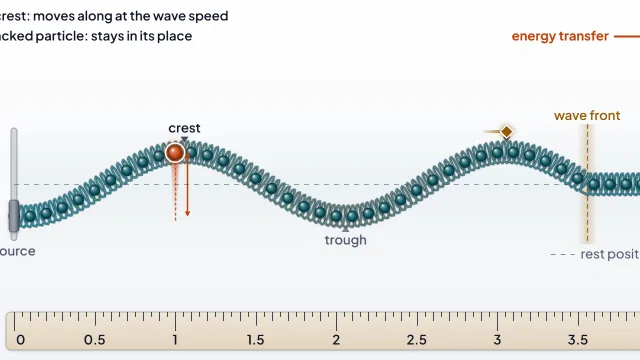
In the simulation at the top of this page, a source on the left sends a wave along a chain of particles.

  1. Press Play, then press Track and tap one particle. Watch the highlighted particle: it moves up and down on its own short path while the crests sweep past it along the chain.
  2. Read the legend on the stage. The crest is marked as travelling, while the tracked particle stays put.
  3. Under Type of wave, switch to Longitudinal and turn on Shade where particles crowd together. Each particle now swings to and fro in line with the chain, and the shaded compressions travel just as the crests did. The tracked particle still ends up where it began.
  4. Raise the Amplitude. Each particle swings further from its rest position, but the wave still takes the same time to cross the chain.
Common mistakes

  • Saying the water in a ripple travels outwards with the wave. A floating leaf or twig only bobs up and down in roughly the same place while the ripples pass it.
  • Saying a wave carries particles from the source to the listener. Sound reaches your ear because air particles pass the vibration on, not because air from the guitar flies across the room.
  • Thinking a wave stops each particle for good. Every particle keeps returning to its rest position; only the disturbance moves on.
  • Mixing up the speed of the wave with the speed of a particle. The ripple can cross a pond in seconds while each bit of water hardly moves along at all.
  • Thinking a ripple tank is for making big waves. It uses small, regular ripples in shallow water so their pattern can be seen clearly on a screen below.
  • Believing a slinky moves along the bench when a wave runs through it. The compressions and rarefactions travel; the spring as a whole stays where it was.

Exam practice

Exam-style questions

Original questions written in the style of Punjab board exams. Try each one before you reveal the answer.

  1. 1.A child drops a pebble into a still pond. A small plastic duck is floating 2 m from where the pebble lands.

    1. (a)Describe how the duck moves as the ripples pass it.

      2 marks
      Show the answer

      Answer: It moves up and down (bobs) about the same position; it is not carried outwards to the edge of the pond.

      Marking points

      • Moves up and down / vibrates about a fixed position
      • Not carried along with the ripples
    2. (b)Use the duck's motion to explain what a wave transfers.

      2 marks
      Show the answer

      Answer: The duck gains energy (it is lifted and moved) but the water around it stays in place, so the wave transfers energy from the pebble outwards without transferring water.

      Marking points

      • Energy is transferred
      • No net movement of water (matter) outwards
  2. 2.A student stretches a long slinky spring along a bench and pushes one end forward and back once.

    1. (a)Describe what is seen travelling along the spring.

      2 marks
      Show the answer

      Answer: A region where the coils are squashed close together (a compression), followed by a region where they are spread out (a rarefaction), moves along the spring.

      Marking points

      • Coils close together (compression) moves along
      • Coils spread apart (rarefaction) follows
    2. (b)A piece of tape is stuck to one coil near the middle. Explain why this helps to show that the spring itself does not travel with the wave.

      2 marks
      Show the answer

      Answer: The tape moves forward and back a little as the pulse passes, then comes back to where it started. The pulse goes on to the far end, so the energy has moved but that coil has not.

      Marking points

      • Tape vibrates and returns to its starting place
      • Pulse (energy) carries on to the far end
  3. 3.A ripple tank is used in a physics lesson.

    1. (a)State the purpose of the vibrating bar and of the motor attached to it.

      2 marks
      Show the answer

      Answer: The motor makes the bar move up and down regularly; the bar dips into the water and produces straight ripples across the tank.

      Marking points

      • Motor makes the bar vibrate steadily
      • Bar produces the ripples (straight wave fronts)
    2. (b)Why is the water kept shallow and at the same depth everywhere?

      2 marks
      Show the answer

      Answer: Shallow water gives small, clear ripples, and an even depth keeps the ripples at the same speed everywhere so the pattern is regular.

      Marking points

      • Shallow water gives clear, small ripples
      • Uniform depth keeps the speed (and spacing) the same
    3. (c)Explain how the pattern on the screen shows that waves carry energy.

      1 mark
      Show the answer

      Answer: The bright and dark lines spread right across the tank away from the bar, so energy from the motor reaches the far side while the water only moves up and down.

      Marking points

      • Pattern spreads away from the bar while the water itself stays put

Quiz

Quick check

6 questions

  1. 1.When a wave passes through a medium, the particles of the medium:
  2. 2.A wave transfers:
  3. 3.A twig floats on a pond as ripples pass. The twig:
  4. 4.When a stretched spring is pushed and pulled along its length, the regions where the coils are close together are called:
  5. 5.In a ripple tank, the ripples are made by:
  6. 6.A guitar string is plucked and the sound is heard across the room. What travels from the string to the ear?

Related articles

Next step

Now see it move

Open the full transverse and longitudinal waves simulation for every preset, graphs and the teacher tools, then test yourself.

Transverse and longitudinal waves simulation: send transverse or longitudinal waves along a slinky