What the greenhouse effect is
The greenhouse effect is the warming of the Earth's surface because gases in the atmosphere trap part of the heat that the ground radiates. It is a natural process and a vital one: without it, the planet would be far too cold for most life as we know it.
The key to understanding it is that the Sun and the Earth give out radiation of different wavelengths:
- the Sun's surface is extremely hot (about 5500 °C), so most of its radiation is short-wavelength: visible light, with some ultraviolet and near infrared;
- the Earth's surface is only warm (on average about 15 °C), so it gives out long-wavelength infrared, which we cannot see.
Some materials let short wavelengths through easily but absorb or block long-wavelength infrared. Glass, clear plastic and certain gases in the air all behave like this.
How a greenhouse stays warm
A greenhouse is a building with walls and roof of glass or clear plastic, used to grow plants in cool weather.
- Short-wavelength sunlight passes straight through the glass.
- The soil, plants and pots inside absorb it and warm up.
- Being warm, they emit radiation of their own, but at much longer wavelengths, in the infrared.
- The glass does not let this long-wavelength infrared pass. It absorbs it and sends part of the energy back inside.
Energy gets in more easily than it gets out, so the temperature inside rises until a balance is reached, well above the temperature outdoors. (Beyond the book: a real greenhouse is also warm because its walls stop the warm air from rising away by convection.)
The greenhouse effect on Earth
The atmosphere does a similar job for the whole planet, although there is no glass roof:
- Light from the Sun crosses the atmosphere with little absorption and heats the land and the oceans.
- The warm surface radiates long-wavelength infrared upwards.
- Greenhouse gases, mainly water vapour and carbon dioxide, with smaller amounts of methane, absorb much of this infrared.
- These gases then re-emit energy in all directions, and part of it comes back down to the surface, keeping it warmer than it would otherwise be.
Going beyond the book, scientists estimate that without any greenhouse gases the Earth's average surface temperature would be around −18 °C instead of about 15 °C, a difference of roughly 33 °C. Oceans would freeze over and most living things could not survive.
Global warming
Since the Industrial Revolution, people have burnt huge amounts of coal, oil and natural gas, and cut down forests that used to absorb carbon dioxide. The concentration of carbon dioxide in the air was roughly 280 parts per million in the 1800s and now exceeds 420 parts per million (beyond the book). With more greenhouse gas in the atmosphere, more of the Earth's infrared is trapped. This enhanced greenhouse effect causes a rise in the average temperature of the Earth, called global warming. The world is now more than 1 °C warmer on average than in the late 1800s.
Effects of global warming include:
- melting of glaciers and polar ice, which threatens the rivers fed by mountain glaciers, including those of northern Pakistan;
- rising sea levels, as water from melting ice enters the oceans and warmer water expands, endangering low coastal areas;
- more frequent and more severe heatwaves;
- changes in rainfall, with heavier floods in some places and droughts in others, which harms crops and water supplies.
Ways to reduce it include using renewable energy sources such as solar, wind and hydroelectric power, saving electricity, using efficient vehicles and public transport, and planting trees.
Worked numerical (beyond the book): comparing wavelengths
Sunlight is strongest at a wavelength of about 500 nm (green light). The warm Earth radiates most strongly at about 10 µm. How many times longer is the Earth's typical wavelength?
Put both in metres: and .
The Earth's infrared has a wavelength about 20 times longer than the Sun's peak, which is why greenhouse gases can treat the two so differently.
The greenhouse effect in the simulation
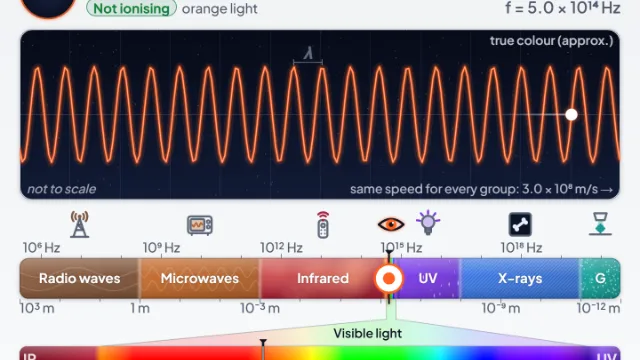
The electromagnetic spectrum simulation shows the wavelengths involved.
- Use Jump to an example to pick Green light, close to the peak of sunlight. Note the Wavelength and Frequency cards.
- Now pick TV remote control. This is infrared, with a longer wavelength than any visible light.
- Drag the Wavelength slider further towards longer waves until it reads about 10 µm, the infrared given out by the warm ground. It is still in the Infrared group, but its wavelength is about 20 times that of green light.