What thermal insulation does
A thermal insulator is a material or design that slows down the flow of heat. Insulation does not create cold or warmth; it simply cuts down the rate at which energy moves between an object and its surroundings. That means it works both ways: it keeps hot things hot and cold things cold.
To insulate well, a design has to tackle all three methods of transfer:
- conduction is reduced by poor conductors, especially trapped air, and best of all by a vacuum;
- convection is reduced by stopping the air or liquid from flowing, for example by trapping it in tiny pockets or sealing a gap;
- radiation is reduced by shiny, silvered surfaces, which are poor emitters and good reflectors of infrared.
The vacuum flask
A vacuum flask (thermos flask) can keep tea hot or juice chilled for many hours. Every part has a job:
| Part | What it reduces | How |
|---|---|---|
| double wall with a vacuum between | conduction and convection | no particles in the gap, so nothing to pass energy along or to flow |
| silvered surfaces facing the vacuum | radiation | the shiny inner wall emits little infrared, and the shiny outer wall reflects it back towards the drink |
| stopper of plastic or cork | conduction, convection and evaporation at the top | a poor conductor; closing the top keeps the warm air and water vapour inside |
| outer casing of plastic or steel, with insulating supports | conduction to the outside and accidental damage | holds the fragile inner vessel in place, touching it only at a few small points |
The flask cannot stop heat flow completely. A little energy is still conducted through the walls at the neck and the supports, and some infrared still crosses the vacuum. So even the best flask of tea cools slowly over a day.
For a cold drink the same features work in reverse: they slow the heat flowing in from the warm room, so the drink stays cool.
Insulating buildings
Most of the energy a building gains or loses passes through its roof, walls, windows and doors, and through gaps around them. Good insulation keeps a house warm in a Murree winter and cool in a Multan summer, cutting the use of heaters and air conditioners and so lowering electricity and gas bills. Common measures:
- Foam or fibre in the walls and roof. Materials such as polystyrene foam and glass wool trap air in countless tiny pockets. Air is a very poor conductor, and air that cannot move cannot form convection currents.
- False ceilings. A layer of trapped air between the roof and the room below acts as a barrier against heat from a sun-baked roof.
- Double glazing. A window is made from a pair of glass sheets with a narrow sealed gap of dry air (or sometimes a partial vacuum) in the middle. The gap conducts heat poorly and is too narrow for strong convection.
- Thick curtains trap a layer of still air against the window at night.
- Shading outside the windows, such as awnings, blinds or trees, stops direct sunlight from entering and heating the rooms in summer.
- Good ventilation and draught control: letting cool night air flow through in summer, and sealing gaps around doors and windows in winter so warm air cannot leak out.
(Going a little beyond the book: painting a flat roof white or silver reflects much of the summer sunshine and keeps the rooms below noticeably cooler.)
Other everyday examples
- Woollen clothes and quilts trap air between their fibres.
- Birds fluff up their feathers on cold days to hold a thicker layer of still air.
- Polystyrene cool boxes and food containers keep ice from melting and takeaway meals hot.
- Pan handles of wood or plastic are poor conductors, so they stay safe to hold (see conduction).
Worked numerical (beyond the book): a flask against a mug
This uses from Chapter 10, treating tea as water, so its specific heat capacity is .
In a flask, 0.50 kg of tea cools from 80 °C to 70 °C in 6.0 hours.
Average rate of heat loss .
In an open mug, 0.25 kg of tea cools from 80 °C to 40 °C in 30 minutes.
Average rate , about 24 times as fast as the flask.
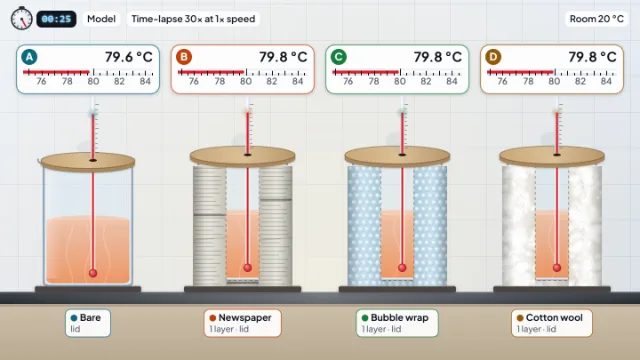
Insulation in the simulation
The simulation is a beaker-cooling experiment that tests insulating materials.
- Under Set-up, choose Materials to compare beakers in different wrappings, such as Bubble wrap, Cotton wool, Expanded polystyrene and Aluminium foil, against one with No insulation. Press Record at each minute and compare the cooling curves.
- Choose Lids to see how much a Card lid reduces the loss from the open top, where hot water evaporates and warm air rises away.
- Choose Layers and change the number of Layers to see thicker insulation slow the cooling further.