Skip to content

Punjab Board Class 10 Physics · Chapter 11: Transfer of thermal energy

Conduction

Section 11.1

Conduction passes heat through a material by collisions between neighbouring particles, while the material stays put. Hotter particles vibrate harder and jostle the next ones. Metals conduct far better than non-metals as their free electrons rush energy from the hot regions into the cold ones.

Loading simulation…

Symbols match your course. Open the full conduction, convection and radiation simulation for more presets and teacher tools.

Heat always flows from hot to cold

Put a hot object next to a cooler one and thermal energy moves from the hotter to the cooler until both reach the same temperature. That final state is called thermal equilibrium, and once it is reached there is no further net flow. Chapter 11 describes three ways this transfer can happen: conduction, convection and radiation. This page covers the first.

What conduction is

Conduction is heat transfer in which energy is handed on from particle to particle by collisions, while the material as a whole stays where it is. Nothing flows from one end of a hot rod to the other; only energy is handed along.

It works best in solids, because their particles are packed tightly and are already touching their neighbours. It is weak in liquids and very weak in gases, where the particles are further apart and meet each other less often.

Conduction by vibrating particles

In any solid the atoms or molecules are held in a fixed pattern called a lattice, and they are always vibrating about their mean positions. Suppose one end of a solid bar is held in a flame:

  1. The particles at the heated end take in energy, so they swing further and faster about their positions.
  2. As they shake, they bump into the particles next to them and pass on part of that energy.
  3. Those neighbours now vibrate harder and jostle the next layer, and so on along the bar.

Heat therefore creeps from the hot end towards the cold end. This process happens in every solid, metal or non-metal, but on its own it is slow, so only a small amount of energy moves along each second.

Why metals conduct so much better

Metals have an extra way of carrying heat. Some of the electrons in a metal are not tied to any one atom: these free (delocalised) electrons drift through the whole lattice. At the hot end they gain a lot of kinetic energy, race off into cooler parts of the metal and hand that energy over when they collide with atoms there.

Because free electrons move much faster and further than vibrations can travel through the lattice, metals are good conductors of heat. Wood, plastic, glass, cloth and air have almost no free electrons, so they are poor conductors, also called thermal insulators.

This explains a familiar test: leave a steel spoon in a cup of hot tea next to a wooden one. Within a minute the steel handle feels warm, while the wooden handle stays cool.

How good is each material?

Going a little beyond the book, physicists give each material a thermal conductivity: the larger the number, the faster heat passes through a sample of a given size. Rough values near room temperature:

MaterialThermal conductivity (W m⁻¹ K⁻¹)Good or poor conductor?
copper400very good
aluminium240very good
steel50good
glass1poor
water0.6poor
wood0.15very poor
air0.025extremely poor

Air is the worst conductor on the list. That is why many insulating materials, such as wool, foam and feathers, are mostly trapped pockets of still air.

Conduction in the kitchen

A cooking pan is a neat example of choosing materials on purpose:

  • the base and sides are made of a metal such as aluminium, steel or copper, so heat from the flame passes quickly and evenly through to the food;
  • the handle is made of wood, plastic or another poor conductor, so it stays cool enough to hold.

The same thinking explains why a metal bench feels colder than a wooden one on a winter morning, even though both are at the same air temperature. Metal conducts heat away from your hand quickly, so your skin cools; wood takes heat away slowly, so it feels warmer.

Worked numerical (beyond the book): comparing conductors

The book has no conduction numericals, so this one is extra practice using the table above.

A copper rod and a steel rod have identical lengths and thicknesses, and one end of each is placed in the same flame. Roughly how many times faster does heat flow along the copper rod?

For rods of the same size and the same temperature difference, the rate of heat flow is proportional to the thermal conductivity:

rate in copperrate in steel=40050=8\frac{\text{rate in copper}}{\text{rate in steel}} = \frac{400}{50} = 8

Heat travels along the copper about 8 times as fast, so wax stuck to the copper rod melts first.

Conduction in the simulation

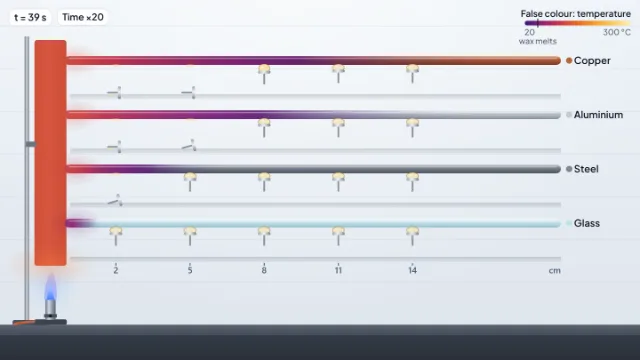
Choose Conduction: rods and wax under Experiment. Four rods (copper, aluminium, steel and glass) are heated by one block, and wax holds a row of pins along every rod.

  1. Watch the pins fall. Copper drops its pins first, then aluminium, then steel, matching the order in the table. Glass barely warms.
  2. Change the Block temperature and see how a bigger temperature difference makes every rod warm faster.
  3. Turn off Rods lose energy to the air for an ideal case in which, given time, every rod reaches the temperature of the block.
Common mistakes

  • Saying that in conduction the hot particles travel from one end of the rod to the other. In a solid the atoms stay in their places; only energy is passed along from one particle to the next.
  • Explaining metal conduction only by vibrating atoms. Metals conduct well mainly because their free electrons move quickly through the lattice and carry energy with them.
  • Writing that cold flows from an object into your hand. Only thermal energy flows, and always from hotter to cooler.
  • Thinking a metal bench is at a lower temperature than a wooden one beside it. Both are at the same temperature; the metal only feels colder because it conducts heat away from the skin faster.
  • Calling a poor conductor a material that stops heat completely. Insulators still conduct, just very slowly.
  • Claiming that liquids and gases are good conductors because their particles move freely. Their particles are far apart, so they conduct very badly.

Exam practice

Exam-style questions

Original questions written in the style of Punjab board exams. Try each one before you reveal the answer.

  1. 1.A student holds one end of a copper rod and puts the other end in a gas flame.

    1. (a)Define conduction.

      1 mark
      Show the answer

      Answer: Conduction is the transfer of heat through a material by collisions between neighbouring particles, without the material itself moving.

      Marking points

      • Heat passed from particle to particle with no movement of the material as a whole
    2. (b)Describe how heat reaches the cool end of the rod by the vibration of its atoms.

      3 marks
      Show the answer

      Answer: Atoms at the hot end gain kinetic energy and vibrate with larger amplitude. They collide with the atoms next to them and pass on some of this energy. Those atoms vibrate harder in turn, so energy is passed along the lattice towards the cool end.

      Marking points

      • Atoms at the hot end vibrate more strongly
      • They collide with neighbouring atoms and pass on energy
      • The process repeats along the rod towards the cooler end
    3. (c)Explain why the student's hand warms much sooner than it would with a glass rod of the same size.

      2 marks
      Show the answer

      Answer: Copper is a metal with free electrons. These pick up energy where the rod is hot and dash through the metal, delivering it to the cool end far faster than vibrations alone. Glass has almost no free electrons.

      Marking points

      • Copper has free (delocalised) electrons; glass does not
      • Free electrons move fast and carry energy quickly to the cool end
  2. 2.On a cold morning, a girl touches an iron gate and a wooden fence post that have been outside all night.

    1. (a)Both are at the same temperature. Explain why the iron feels much colder.

      2 marks
      Show the answer

      Answer: Iron is a good conductor, so it carries heat away from her hand quickly and her skin cools. Wood is a poor conductor, so it removes heat from the skin only slowly.

      Marking points

      • Iron conducts heat away from the hand quickly
      • Wood is a poor conductor, so the skin loses heat slowly
    2. (b)State what happens to the flow of heat between her hand and the gate if she keeps her hand on it for a long time.

      1 mark
      Show the answer

      Answer: Heat flows from her hand to the gate until the touching surfaces reach the same temperature; then there is no net flow.

      Marking points

      • Flow continues until the temperatures are equal (thermal equilibrium), then stops
  3. 3.A frying pan has an aluminium body and a plastic handle.

    1. (a)Explain why aluminium is used for the body of the pan.

      2 marks
      Show the answer

      Answer: Aluminium is a good conductor of heat, so energy from the flame passes quickly through the base to the food and spreads evenly over the pan.

      Marking points

      • Aluminium is a good thermal conductor
      • Heat reaches the food quickly and evenly
    2. (b)Give a reason for making the handle out of plastic.

      2 marks
      Show the answer

      Answer: It is a poor conductor (an insulator), so very little heat passes along the handle and it stays cool enough to hold safely.

      Marking points

      • Plastic is a poor conductor / insulator
      • Handle stays cool and safe to hold

Quiz

Quick check

6 questions

  1. 1.Conduction of heat is most effective in:
  2. 2.The main reason metals are good conductors of heat is that they have:
  3. 3.During conduction along a solid rod, the atoms of the rod:
  4. 4.Which of these is the poorest conductor of heat?
  5. 5.A tile floor feels colder to bare feet than a carpet in the same room because the tile:
  6. 6.Heat flows by conduction between two objects in contact until they:

Related articles

Next step

Now see it move

Open the full conduction, convection and radiation simulation for every preset, graphs and the teacher tools, then test yourself.

Conduction, convection and radiation simulation: waxed rods, a convection current traced with dye and a Leslie cube