A wire with no resistance at all
Every ordinary wire wastes some energy. Push a current through a copper cable and part of the electrical energy turns into heat, which is why chargers get warm and long power lines lose some of what they carry. Now picture a wire in which a current could flow forever with no loss at all. Such materials exist, but only when they are made extremely cold. This is superconductivity, section 10.6 of your book.
Superconductivity: the property of some materials of having zero electrical resistance when they are cooled below a certain temperature.
Critical temperature : the temperature below which a material becomes a superconductor. Above it, the material behaves as an ordinary conductor with resistance.
Why resistance usually exists
Current in a metal is carried by free electrons drifting past a regular arrangement of positive ions. The ions are always vibrating. As the electrons drift along, they keep colliding with these vibrating ions and lose energy, which heats the wire. Those collisions are what we measure as resistance. You met resistance in Chapter 16 on the resistivity page.
Cooling a metal makes its ions vibrate less, with less kinetic energy, so there are fewer collisions and the resistance falls. In an ordinary metal it falls gradually and levels off at a small value: it never quite reaches zero.
What happens in a superconductor
A superconductor behaves differently. As it cools, its resistance falls like any metal's, until it reaches the critical temperature. There the resistance drops suddenly to zero. Below the electrons move through the material without being scattered, so a current meets no resistance and no electrical energy is turned into heat.
Sketch the graph your book shows, with resistivity up the side and temperature in kelvin along the bottom:
- Ordinary metal: a curve that slopes gently down as the temperature falls and flattens out above zero.
- Superconductor: a curve that falls as it cools, then drops vertically to zero at and stays at zero for all lower temperatures.
Which materials, and how cold?
| Material | Critical temperature (K) | In °C (about) |
|---|---|---|
| Mercury | 4.2 | −269 |
| Lead | 7.2 | −266 |
| High-temperature superconductors (ceramics) | up to about 135 | −138 |
To convert, subtract 273 from the kelvin value. Metals such as mercury and lead superconduct only a few kelvin above absolute zero (0 K, about −273 °C). Certain ceramics, compounds containing copper and oxygen, work at much "higher" temperatures, though 135 K is still about −138 °C. They are called high-temperature superconductors only by comparison.
That is why superconductors need such extreme cold: their special state exists only below , and for every known material at ordinary pressure, is far below room temperature.
Uses of superconductors
- MRI scanners. Coils of superconducting wire carry very large currents without overheating, producing the strong, steady magnetic fields needed for detailed images of the inside of the body.
- Maglev trains. Powerful superconducting magnets lift the train so it floats just above the track. With no wheels touching the rails, friction is almost eliminated and very high speeds are possible.
- Particle accelerators. Superconducting magnets steer and focus beams of particles travelling close to the speed of light, so that scientists can study the fundamental particles of matter.
Because no energy is lost as heat, superconductors could make electrical systems far more efficient in future, for example in power cables. The main obstacle is the cost of keeping them cold.
Worked numerical 1: converting critical temperatures
Express the critical temperatures of mercury (4.2 K) and of a ceramic superconductor (135 K) in degrees Celsius.
Worked numerical 2: what is saved
A cable with a resistance of 0.50 Ω carries a current of 200 A. Using from Chapter 16 on electric power, find the power wasted as heat. What would it be if the cable were superconducting?
For a superconducting cable, , so
No heat at all is produced by the current, although energy is still needed to keep the cable cold.
Worked numerical 3: is liquid nitrogen cold enough?
Liquid nitrogen boils at −196 °C. Which of mercury, lead and the 135 K ceramic would superconduct if cooled with it?
A material superconducts only below its own . Mercury (4.2 K) and lead (7.2 K) need to be far colder than 77 K, so they stay ordinary conductors. The ceramic, with of about 135 K, is below its critical temperature at 77 K, so only the ceramic becomes a superconductor.
Superconductivity in the simulation
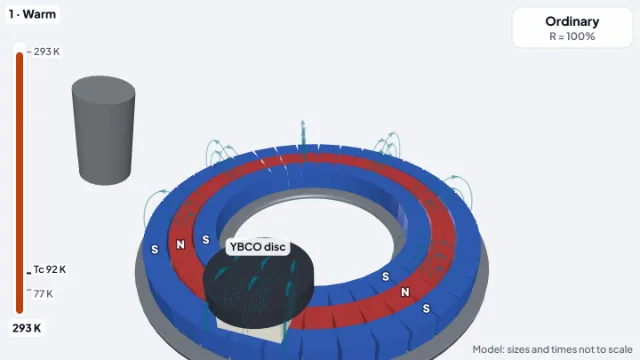
This 3D simulation goes beyond the book. It shows a ceramic disc of YBCO (critical temperature about 92 K) being cooled and then floating over a track of magnets.
- Press Pour liquid nitrogen. Watch the Temperature and Resistance rows in What changed: once the disc is below its critical temperature, the resistance reads Zero and the disc row changes from Ordinary material to Superconductor.
- Press Pull out the spacer. The disc stays floating at the height it was cooled at.
- With Give it a push, the disc circles the track with almost no friction, the idea behind maglev trains.
- Press Warm it up. Above the critical temperature the disc is an ordinary material again, and it drops.
The levitating disc also has its own page, the superconductor levitation simulation, one of our Science Frontiers collection of real effects that look impossible at first sight.