Why a steel ruler lies in summer
A steel ruler marked at 20 °C is very slightly longer on a scorching afternoon in Multan and slightly shorter on a frosty night in Murree. You would never see the difference by eye, but it is real. Almost every solid grows a little when it is warmed and shrinks a little when it is cooled. Section 10.1 of your book calls this thermal expansion.
Thermal expansion: the growth in a body's length, area or volume as its temperature goes up. The opposite, shrinking on cooling, is thermal contraction.
What the particles are doing
The atoms in a solid are held in fixed places by strong forces, but they are never still: each one vibrates about its own position.
- When the solid is heated, the atoms gain kinetic energy and vibrate with a larger amplitude. Each atom shoves harder on its neighbours, so on average they sit a little further apart. Added up over billions of atoms, that tiny extra spacing becomes a change you can measure.
- When the solid is cooled, the vibrations die down and the atoms settle slightly closer together, so the solid contracts.
The atoms themselves do not swell. Only the spaces between them change. You met the particle picture of solids in the Class 9 kinetic molecular theory page.
Linear expansion
When we care mostly about a change in length, as with a rod, a rail or a wire, we call it linear thermal expansion. Suppose a rod is long at temperature and long at a higher temperature :
Experiments show that the increase in length is proportional to the original length and to the rise in temperature. A rod twice as long grows twice as much, and a rise of 40 K gives twice the growth of a rise of 20 K. Bringing in a constant for the material:
Rearranging gives the length after heating:
and the constant itself:
Coefficient of linear expansion : the fractional increase in length, , for each kelvin rise in temperature. Its unit is . Steps of one kelvin and one degree Celsius are equal in size, so a value "per °C" is numerically identical.
A material with a larger grows more for the same heating. Some values from Table 10.1 of the book:
| Material | α (K⁻¹) |
|---|---|
| Aluminium | 2.4 × 10⁻⁵ |
| Brass | 1.9 × 10⁻⁵ |
| Copper | 1.7 × 10⁻⁵ |
| Steel | 1.2 × 10⁻⁵ |
| Concrete | 1.2 × 10⁻⁵ |
| Ordinary glass | 0.9 × 10⁻⁵ |
| Pyrex glass | 0.4 × 10⁻⁵ |
These numbers are tiny. A steel bar 1 m long warmed by 1 K grows by only 0.000012 m, about a hundredth of a millimetre. That is why you rarely notice expansion until the objects are long (bridges, railway lines) or the temperature changes are large.
Volume expansion
A heated solid does not just get longer: it grows in every direction, so its volume increases too. This is volume thermal expansion. If the volume is at and at , then in the same way
Coefficient of volume expansion : the fractional increase in volume for each kelvin rise in temperature, also measured in . Each solid has its own value of .
Why does the whole block grow outwards? Every atom pushes a little harder on the atoms all round it. There is no empty space inside a solid for the atoms to move into, so the only way the structure can make room is by spreading out at its surfaces.
Worked numerical 1: a hot-water pipe
A copper hot-water pipe is 4.0 m long at 15 °C. Hot water warms it to 65 °C. By how much does it lengthen? ()
Data: ,
The pipe grows by 3.4 mm. Plumbers leave room for this, or the pipe bends or pulls at its joints.
Worked numerical 2: which metal is it?
A 0.80 m rod is heated from 20 °C to 120 °C and its length increases by 0.96 mm. Find and use the table to suggest the material.
Data: , ,
That matches steel in the table. Convert the millimetres to metres first, or the answer comes out a thousand times too big.
Worked numerical 3: the new length
A brass rod is 2.50 m long at 10 °C. What is its length at 90 °C? ()
The rod is now about 2.504 m long, 3.8 mm longer than before.
Worked numerical 4: a block grows in volume
An aluminium block has a volume of 500 cm³ at 20 °C. It is heated to 80 °C. Taking , find the increase in volume.
The block gains about 2.2 cm³. Because was in cm³, the answer comes out in cm³ as well: no conversion is needed as long as you stay consistent.
What decides how much a solid expands
Putting the equation into words, a solid expands more when:
- it is longer (or bigger) to begin with;
- its temperature rises more;
- it is made of a material with a larger coefficient of expansion.
These are the three factors behind short question 10.1 in the exercise. Where the expansion matters in daily life, from railway gaps to jar lids, is covered on the next page, uses and consequences of thermal expansion. Liquids and gases are on the expansion of liquids and gases page.
Expanding rods in the simulation
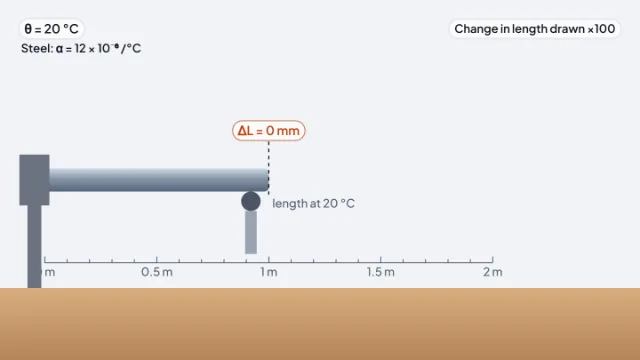
- Choose the Rod scene. Pick Steel as the Material and raise the Temperature. Read the Change in length card, then double the Length at 20 °C and watch the change in length double too.
- Keep the temperature fixed and switch the Material between Aluminium, Copper and Glass. The Linear expansivity card shows each value of α. The simulation rounds aluminium to 23 × 10⁻⁶ per °C, very close to the book's 2.4 × 10⁻⁵ K⁻¹.
- Switch off Magnify the change in length to see how small the real change is when it is drawn to scale.
- Lower the temperature below 20 °C: the rod contracts and the change in length becomes negative.