Ice, water and steam from one kettle
Drop an ice cube into a pan and switch on the stove. First the cube shrinks into a puddle, then the puddle warms, then it bubbles and disappears into the air as steam. The water molecules are the same throughout: what changes is how much energy they have and how tightly they hold on to one another. Section 10.3 of your book calls this a change in state.
Energy in, energy out
A substance changes state when it gains or loses enough energy.
- Gaining energy: the particles move more vigorously and need more room. A solid can turn into a liquid (melting), and a liquid can turn into a gas (boiling, or more slowly, evaporation).
- Losing energy: the particles slow down and draw closer together. A gas can turn into a liquid (condensation), and a liquid can turn into a solid (solidification, also called freezing).
| Change | From | To | Energy |
|---|---|---|---|
| Melting | solid | liquid | taken in |
| Boiling | liquid | gas | taken in |
| Condensation | gas | liquid | given out |
| Solidification (freezing) | liquid | solid | given out |
A particle picture of each state
Picture the three states one at a time:
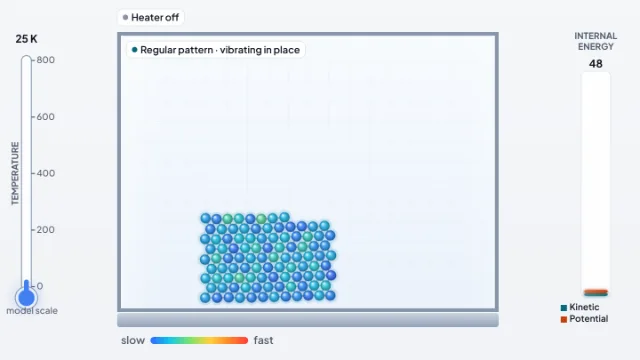
- Solid: particles packed closely in a regular pattern, held by strong forces, vibrating about fixed positions.
- Liquid: particles still close together but no longer in fixed places; they slide past one another, so a liquid flows and takes the shape of its container.
- Gas: particles far apart, moving fast in all directions, with only very weak forces between them.
Particles attract each other most strongly in a solid, where they sit closest, and most weakly in a gas, where they are widest apart. That is also why gases show the biggest thermal expansion and solids the smallest, as the liquids and gases page explains.
Melting point and boiling point
Every pure substance melts at its own fixed temperature, the melting point. Its liquid freezes at exactly the same temperature, so the melting point and the freezing point are one and the same. Likewise, each liquid boils at a fixed boiling point at normal air pressure, and its vapour condenses at that temperature too. Some values from the book's Table 10.2:
| Substance | Melting point (°C) | Boiling point (°C) |
|---|---|---|
| Water | 0 | 100 |
| Mercury | −39 | 357 |
| Lead | 327 | 1750 |
| Nitrogen | −210 | −196 |
| Oxygen | −219 | −183 |
A substance below its melting point is a solid. Between its melting and boiling points it is a liquid. Above its boiling point it is a gas.
What the temperature does during a change
Heat a block of ice steadily and watch a thermometer in it.
- The ice warms up until it reaches 0 °C. The energy going in makes the molecules vibrate faster, so the temperature rises.
- At 0 °C the ice begins to melt. Heat keeps flowing in, yet the thermometer reading holds at 0 °C for as long as any ice is left. The energy now goes into pulling the molecules out of their fixed pattern, not into speeding them up.
- Once it is all water, the temperature rises again, up to 100 °C.
- At 100 °C the water boils, and once more the temperature holds steady until all the water has become steam.
The energy taken in without a change in temperature is called latent heat, which has its own page: latent heat of fusion and vaporisation. Going the other way, a liquid that is freezing or a vapour that is condensing gives out energy, again at a steady temperature.
Worked numerical 1: which state?
Use the table to give the state of each substance at normal air pressure.
- Mercury at −50 °C: below its melting point of −39 °C, so solid.
- Nitrogen at −200 °C: between −210 °C and −196 °C, so liquid.
- Lead at 400 °C: above 327 °C but well below 1750 °C, so liquid.
- Oxygen at −190 °C: between −219 °C and −183 °C, so liquid.
- Water at 120 °C: above 100 °C, so gas (steam).
Worked numerical 2: warming ice up to its melting point
A 0.50 kg block of ice is taken from a freezer at −20 °C. How much energy does it need just to reach 0 °C? Take the specific heat capacity of ice as 2100 J kg⁻¹ K⁻¹ (this value is not in the book).
That energy only brings the ice to 0 °C. Melting it needs a further, much larger amount, worked out with the latent heat. The formula used here is from the specific heat capacity page.
Worked numerical 3: lead heated to its melting point
2.0 kg of lead at 27 °C is heated until it just reaches its melting point. Taking J kg⁻¹ K⁻¹ for lead, find the energy needed.
At 327 °C the lead is still solid. Only extra energy, with no further rise in temperature, turns it into liquid.
Changes of state in the simulation
- Set the View to States of matter and Start from Solid. Turn on Arrangement labels.
- Press Heat. The particles shake harder until the pattern starts to break up, then slide past each other as a liquid, then fly apart as a gas.
- Watch the Internal energy bars. While the pattern breaks up, most of the energy going in shows up in the Potential bar rather than the Kinetic one, so the temperature rises far more slowly. That is the latent heat at work.
- Press Cool and run it backwards: condensing, then freezing back into a regular pattern.
- For a real temperature–time graph, try the Heating curve experiment in the latent heat simulation.