Skip to content

Punjab Board Class 10 Physics · Chapter 10: Thermal physics

Uses and consequences of thermal expansion

Section 10.1

Thermal expansion is useful in thermometers, hot-air balloons and for loosening tight metal lids. It also causes problems, so engineers leave gaps in railway tracks, fit expansion joints to bridges, hang power cables with slack, add loops to pipes and keep gas cans away from heat.

Loading simulation…

Symbols match your course. Open the full thermal expansion simulation for more presets and teacher tools.

Why railway lines have gaps

Walk beside an older railway line and you will see a small gap every few metres where one length of rail meets the next. It is not careless work. On a hot June afternoon the steel grows, and without those gaps the rails would push against each other until the track bent sideways. Engineers cannot stop thermal expansion, so they either make room for it or put it to work. This page goes through the examples in section 10.1 of your book, then works out how big the effects really are.

Making use of expansion

1. Liquid-in-glass thermometers. A small bulb of mercury or coloured alcohol joins a very narrow tube. When the bulb warms, the liquid expands far more than the glass around it, and because the tube is so fine, a tiny increase in volume pushes the thread a long way up the scale.

2. Loosening a tight metal lid. Hold a stuck metal lid of a glass jar under warm water for a minute. Metal expands more than glass for the same rise in temperature, so the lid grows slightly away from the glass and twists off more easily.

3. Hot-air balloons. A burner heats the air inside the envelope. The warm air expands, its density falls below that of the cool air outside, and the balloon is pushed upwards. The liquids and gases page explains why gases expand so much.

Problems that expansion causes, and the fixes

4. Railway tracks. Steel rails lengthen in summer. If they have no room, the forces become so large that the track buckles into a sideways bend, sometimes called a sun kink, which can derail a train. Leaving small gaps at the joints gives the rails space to grow.

5. Bridges. A long bridge can change length by several centimetres between a winter night and a summer afternoon. Expansion joints, often interlocking metal "fingers" across a gap in the road deck, let each section grow and shrink without cracking the concrete or bending the supports.

6. Gas containers. Aerosol cans and gas cylinders left in hot sun can burst, because the gas inside is heated but cannot expand, so its pressure rises. That is why such containers carry "store away from heat" warnings, and larger cylinders are fitted with pressure relief valves.

7. Pipes and plumbing. Hot-water pipes lengthen and shorten every time hot water runs through them. Bends, loops and flexible joints in the pipework take up the movement, so joints do not leak and pipes do not split.

8. Overhead wires. Electricity cables strung between poles are put up with some slack. In summer they lengthen and sag further; in winter they contract and pull tighter. If they were hung tight in summer, winter contraction could snap them or pull over the poles.

Worked numerical 1: how big should the rail gap be?

Steel rails 12 m long are laid at 20 °C. The hottest the rails get in summer is 50 °C. What is the smallest gap to leave? Steel's coefficient is 1.2×10−51.2 \times 10^{-5} per kelvin.

The temperature rise is 50−20=30 K50 - 20 = 30\ \text{K} and Lo=12 mL_o = 12\ \text{m}, so

ΔL=(1.2×10⁻⁵)(12)(30)=4.32×10⁻³ m\Delta L = (1.2 \times 10^{-5})(12)(30) = 4.32 \times 10^{-3}\ \text{m}

Each rail grows by about 4.3 mm, so a gap of at least that size is needed. In practice a little more is left for safety.

Worked numerical 2: a long steel bridge

A steel bridge is 200 m long. Its temperature ranges from −5 °C on a winter night to 45 °C in the summer sun. How much does its length change?

ΔT=45−(−5)=50 K\Delta T = 45 - (-5) = 50\ \text{K} ΔL=1.2×10−5×200×50=0.12 m\Delta L = 1.2 \times 10^{-5} \times 200 \times 50 = 0.12\ \text{m}

A change of 12 cm is far too much to ignore, which is why long bridges need proper expansion joints rather than a small gap.

Worked numerical 3: the stuck lid

An aluminium lid on a glass jar has a diameter of 7.0 cm. Warm water raises both by 40 K. Compare how much each diameter grows. (Aluminium α=2.4×10⁻⁵ K−1\alpha = 2.4 \times 10^{-5}\ \text{K}^{-1}; ordinary glass α=0.9×10⁻⁵ K−1\alpha = 0.9 \times 10^{-5}\ \text{K}^{-1})

ΔLlid=2.4×10−5×7.0×40=6.72×10⁻³ cm\Delta L_\text{lid} = 2.4 \times 10^{-5} \times 7.0 \times 40 = 6.72 \times 10^{-3}\ \text{cm} ΔLglass=0.9×10−5×7.0×40=2.52×10⁻³ cm\Delta L_\text{glass} = 0.9 \times 10^{-5} \times 7.0 \times 40 = 2.52 \times 10^{-3}\ \text{cm}

The lid grows by nearly three times as much as the glass rim, about 0.04 mm more. That is enough to break the grip. In practice the warm water reaches the lid first, which helps even more.

Worked numerical 4: a sagging cable

An aluminium cable spans 50 m between two pylons. Between a 5 °C winter day and a 45 °C summer day, how much longer does it become?

ΔL=2.4×10−5×50×40=0.048 m\Delta L = 2.4 \times 10^{-5} \times 50 \times 40 = 0.048\ \text{m}

The extra 4.8 cm of cable has nowhere to go but down, so the cable visibly sags more in summer.

Thinking it through: summer, not winter

The book's brain teaser asks why tracks buckle in summer but not in winter, when the metal is the same. In winter the rails contract, so the gaps simply open wider: the rails are pulled, not squeezed, and a slightly wider gap does no harm. In summer the rails expand into the gaps, and once a gap closes the rails squeeze each other with huge forces. A long, thin rail under compression bends sideways easily, so buckling is a hot-weather problem.

How fast heat reaches these objects in the first place is the subject of Chapter 11: see conduction.

Expansion at work in the simulation

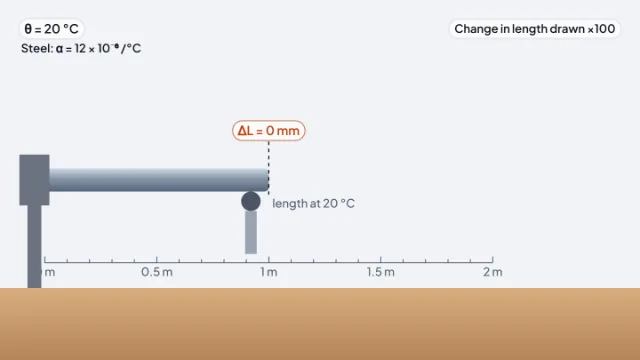
  1. Choose the Uses scene. Slide the Temperature from its lowest to its highest value and watch the Gap at a rail joint card shrink.
  2. Keep going until the gap closes: the stage warns that the rails are pushing and may buckle.
  3. Watch the Cable sag card at the same time: the hotter the day, the lower the cable hangs.
  4. Read the Thermometer reads card. The mercury thread rises because the mercury expands more than its glass bulb.
  5. For the bimetallic strip from the callout, choose the Strip scene, set different metals for the Top layer and Bottom layer, and heat it.
Common mistakes

  • Saying rail gaps are there to stop the rails contracting in winter. They give the rails room to expand in summer; contraction only widens the gaps.
  • Claiming that overhead wires are tight in summer. They lengthen when hot, so they sag more in summer and are tighter in winter.
  • Explaining the warm-water trick for a jar lid by saying the glass shrinks. The metal lid expands more than the glass, so it loosens.
  • Saying a heated aerosol can explodes because the gas expands. The can stops the gas expanding, so its pressure rises until the can fails.
  • Forgetting the minus sign when a temperature range starts below zero: from −5 °C to 45 °C the rise is 50 K, not 40 K.
  • Writing only 'because of expansion' in a why question. Say which part expands, when, and how the design makes room for it.

Exam practice

Exam-style questions

Original questions written in the style of Punjab board exams. Try each one before you reveal the answer.

  1. 1.Steel railway rails, each 15 m long, are laid at 25 °C. In summer they can reach 55 °C. For steel, α = 1.2 × 10⁻⁵ K⁻¹.

    1. (a)Work out the least gap that must be left between neighbouring rails.

      3 marks
      Show the answer

      Answer: ΔT = 55 − 25 = 30 K. ΔL = αLₒΔT = 1.2 × 10⁻⁵ × 15 × 30 = 5.4 × 10⁻³ m, so the gap must be at least 5.4 mm.

      Marking points

      • ΔT = 30 K
      • ΔL = αLₒΔT substituted
      • 5.4 mm
    2. (b)Explain what could happen if no gaps were left.

      2 marks
      Show the answer

      Answer: In hot weather the rails would push hard against each other, and the track could buckle sideways, which could derail a train.

      Marking points

      • Rails push on each other as they expand
      • Track buckles / bends, risking derailment
  2. 2.Electricity cables are hung between pylons.

    1. (a)Power lines hang lower in June than in January. Explain this.

      3 marks
      Show the answer

      Answer: In summer the wires are warmer, so they expand and become longer; the extra length hangs lower. In winter they cool and contract, so they become shorter and are pulled tighter.

      Marking points

      • Warmer in summer, so wires expand / get longer
      • Longer wire sags more
      • Contract in winter, so tighter
    2. (b)Suggest why the wires are not hung tightly on a hot day.

      2 marks
      Show the answer

      Answer: In winter they would contract further, and the tension could snap the wires or pull on the pylons.

      Marking points

      • Wires contract in cold weather
      • Could snap / damage the supports
  3. 3.A bridge has expansion joints, but a glass jar with a metal lid has nothing similar.

    1. (a)Suggest why a bridge needs expansion joints.

      2 marks
      Show the answer

      Answer: The bridge is very long and faces a large temperature range, so its change in length (ΔL = αLₒΔT) is several centimetres. Without joints this would crack the deck or damage the supports.

      Marking points

      • Large length so a large change in length
      • Joints let it expand and contract without damage
    2. (b)Suggest why a jar lid can do without them.

      2 marks
      Show the answer

      Answer: The lid is only a few centimetres across and its temperature changes little, so the change in size is a tiny fraction of a millimetre, which the screw thread easily allows.

      Marking points

      • Small original size and small temperature change
      • Expansion is tiny, so no damage
  4. 4.A label on an aerosol can says: 'Pressurised container. Protect from sunlight. Do not expose to temperatures above 50 °C.'

    1. (a)Explain the reason for this warning.

      3 marks
      Show the answer

      Answer: Heating the can heats the gas inside. Its molecules gain speed, so their impacts on the inside of the can become stronger and more frequent. The can is rigid so the gas cannot expand, and its pressure rises until the can could burst.

      Marking points

      • Gas inside is heated, molecules move faster
      • The volume cannot increase in the rigid can
      • Pressure rises; the can may burst

Quiz

Quick check

6 questions

  1. 1.Small gaps are left between lengths of railway track so that:
  2. 2.Overhead power cables sag most:
  3. 3.A tight metal lid on a glass jar is easier to open after running warm water over it because:
  4. 4.A 100 m steel bridge (α = 1.2 × 10⁻⁵ K⁻¹) warms by 40 K. Its increase in length is:
  5. 5.Why can an aerosol can burst if it is left in strong sunlight?
  6. 6.Which of these uses thermal expansion deliberately?

Next step

Now see it move

Open the full thermal expansion simulation for every preset, graphs and the teacher tools, then test yourself.

Thermal expansion simulation: warm or cool a rod of aluminium, brass, copper, steel, glass or invar