Skip to content

Punjab Board Class 10 Physics · Chapter 10: Thermal physics

Latent heat of fusion and vaporisation

Section 10.5

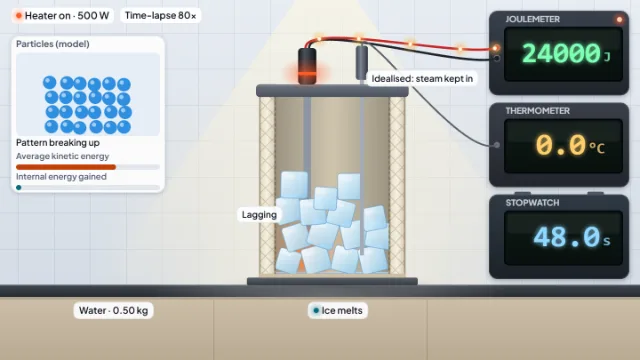
Latent heat changes a substance's state without changing its temperature. Melting needs Q = mL_f, with L_f = 3.36 × 10⁵ J kg⁻¹ for ice. Boiling needs Q = mL_V, with L_V = 2.26 × 10⁶ J kg⁻¹ for water. On a heating curve these show up as flat parts.

Loading simulation…

Symbols match your course. Open the full latent heat and heating curves simulation for more presets and teacher tools.

The heat that hides

Put a thermometer in a glass of crushed ice and leave it on a warm table. Heat flows in from the room all the time, yet the reading sits at 0 °C for many minutes. Only when the last sliver of ice has gone does the temperature start to climb. The heat that went in without showing on the thermometer is called latent heat: "latent" means hidden. Section 10.5 of your book covers it.

Latent heat: energy taken in (or given out) while a material switches state at a steady temperature.

Where the energy goes

While the state is changing, the energy going in does not speed the particles up, and so the thermometer reading stays put. Instead it works against the attractive forces between particles, breaking the bonds that hold them in place. Going the other way, when a liquid freezes or a vapour condenses, bonds re-form and exactly the same amount of energy is given out. The particle picture of each state is on the change of state page.

Melting and the latent heat of fusion

LfL_f, the latent heat of fusion, is the energy that turns one kilogram of a solid, already at its melting point, into liquid without warming it.

The energy to melt a mass mm is:

Q=mLfQ = mL_f

with QQ in joules, mm in kilograms and LfL_f in J kg−1\text{J kg}^{-1}. For ice, the book uses Lf=3.36×10⁵ J kg−1L_f = 3.36 \times 10^5\ \text{J kg}^{-1}: every kilogram of ice at 0 °C must take in 336 000 J to become water at 0 °C.

Latent heat of vaporisation

LVL_V, the latent heat of vaporisation, is the energy that turns one kilogram of a liquid, already at its boiling point, into vapour without warming it.

Q=mLVQ = mL_V

Water's value, which the book gives as 2.26 × 10⁶ J kg⁻¹, means that turning 1 kg of boiling water at 100 °C into steam at 100 °C takes 2 260 000 J.

That is almost seven times the latent heat of fusion. Melting only loosens the particles from their fixed pattern while leaving them touching. Boiling has to pull them completely apart, far enough to form a gas.

SubstanceMelting point (°C)Latent heat of fusion (J kg⁻¹)Boiling point (°C)Latent heat of vaporisation (J kg⁻¹)
Water03.36 × 10⁵1002.26 × 10⁶
Copper10832.05 × 10⁵25954.81 × 10⁶
Lead3272.30 × 10⁴17508.58 × 10⁵
Nitrogen−2102.55 × 10⁴−1962.00 × 10⁵

These come from the book's Table 10.2, which lists them in J g⁻¹. To change J g⁻¹ to J kg⁻¹, multiply by 1000: water's 336 J g⁻¹ is 3.36 × 10⁵ J kg⁻¹.

The heating curve experiment

Experiment 1: melting. Small pieces of ice go into a beaker on a stand over a steady flame or heater, with a thermometer hung in the ice so it does not touch the glass. Read the temperature every half minute and plot temperature against time.

  1. The ice warms up to 0 °C.
  2. While the ice is melting, the line stays level at 0 °C. Note how long this lasts: the melting time.
  3. Once all the ice has melted, the water warms steadily to 100 °C. Note how long that rise takes.

Experiment 2: boiling. Keep heating. The line is level again, now at 100 °C, as the water boils away. Note how long it takes for all of it to turn into steam.

Because the heater gives out energy at a steady rate, the energy supplied is proportional to the time. Call the melting time tmeltt_\text{melt} and the time for the water to warm from 0 °C to 100 °C twarmt_\text{warm}. The same mass of water is involved in both, so mLfmL_f and mc×100 Kmc \times 100\ \text{K} are in the same ratio as the times:

Lf=c×100 K×tmelttwarmL_f = \frac{c \times 100\ \text{K} \times t_\text{melt}}{t_\text{warm}}

The same idea, with the boiling time in place of tmeltt_\text{melt}, gives LVL_V. Both assume that the heater's rate never changes and that no heat is lost, so class results come out only roughly right.

Worked numerical 1: melting ice

A tray of ice cubes holds 250 g of ice, all at 0 °C. How much heat melts it completely?

Data: m=250 g=0.250 kgm = 250\ \text{g} = 0.250\ \text{kg}, Lf=3.36×10⁵ J kg−1L_f = 3.36 \times 10^5\ \text{J kg}^{-1}

Q=mLf=0.250×3.36×105=84 000 J=84 kJQ = mL_f = 0.250 \times 3.36 \times 10^5 = 84\ 000\ \text{J} = 84\ \text{kJ}

Worked numerical 2: boiling water away

How much heat turns 0.40 kg of water at 100 °C completely into steam?

Q=mLV=0.40×2.26×106=9.04×10⁵ JQ = mL_V = 0.40 \times 2.26 \times 10^6 = 9.04 \times 10^5\ \text{J}

Worked numerical 3: a kettle measures the latent heat of vaporisation

A 3.0 kW kettle is left boiling with its lid off for 2.0 minutes. A balance shows that 0.16 kg of water has boiled away. Estimate LVL_V for water.

The kettle supplies 3000 J every second, so in 120 s:

Q=3000×120=360 000 JQ = 3000 \times 120 = 360\ 000\ \text{J} LV=Qm=360 0000.16=2.25×10⁶ J kg−1L_V = \frac{Q}{m} = \frac{360\ 000}{0.16} = 2.25 \times 10^6\ \text{J kg}^{-1}

Very close to the accepted 2.26×1062.26 \times 10^6. A real kettle loses some heat to the air, which would make the estimate a little high.

Worked numerical 4: ice all the way to steam

How much energy turns 0.10 kg of ice at 0 °C into steam at 100 °C? (For water, c=4200c = 4200 J kg⁻¹ K⁻¹.)

Melt the ice: Q1=0.10×3.36×105=33 600 JQ_1 = 0.10 \times 3.36 \times 10^5 = 33\ 600\ \text{J}

Warm the water from 0 °C to 100 °C: Q2=0.10×4200×100=42 000 JQ_2 = 0.10 \times 4200 \times 100 = 42\ 000\ \text{J}

Boil it: Q3=0.10×2.26×106=226 000 JQ_3 = 0.10 \times 2.26 \times 10^6 = 226\ 000\ \text{J}

Q=33 600+42 000+226 000=301 600 J≈3.0×10⁵ JQ = 33\ 600 + 42\ 000 + 226\ 000 = 301\ 600\ \text{J} \approx 3.0 \times 10^5\ \text{J}

Three quarters of the energy goes into the boiling stage alone. For the middle step, see Q=mcΔTQ = mc\Delta T on the specific heat capacity page.

Worked numerical 5: the latent heat of fusion from a graph

In a class experiment, the flat part of the graph at 0 °C lasts 2.0 minutes, and the water then takes 2.5 minutes to warm from 0 °C to 100 °C. Find LfL_f.

Lf=4200×100×2.02.5=336 000 J kg−1=3.36×10⁵ J kg−1L_f = \frac{4200 \times 100 \times 2.0}{2.5} = 336\ 000\ \text{J kg}^{-1} = 3.36 \times 10^5\ \text{J kg}^{-1}

The minutes cancel, so there is no need to convert them to seconds, as long as both times are in the same unit.

Latent heat in the simulation

  1. Choose the Heating curve experiment. Set the Mass of ice and the Heater power, and pick No losses under Insulation.
  2. Press Play and watch the graph go flat twice: once at 0 °C while the Stage card reads Ice melts, and again at 100 °C during Water boils.
  3. Compare the lengths of the two flat parts. The boiling one is far longer, because LVL_V is so much bigger than LfL_f.
  4. Try the Melting practical experiment, with a heated funnel and a control funnel, and read the L from readings card.

The simulation uses 3.34×1053.34 \times 10^5 J kg⁻¹ for ice, the value in most data tables. The book rounds it to 3.36×1053.36 \times 10^5 J kg⁻¹; in your exam, use the book's value or the one given in the question.
Formula sheet

Equations

  • Specific latent heat

    Learn this

    Q=mL

    thermal energy for a change of state = mass × specific latent heat

Common mistakes

  • Using Q = mcΔT while ice is melting. The temperature does not change during melting, so use Q = mL_f.
  • Forgetting to change grams to kilograms: 600 g of ice is 0.600 kg.
  • Mixing up the two latent heats. Fusion (3.36 × 10⁵ J kg⁻¹ for ice) is for melting; vaporisation (2.26 × 10⁶ J kg⁻¹ for water) is for boiling.
  • Thinking latent heat is lost or destroyed. It is stored as the particles move apart, and the same amount is given out again on freezing or condensing.
  • Saying boiling water gets hotter if you heat it more strongly. At its boiling point the extra energy only boils it away faster; the temperature stays at 100 °C.
  • Reading Table 10.2 values in J g⁻¹ as if they were J kg⁻¹. Multiply by 1000 to get J kg⁻¹.

Exam practice

Exam-style questions

Original questions written in the style of Punjab board exams. Try each one before you reveal the answer.

  1. 1.A 500 W electric heater is used to melt ice that is already at 0 °C. Take L_f for ice as 3.36 × 10⁵ J kg⁻¹.

    1. (a)What is meant by the latent heat of fusion of ice?

      2 marks
      Show the answer

      Answer: The heat needed to turn 1 kg of ice at its melting point (0 °C) into water at 0 °C, with no change in temperature.

      Marking points

      • Heat to change 1 kg from solid to liquid
      • At the melting point, with no temperature change
    2. (b)Calculate the heat needed to melt 0.300 kg of ice.

      2 marks
      Show the answer

      Answer: Q = mL_f = 0.300 × 3.36 × 10⁵ = 1.008 × 10⁵ J (about 1.0 × 10⁵ J).

      Marking points

      • Q = mL_f used
      • 1.0 × 10⁵ J
    3. (c)Assuming all the heater's energy goes into the ice, how long does the melting take?

      2 marks
      Show the answer

      Answer: t = Q ÷ P = 100 800 ÷ 500 = 201.6 s, about 200 s (3.4 minutes).

      Marking points

      • t = Q ÷ P
      • About 200 s
  2. 2.Crushed ice in a beaker is warmed by a steady flame. A thermometer is read every 30 seconds, and the readings continue until the water has been boiling for a while.

    1. (a)Sketch and describe the shape of the temperature–time graph.

      3 marks
      Show the answer

      Answer: A rise up to 0 °C; a level section at 0 °C during melting; a steady climb to 100 °C; then a second level section at 100 °C during boiling.

      Marking points

      • Flat section at 0 °C
      • Steady rise from 0 °C to 100 °C
      • Flat section at 100 °C
    2. (b)Explain why the temperature stays constant during the flat parts even though heat is still being supplied.

      2 marks
      Show the answer

      Answer: The energy goes into breaking bonds between the molecules to change the state. Their average kinetic energy does not increase, and temperature depends on that.

      Marking points

      • Energy breaks bonds / changes state
      • Kinetic energy (temperature) does not increase
    3. (c)The flat part at 100 °C lasts much longer than the flat part at 0 °C. Suggest why.

      2 marks
      Show the answer

      Answer: The latent heat of vaporisation of water is much larger than the latent heat of fusion of ice (about seven times), because boiling separates the molecules completely, so much more energy, and so more time, is needed.

      Marking points

      • L_V is much larger than L_f
      • More energy needed to separate molecules completely
  3. 3.For water, L_V = 2.26 × 10⁶ J kg⁻¹.

    1. (a)Explain what this value means.

      1 mark
      Show the answer

      Answer: Each kilogram of boiling water needs 2.26 × 10⁶ J to become steam, with no rise above 100 °C.

      Marking points

      • Energy to turn 1 kg of water at its boiling point into steam at the same temperature
    2. (b)A pan holds 1.5 kg of water that is already boiling. How much more heat is needed to boil it all away?

      2 marks
      Show the answer

      Answer: Q = mL_V = 1.5 × 2.26 × 10⁶ = 3.39 × 10⁶ J.

      Marking points

      • Q = mL_V
      • 3.39 × 10⁶ J

Quiz

Quick check

6 questions

  1. 1.Latent heat is the heat that:
  2. 2.How much heat melts 0.20 kg of ice that is already at its melting point? (L_f = 3.36 × 10⁵ J kg⁻¹)
  3. 3.The unit of specific latent heat is:
  4. 4.Why is the latent heat of vaporisation of water much larger than its latent heat of fusion?
  5. 5.Which gives out heat to its surroundings?
  6. 6.2.0 kg of water at 100 °C is turned completely into steam (L_V = 2.26 × 10⁶ J kg⁻¹). The heat needed is:

Related articles

Next step

Now see it move

Open the full latent heat and heating curves simulation for every preset, graphs and the teacher tools, then test yourself.

Latent heat and heating curves simulation: turn crushed ice into steam on a virtual bench