Skip to content

Punjab Board Class 10 Physics · Chapter 10: Thermal physics

Specific heat capacity

Section 10.2

Specific heat capacity c is the number of joules that make 1 kg of a material 1 K hotter, in J kg⁻¹ K⁻¹. The heat needed is Q = mcΔT. Water's c is very high (4200), so it warms and cools slowly: that keeps coastal weather mild and makes water a good engine coolant.

Loading simulation…

Symbols match your course. Open the full specific heat capacity simulation for more presets and teacher tools.

Same flame, different results

Put a steel pan with 1 kg of water and an empty steel pan of the same mass on two identical burners. Within a minute the empty pan is too hot to touch, while the water is barely warm. The same heat goes in, yet the temperature rise is wildly different. The property behind this is specific heat capacity, section 10.2 of your book.

What decides the heat needed

The energy QQ you must supply to warm something depends on three things:

  1. its mass mm: twice the water needs twice the energy for the same warming;
  2. the change in temperature ΔT\Delta T: a 20 K rise needs twice the energy of a 10 K rise;
  3. the material it is made of: 1 kg of water needs far more energy per degree than 1 kg of alcohol or of steel.

Putting the three together:

Q=mcΔTQ = mc\Delta T

where cc is the specific heat capacity of the material.

Specific heat capacity cc: how many joules it takes to make one kilogram of a material one kelvin (one degree Celsius) hotter. Its SI unit is J kg−1 K−1\text{J kg}^{-1}\ \text{K}^{-1}.

Rearranged for the other quantities:

c=QmΔTΔT=Qmcm=QcΔTc = \frac{Q}{m\Delta T} \qquad \Delta T = \frac{Q}{mc} \qquad m = \frac{Q}{c\Delta T}

A high cc means the substance soaks up plenty of energy for every degree it warms, and hands plenty back for every degree it cools, so its temperature changes sluggishly. A low cc means it heats up and cools down quickly.

Substancec (J kg⁻¹ K⁻¹)
Water4200
Alcohol (ethanol)about 2400
Aluminium900
Dry soil810
Iron450
Copper390
Mercuryabout 140

Water, soil and iron are the values the book uses. The others are typical values from data tables, so use whatever a question gives you.

Solids

For a solid, cc gives the joules per kilogram per degree for that particular solid. Metals such as copper, aluminium and steel have low values: little energy makes them hot, and they lose their heat just as fast. That suits pans, kettles, radiators and engine parts, where you want heat to pass on quickly.

Wood and rubber have higher values than metals. A wooden or plastic handle on a pan stays comfortable mostly because it is a poor conductor of heat; see the Chapter 11 page on conduction. The same idea explains the book's question about why metal feels colder than wood at the same temperature: the metal carries heat away from your hand faster.

Liquids, and why water is special

Liquids are described in the same way, in joules per kilogram per degree. Water's value, 4200 J kg⁻¹ K⁻¹, is one of the highest of any common substance. It can soak up a great deal of energy with only a small rise in temperature, and give it back slowly. Alcohol and mercury have much lower values, so they warm up and cool down faster.

Coasts have milder weather

Dry soil's value is only 810 J kg⁻¹ K⁻¹, about a fifth of water's. Under the same sunshine, the temperature rise of one kilogram of soil is roughly five times that of one kilogram of water. So land heats up fast by day and cools fast at night, while the sea changes temperature only slowly. Towns on the coast, such as Karachi, have far smaller swings between day and night, and between summer and winter, than inland cities such as Jacobabad.

Cooling a car engine

Burning fuel makes an engine very hot, and water's high cc makes it an excellent coolant.

  1. A pump pushes water through channels (a water jacket) around the hot cylinders, where it absorbs heat.
  2. The warm water reaches a thermostat, a valve that opens only once the water is hot enough, letting it through to the radiator.
  3. In the radiator, the water flows through thin tubes while a fan drives air across them, carrying the heat away.
  4. The cooled water returns to the engine to collect more heat, round and round.
  5. A pressure cap releases excess pressure so that the system stays safe.

Because each kilogram of water carries so much energy per degree, a modest flow keeps the engine from overheating.

Worked numerical 1: boiling water for tea

How much energy is needed to heat 1.5 kg of water from 25 °C to 100 °C?

Data: m=1.5m = 1.5 kg, water's cc = 4200 J kg⁻¹ K⁻¹, ΔT=100−25=75\Delta T = 100 - 25 = 75 K

Q=mcΔT=1.5×4200×75=472 500 J≈4.7×10⁵ JQ = mc\Delta T = 1.5 \times 4200 \times 75 = 472\ 500\ \text{J} \approx 4.7 \times 10^{5}\ \text{J}

A 2 kW electric kettle supplies that much energy in about four minutes, if none is wasted.

Worked numerical 2: identifying a metal

Supplying 9000 J to a 0.50 kg block raises its temperature by 20 °C. Find its specific heat capacity and suggest the metal.

c=QmΔT=90000.50×20=900 J kg−1 K−1c = \frac{Q}{m\Delta T} = \frac{9000}{0.50 \times 20} = 900\ \text{J kg}^{-1}\ \text{K}^{-1}

The table points to aluminium.

Worked numerical 3: soil against water

1 kg of dry soil and 1 kg of water each absorb 16 200 J from the Sun. Compare their temperature rises.

ΔTsoil=16 2001×810=20 ∘C\Delta T_\text{soil} = \frac{16\ 200}{1 \times 810} = 20\ ^\circ\text{C} ΔTwater=16 2001×4200≈3.9 ∘C\Delta T_\text{water} = \frac{16\ 200}{1 \times 4200} \approx 3.9\ ^\circ\text{C}

The soil's rise is roughly 5.2 times the water's, which is just the ratio 4200÷8104200 \div 810.

Worked numerical 4: an immersion heater

A 1000 W immersion heater runs for 5.0 minutes in 2.0 kg of water. Assuming no heat is lost, by how much does the water warm?

The heater supplies 1000 J every second. (Energy from power and time, E=PtE = Pt, is in Chapter 16 on electric power.)

Q=1000×300=300 000 JQ = 1000 \times 300 = 300\ 000\ \text{J} ΔT=Qmc=300 0002.0×4200≈36 ∘C\Delta T = \frac{Q}{mc} = \frac{300\ 000}{2.0 \times 4200} \approx 36\ ^\circ\text{C}

In a real beaker some heat escapes to the air, so the measured rise would be a little smaller.

Specific heat capacity in the simulation

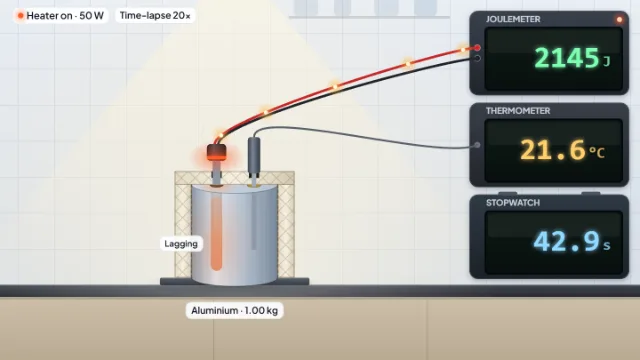
  1. Choose Water in a beaker under Sample (1.00 kg) and set Insulation to No losses. Press Heater and watch the Energy supplied and Temperature cards.
  2. Under Heat a second sample beside it, pick Aluminium. Both have identical heaters, yet the aluminium races ahead: its cc is less than a quarter of water's.
  3. Press Record at a few moments and compare the Measured value of cc with the Accepted one.
  4. Switch Insulation to None and repeat. Some energy now warms the room, so the measured cc comes out too high. Lagging brings it closer.

The simulation gives units as J/(kg °C), which equals the book's J kg⁻¹ K⁻¹.
Formula sheet

Equations

  • Specific heat capacity

    Learn this

    Q=mcΔT

    change in thermal energy = mass × specific heat capacity × temperature change

Common mistakes

  • Leaving the mass in grams. c is quoted per kilogram, so 500 g must go in as 0.5 kg.
  • Using the end temperature as ΔT. The equation wants the change: final minus initial.
  • Thinking a high specific heat capacity means a substance heats up quickly. It is the opposite: a high c means more energy for each degree, so it warms slowly.
  • Confusing specific heat capacity with temperature or with conduction. A wooden handle stays cool mainly because wood conducts heat badly.
  • Converting ΔT to kelvin by adding 273. A temperature change has the same value in °C and in K.
  • Forgetting that a real experiment loses heat to the surroundings, which makes the measured c come out too high.

Exam practice

Exam-style questions

Original questions written in the style of Punjab board exams. Try each one before you reveal the answer.

  1. 1.An iron bar of mass 3.0 kg is heated from 25 °C to 75 °C. For iron, c = 450 J kg⁻¹ K⁻¹.

    1. (a)What is meant by the specific heat capacity of a material?

      2 marks
      Show the answer

      Answer: The number of joules needed to make 1 kg of the material 1 K (1 °C) hotter.

      Marking points

      • Energy per kilogram
      • For a 1 K (1 °C) rise in temperature
    2. (b)Calculate the heat energy the bar absorbs.

      3 marks
      Show the answer

      Answer: ΔT = 50 K. Q = mcΔT = 3.0 × 450 × 50 = 67 500 J (6.75 × 10⁴ J).

      Marking points

      • ΔT = 50 K
      • Q = mcΔT substituted
      • 67 500 J
  2. 2.Two liquids, P and Q, of equal mass are heated by identical heaters for the same time. The temperature of P rises faster.

    1. (a)State what this shows about their specific heat capacities.

      1 mark
      Show the answer

      Answer: P has the smaller specific heat capacity.

      Marking points

      • P has a lower c than Q
    2. (b)Explain your answer using Q = mcΔT.

      2 marks
      Show the answer

      Answer: Both receive the same energy and have the same mass, so ΔT = Q ÷ (mc). A larger temperature rise means a smaller c.

      Marking points

      • Same Q and m
      • ΔT is inversely proportional to c
  3. 3.Cities on the coast have smaller temperature changes between day and night than cities far inland.

    1. (a)Explain this using the specific heat capacities of water (4200 J kg⁻¹ K⁻¹) and dry soil (810 J kg⁻¹ K⁻¹).

      3 marks
      Show the answer

      Answer: Water has a much higher specific heat capacity than soil, about five times. For the same energy from the Sun, the sea warms far less than the land by day, and it releases its stored energy slowly at night. The nearby sea keeps coastal temperatures steadier.

      Marking points

      • Water's c is much larger (about five times soil's)
      • Sea warms and cools much less for the same energy
      • Sea's slow changes keep the coast's temperature steady
  4. 4.A car engine is cooled by water pumped round the cylinders and through a radiator.

    1. (a)Give one reason why water is used as the coolant.

      1 mark
      Show the answer

      Answer: Its high specific heat capacity lets it absorb a lot of heat for only a small rise in temperature.

      Marking points

      • High specific heat capacity
    2. (b)5.0 kg of water in the system warms from 40 °C to 90 °C. Calculate the energy it absorbs.

      2 marks
      Show the answer

      Answer: Q = mcΔT = 5.0 × 4200 × 50 = 1.05 × 10⁶ J.

      Marking points

      • Correct substitution with ΔT = 50 K
      • 1.05 × 10⁶ J
    3. (c)State the job of the thermostat and of the fan.

      2 marks
      Show the answer

      Answer: The thermostat lets water through to the radiator only once it is hot enough. The fan blows air through the radiator to carry heat away from the water.

      Marking points

      • Thermostat controls the flow to the radiator according to temperature
      • Fan drives air over the radiator to cool the water

Quiz

Quick check

6 questions

  1. 1.Which is the correct SI unit for c?
  2. 2.The energy needed to warm 2.0 kg of water by 10 K is (c = 4200 J kg⁻¹ K⁻¹):
  3. 3.Which property tells you how much heat a substance can take in before its temperature changes much?
  4. 4.A 0.20 kg metal block warms by 20 °C when given 3600 J. Its specific heat capacity is:
  5. 5.Land heats up faster than the sea on a sunny day mainly because:
  6. 6.Equal masses of copper (c = 390) and aluminium (c = 900) receive the same energy. Which is true?

Related articles

Next step

Now see it move

Open the full specific heat capacity simulation for every preset, graphs and the teacher tools, then test yourself.

Specific heat capacity simulation: run the classic specific heat capacity practical on a virtual bench