Skip to content

Punjab Board Class 10 Physics · Chapter 10: Thermal physics

Evaporation and cooling

Section 10.4

Evaporation is a liquid slowly turning into vapour at its surface, at any temperature, without boiling. The fastest molecules escape, so the average kinetic energy of those left falls and the liquid cools. Temperature, surface area, wind, humidity, the liquid itself and pressure all change the rate.

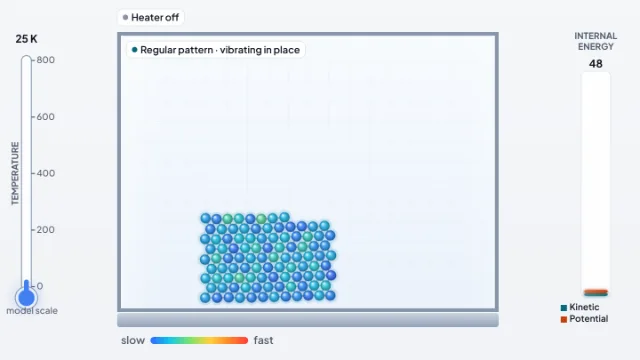
Loading simulation…

Symbols match your course. Open the full particle model and states of matter simulation for more presets and teacher tools.

Why a clay matka keeps water cool

On a hot afternoon, water from an unglazed clay pot tastes noticeably cooler than water from a plastic bottle standing beside it. There is no ice and no electricity. A little water seeps through the pores of the clay and evaporates from the outside, and evaporation carries heat away. Section 10.4 of your book explains how.

What evaporation is

Evaporation: the slow change of a liquid into a gas (vapour) that happens only at its surface, at any temperature, without the liquid boiling.

Molecules in a liquid have a wide spread of speeds. At any moment a few near the surface are moving fast enough, and in the right direction, to break away from their neighbours and escape into the air as vapour. Water spilled on a floor slowly disappears in this way, even though it never gets anywhere near 100 °C. Evaporation dries wet clothes and wet roads, and it keeps your body cool through sweating.

Evaporation and boiling are different

EvaporationBoiling
Temperatureat any temperatureonly at the boiling point
Whereonly at the surfacethroughout the liquid, with bubbles
Speedslowfast
Effect on the liquidcools ittemperature stays fixed while heat is supplied

Six things that change the rate

  1. Temperature. In a warmer liquid more molecules are fast enough to escape, so evaporation is quicker.
  2. Surface area. Only surface molecules can escape. The same water spread in a wide shallow tray dries much faster than in a tall narrow glass.
  3. Air movement (wind). Moving air sweeps away the vapour just above the surface, so the air there never becomes saturated and more molecules can leave.
  4. Humidity. Air already full of water vapour takes up little more, so evaporation is slow on humid days. Dry air takes up vapour readily.
  5. Nature of the liquid. Some liquids evaporate faster because their molecules need less energy to break free. Spirit or nail-polish remover dries on your skin far quicker than water.
  6. Pressure. Lower air pressure above the liquid makes escape easier, so evaporation speeds up.

That is why washing dries best on a hot, dry, windy day, hung out flat rather than bunched up.

Why evaporation cools

The molecules that escape are the fastest ones, the ones with the most kinetic energy. Once they have gone, the average kinetic energy of the molecules that stay is lower than before. Because temperature goes with the average kinetic energy of the molecules, the liquid that remains is cooler. To keep evaporating, the liquid draws heat from whatever it touches: your skin, the clay pot, the air.

Everyday examples:

  • Sweating: sweat evaporates from your skin and takes body heat with it. On a humid day it evaporates poorly, which is why humid heat feels so exhausting.
  • Spirit on the skin: a dab of spirit on the back of your hand feels icy as it evaporates quickly.
  • Earthen pots: water seeping through the clay evaporates from its outer surface and cools the water inside.
  • A wet cloth on the forehead of someone with a fever cools them as the water evaporates.

Cooling without CFCs: the refrigerator

A refrigerator uses the cooling effect of evaporation, over and over, with a special liquid called a refrigerant flowing round a closed loop of pipes.

  1. Evaporator (inside the fridge): the refrigerant enters as a cold liquid at low pressure and evaporates in the coils. Evaporating takes in a large amount of heat, so it draws heat out of the food compartment.
  2. Compressor: a pump squeezes the vapour to a high pressure, which also makes it hot.
  3. Condenser (the coils on the back, outside): the hot vapour gives out its heat to the room and condenses back into a liquid.
  4. Expansion valve: the liquid passes through a narrow opening, its pressure drops and it cools, ready to evaporate again.

Heat is taken in inside and given out outside, so the inside stays cold. Older fridges used chlorofluorocarbons (CFCs) as refrigerants. Leaked CFCs drift up and destroy the ozone layer that shields us from ultraviolet radiation, so they have been phased out. Modern fridges use refrigerants that do not harm the ozone layer.

Worked numerical 1: surface area

A tall jar of water loses 6 g by evaporation in a day. The same amount of water in a shallow tray has ten times the surface area. Roughly how much does the tray lose in a day in the same room?

If everything else is the same, the rate is roughly proportional to the surface area:

6 g×10=60 g6\ \text{g} \times 10 = 60\ \text{g}

About 60 g, which is why farmers' drying yards and salt pans are spread out wide and shallow.

Worked numerical 2: how much does sweating cool you?

During a run, 0.20 kg of sweat evaporates from an athlete. How much heat does it remove?

Q=0.20×2.4×106=4.8×10⁵ JQ = 0.20 \times 2.4 \times 10^6 = 4.8 \times 10^5\ \text{J}

If this heat stayed in a 60 kg body with an average specific heat capacity of about 3500 J kg⁻¹ K⁻¹, it would warm the body by

ΔT=4.8×10560×3500≈2.3 ∘C\Delta T = \frac{4.8 \times 10^5}{60 \times 3500} \approx 2.3\ ^\circ\text{C}

A 2 °C rise would mean a high fever, so evaporation of sweat really does keep you safe.

Worked numerical 3: the matka again

In a clay pot holding 10 kg of water, 0.050 kg seeps out and evaporates. Using the same 2.4×1062.4 \times 10^6 J kg⁻¹, estimate how much the remaining water cools if no heat flows in from the room.

Q=0.050×2.4×106=1.2×10⁵ JQ = 0.050 \times 2.4 \times 10^6 = 1.2 \times 10^5\ \text{J} ΔT=1.2×10510×4200≈2.9 ∘C\Delta T = \frac{1.2 \times 10^5}{10 \times 4200} \approx 2.9\ ^\circ\text{C}

In reality the warm room keeps feeding heat in, so the pot settles a few degrees below room temperature rather than cooling forever. The formula used is from the specific heat capacity page, and the energy per kilogram from the latent heat page.

Evaporation in the simulation

  1. Choose Liquid under Start from, keeping the States of matter view, and switch on Colour by speed.
  2. Without pressing Heat, watch the surface: now and then a fast particle breaks away and flies off as a gas, even though the liquid is far below boiling. With Arrangement labels on, the label notes when some particles have escaped as a gas.
  3. Press Track to follow one particle and see how rarely a single one manages to escape.
  4. Press Heat with a Low Heater power: more particles escape as the liquid warms, just as evaporation speeds up at higher temperatures.

The particle picture behind all of this is on the change of state page.
Common mistakes

  • Saying evaporation only happens at 100 °C. Water evaporates at any temperature; 100 °C is where it boils at normal pressure.
  • Explaining the cooling by saying the cold molecules escape. It is the most energetic molecules that leave, lowering the average energy of the rest.
  • Thinking humid air speeds up evaporation because it is 'wetter'. Air already holding a lot of vapour slows evaporation down.
  • Saying wind helps evaporation by heating the water. Moving air carries away the vapour above the surface so that more molecules can escape.
  • Claiming a refrigerator makes cold. It moves heat from inside the cabinet to the room outside, using evaporation inside and condensation outside.
  • Saying CFCs were banned because they are poisonous to eat. They were phased out because they destroy the ozone layer.

Exam practice

Exam-style questions

Original questions written in the style of Punjab board exams. Try each one before you reveal the answer.

  1. 1.Equal amounts of water are left in a wide, shallow dish and in a tall, narrow glass in the same room.

    1. (a)State which loses water faster and explain why.

      3 marks
      Show the answer

      Answer: The shallow dish. Evaporation happens only at the surface, and the dish has a much larger surface area, so many more molecules sit at the surface where they can break away each second.

      Marking points

      • The shallow dish
      • Evaporation takes place only at the surface
      • Larger surface area, so more molecules escape per second
    2. (b)Give two other changes to the room that would make both evaporate faster.

      2 marks
      Show the answer

      Answer: Any two of: a higher temperature; moving air, for example a fan; drier air (lower humidity); a lower air pressure.

      Marking points

      • First correct factor
      • Second correct factor
  2. 2.After a swim on a windy day, a girl feels cold as soon as she steps out of the pool.

    1. (a)Explain, using the motion of molecules, why evaporation of the water on her skin cools her.

      3 marks
      Show the answer

      Answer: The fastest-moving water molecules escape from the surface. That lowers the average kinetic energy of the water that remains, so it is cooler, and heat flows from her skin into it to keep it evaporating.

      Marking points

      • Most energetic molecules escape
      • Average kinetic energy of the remaining water falls, so it is cooler
      • Heat is taken from her skin
    2. (b)Explain why she feels colder on a windy day than on a calm one.

      2 marks
      Show the answer

      Answer: The wind carries away the water vapour near her skin, so the air there does not become saturated and evaporation, with its cooling, is faster.

      Marking points

      • Wind removes the vapour near the surface
      • Faster evaporation, so more cooling
  3. 3.A refrigerator keeps food cold using a refrigerant that circulates in a closed loop.

    1. (a)State where the refrigerant evaporates and where it condenses.

      2 marks
      Show the answer

      Answer: It evaporates in the coils inside the fridge and condenses in the coils outside, usually at the back.

      Marking points

      • Evaporates inside the cabinet
      • Condenses outside
    2. (b)Explain how this keeps the inside cold.

      2 marks
      Show the answer

      Answer: The refrigerant needs a lot of heat to evaporate, and it draws that heat from the food compartment. The heat is given out to the room when the vapour is compressed and condenses outside.

      Marking points

      • Evaporation inside absorbs heat from the cabinet
      • Heat is released outside when it condenses
    3. (c)Explain why CFCs are no longer used as refrigerants.

      1 mark
      Show the answer

      Answer: Leaked CFCs damage the ozone layer.

      Marking points

      • They destroy the ozone layer
  4. 4.Evaporation and boiling both turn liquid water into water vapour.

    1. (a)Give three differences between evaporation and boiling.

      3 marks
      Show the answer

      Answer: Water can evaporate whatever its temperature, but it boils only once it reaches its boiling point; evaporation is only at the surface, boiling happens throughout the liquid with bubbles; evaporation is slow and cools the liquid, while boiling is fast and the temperature stays fixed.

      Marking points

      • Any temperature versus a fixed boiling point
      • Surface only versus throughout the liquid
      • Slow and cooling versus fast at constant temperature

Quiz

Quick check

6 questions

  1. 1.A liquid that evaporates turns into:
  2. 2.Evaporation causes cooling because:
  3. 3.Wet clothes dry most slowly on a day that is:
  4. 4.Which liquid placed on the back of your hand will feel coldest?
  5. 5.In a refrigerator, heat is taken from the food when the refrigerant:
  6. 6.Which change would NOT make a puddle evaporate faster?

Related articles

Next step

Now see it move

Open the full particle model and states of matter simulation for every preset, graphs and the teacher tools, then test yourself.

Particle model and states of matter simulation: a sealed box of 100 particles that pull on and push against each other