Where this sits in AQA chemistry
What does the particle model say about solids, liquids and gases?
In the simple model, every particle (atom, ion or molecule) is drawn as a small solid sphere. The three states differ in how the spheres are arranged and how they move.
| State | Arrangement | Movement | Spacing | Shape and volume |
|---|---|---|---|---|
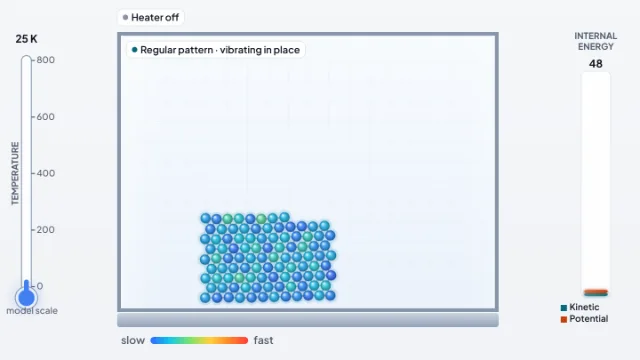
| Solid | Regular pattern | Vibrate about fixed positions | Touching | Fixed shape and fixed volume |
| Liquid | Random, no pattern | Move around each other | Mostly touching | Takes the shape of the container; fixed volume |
| Gas | Random | Move quickly in all directions | Far apart | Fills the whole container |
When drawing these in an exam, keep the spheres the same size in all three states: only their arrangement and spacing change.
What happens to the particles during a change of state?
- Melting (solid to liquid) and freezing (liquid to solid) both happen at the melting point.
- Boiling (liquid to gas) and condensing (gas to liquid) both happen at the boiling point.
To melt or boil a substance, energy must be transferred to it so the particles can overcome the forces holding them together. Freezing and condensing are the reverse: energy is transferred to the surroundings as the particles come closer and the forces pull them back together. Changes of state are physical changes; no new substances form, and the particles themselves are unchanged.
Why do substances melt and boil at different temperatures?
The energy needed to change state depends on how strong the forces between the particles are, and that depends on the bonding and structure:
- Giant ionic lattices, giant covalent structures and metals: melting means breaking many strong bonds (ionic, covalent or metallic), so melting and boiling points are high. Sodium chloride, silicon dioxide and copper are all solids at room temperature.
- Small molecules: melting and boiling only overcome the weak intermolecular forces between molecules. Each molecule stays whole: its strong covalent bonds are untouched. Very little energy is needed, so most substances made of small molecules are liquids or gases at 20 °C.
In short: stronger forces between particles mean more energy is needed, so the substance melts and boils at higher temperatures. More detail on each structure is on ionic and molecular properties.
Worked example: predicting states from data
Question: Decide whether each substance below is a solid, liquid or gas at 25 °C and at 100 °C.
| Substance | Melting point / °C | Boiling point / °C |
|---|---|---|
| A | −95 | 69 |
| B | 44 | 280 |
| C | −210 | −196 |
| D | 1085 | 2560 |
The rule: below the melting point the substance is solid, between the melting and boiling points it is liquid, and above the boiling point it is a gas.
- A at 25 °C: between −95 and 69, so liquid. At 100 °C it is above 69, so gas.
- B at 25 °C: below its melting point of 44, so solid. At 100 °C it is between 44 and 280, so liquid.
- C: both temperatures are above −196, so it is a gas at both.
- D: both temperatures are far below 1085, so it is a solid at both. Its very high melting point suggests a giant structure such as a metal.
Watch the signs: −95 is a lower temperature than −10, so a substance melting at −95 °C has already melted long before room temperature.
Do single atoms have the properties of the material?
No. Properties such as colour, hardness, melting point and conductivity are bulk properties: they come from huge numbers of particles and the bonds between them. A single copper atom is not orange, does not conduct and has no melting point. Copper metal has these properties because of how countless atoms are held together in a lattice.
What are the limits of the sphere model? (Higher tier)
The simple model treats particles as solid, inelastic spheres with no forces between them. That causes problems:
- No forces: without forces, nothing explains why particles in a solid stay together, or why energy is needed to melt or boil a substance. The model cannot explain different melting points at all.
- All particles are spheres: real molecules come in many shapes, such as the long chains of polymers, which affects how they pack.
- The spheres are solid: real atoms are mostly empty space, with electrons spread round a tiny nucleus, and particles are not rigid balls.
How do you use state symbols?
| Symbol | Meaning | Example |
|---|---|---|
| (s) | Solid | Zn(s), CaCO₃(s) |
| (l) | Liquid | H₂O(l), Br₂(l) |
| (g) | Gas | O₂(g), CO₂(g) |
| (aq) | Aqueous: dissolved in water | NaCl(aq), HCl(aq) |
For example, when zinc reacts with hydrochloric acid:
Water itself is (l), not (aq). Something dissolved in water is (aq); something that is a liquid on its own is (l).
Try it in the simulation
The particle box above starts as a cold Solid. Press Play and then Heat, and watch the regular rows break apart into a liquid and then a gas. Press Track to follow one particle and compare its path in each state. Next set Start from to Gas, then press Cool and watch the particles condense and then freeze. To see how real substances heat up and change state, use the heating curve simulation.