Skip to content

GCSE Chemistry — AQA (8462) · Bonding, structure and the properties of matter

Ionic bonding and ionic compounds

4.2.1.14.2.1.24.2.1.3

In ionic bonding a metal atom transfers its outer electrons to a non-metal atom. The metal becomes a positive ion and the non-metal a negative ion, both with a noble gas structure, and strong electrostatic attraction holds the oppositely charged ions together in a giant lattice.

Loading simulation…

Symbols match your course. Open the full electron shells in 3d (atoms and ions up to calcium) simulation for more presets and teacher tools.

Where this sits in AQA chemistry

What is ionic bonding?

Chemists recognise three types of strong bond: ionic, covalent and metallic. Ionic bonding is found in compounds of a metal with a non-metal. When the atoms react, electrons move from the outer shell of the metal atom to the non-metal atom:

  • the metal atom loses electrons and becomes a positive ion
  • the non-metal atom gains those electrons and becomes a negative ion

Both new ions end up with full outer shells, matching the arrangement of a Group 0 noble gas. The bond itself is the strong electrostatic attraction between the oppositely charged ions. No electrons are shared: they have been handed over completely.

How do you work out the charge on an ion?

For the four groups AQA tests, the charge follows from the group number. A metal loses all its outer electrons; a non-metal gains enough to reach 8.

GroupOuter electronsChangeIon chargeExamples
11loses 11+Li⁺, Na⁺, K⁺
22loses 22+Mg²⁺, Ca²⁺
66gains 22−O²⁻, S²⁻
77gains 11−F⁻, Cl⁻, Br⁻

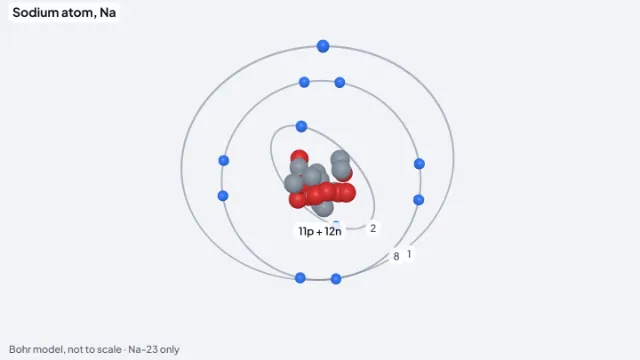
The nucleus does not change when an ion forms, so the charge is just protons minus electrons. A sodium ion still has 11 protons, but only 10 electrons, so its charge is 1+ and its structure is [2,8]⁺, the same as neon.

How do you draw a dot and cross diagram for an ionic compound?

Use dots for the electrons that came from one element and crosses for those from the other. For the ions themselves:

  1. Draw each ion's outer shell (examiners usually accept the outer shell alone). The non-metal ion has a full set of 8; the metal ion is drawn with an empty outer shell or with the full shell underneath.
  2. Show which electron was transferred: the non-metal ion has one or two crosses among its dots.
  3. Put each ion in square brackets with its charge outside, top right.
  4. Show the right number of each ion, so the charges cancel.

Electrons are all identical; the dots and crosses only record where each one came from.

Worked example: magnesium oxide

Question: Describe what happens to the electrons when magnesium reacts with oxygen to form magnesium oxide. Magnesium is 2,8,2 and oxygen is 2,6.

  1. Magnesium is in Group 2: each atom loses its two outer electrons, leaving [2,8]²⁺.
  2. Oxygen is in Group 6: each atom gains two electrons, giving [2,8]²⁻.
  3. One magnesium atom supplies exactly what one oxygen atom needs, so the ions are in a 1 : 1 ratio and the formula is MgO.

In the diagram, Mg²⁺ is drawn with an empty outer shell (or with its full second shell of 8), and O²⁻ shows 6 dots plus 2 crosses. With calcium and chlorine, one calcium atom gives one electron to each of two chlorine atoms, so the formula is CaCl₂.

What is the structure of an ionic compound?

Solid ionic compounds are giant structures: lattices built from enormous numbers of ions. In sodium chloride, Na⁺ and Cl⁻ ions alternate in three directions, and each ion sits next to 6 ions of the opposite charge. The attractions act in all directions, between every ion and its neighbours, so the whole crystal is held together, not separate pairs. That is why it makes no sense to talk about "a molecule of sodium chloride": NaCl is only the ratio of the ions. High melting points and conduction when molten follow from this lattice: see ionic compound properties.

To find the empirical formula from a diagram of a lattice, count each kind of ion and simplify the ratio. A diagram showing 8 K⁺ ions and 4 O²⁻ ions gives 2 : 1, so the formula is K₂O, and the charges check out: two 1+ ions balance one 2− ion.

What does each kind of diagram leave out?

DiagramUseful forLimitation
Dot and crossShowing where the transferred electrons came fromShows no structure: not how the ions are arranged, nor their relative sizes
Ball and stickShowing the regular 3D arrangementThe sticks suggest bonds between particular pairs; the ions are drawn far apart, with gaps that are not really there
2D drawing of a layerCounting ions to get the formulaShows one layer only, not the 3D arrangement
3D space-fillingShowing ions packed closely, with relative sizesHides the ions inside; only shows a tiny part of the lattice

Try it in the simulation

In the 3D shells model above, pick sodium and press Make ion: the outer electron leaves and the charge appears. Press Atom, choose chlorine, and do the same to watch it gain one. Try magnesium, oxygen and sulfur next and predict each charge before you press. To see how millions of these ions stack up, open the sodium chloride model in the giant structures simulation and highlight one ion to count its six neighbours.
Common mistakes

  • Saying the ions in sodium chloride share electrons. Electrons are transferred completely; sharing pairs of electrons is covalent bonding.
  • Giving a Group 6 ion a charge of 6−. Oxygen and sulfur gain 2 electrons to complete their outer shell, so their ions are 2−.
  • Thinking the nucleus changes when an ion forms. A sodium ion still has 11 protons; only the number of electrons changes.
  • Writing about NaCl molecules. Sodium chloride is a giant lattice of ions, and NaCl is only the ratio of sodium ions to chloride ions.
  • Leaving off the square brackets and charges in an ionic dot and cross diagram, or drawing the electrons as still shared between the two ions.
  • Saying each ion is bonded only to the ion it took an electron from. The electrostatic attraction acts in all directions, to every neighbouring ion of opposite charge.

Exam practice

Exam-style questions

Original questions written in the style of GCSE AQA Chemistry. Try each one before you reveal the answer.

  1. 1.Lithium (Group 1) reacts with fluorine (Group 7) to form lithium fluoride, an ionic compound. The electronic structure of lithium is 2,1 and of fluorine is 2,7.

    1. (a)Describe what happens when a lithium atom reacts with a fluorine atom. Give the charge on each ion formed.

      4 marks
      Show the answer

      Answer: One electron is transferred from the outer shell of the lithium atom to the outer shell of the fluorine atom. The lithium atom becomes a positive ion, Li⁺ (charge 1+). The fluorine atom becomes a negative ion, F⁻ (charge 1−). Each ion now has a full outer shell: Li⁺ is 2, like helium, and F⁻ is 2,8, like neon.

      Marking points

      • One electron transferred from lithium to fluorine
      • Lithium ion has a 1+ charge
      • Fluoride ion has a 1− charge
      • Both ions have a full outer shell / noble gas electronic structure
    2. (b)Name the type of force that holds the ions together in lithium fluoride.

      1 mark
      Show the answer

      Answer: Electrostatic attraction between oppositely charged ions.

      Marking points

      • (Strong) electrostatic attraction between oppositely charged ions
  2. 2.A diagram shows part of the lattice of an ionic compound of calcium and chlorine. It contains 6 calcium ions and 12 chloride ions.

    1. (a)Work out the empirical formula of the compound.

      2 marks
      Show the answer

      Answer: Ratio of Ca²⁺ to Cl⁻ is 6 : 12, which simplifies to 1 : 2, so the formula is CaCl₂.

      Marking points

      • Ratio 6 : 12 simplified to 1 : 2
      • CaCl₂
    2. (b)Explain why calcium forms ions with a 2+ charge.

      2 marks
      Show the answer

      Answer: Calcium is in Group 2, so its atoms have 2 outer electrons. They lose both, leaving 20 protons and 18 electrons, an overall charge of 2+.

      Marking points

      • Calcium has 2 outer electrons (Group 2)
      • It loses both, so it has 2 more protons than electrons
  3. 3.Sodium chloride can be shown as a dot and cross diagram, a ball and stick model or a space-filling model.

    1. (a)Give one limitation of a dot and cross diagram for sodium chloride.

      1 mark
      Show the answer

      Answer: It does not show how the ions are arranged in the lattice (or their relative sizes).

      Marking points

      • Does not show the arrangement / structure of the lattice, or the relative sizes of the ions
    2. (b)State one drawback of showing sodium chloride as a ball and stick model.

      1 mark
      Show the answer

      Answer: The sticks suggest bonds between particular pairs of ions, but the attraction acts in all directions; the ions are also shown spaced far apart when in reality they touch.

      Marking points

      • Sticks imply fixed bonds between pairs / ions shown too far apart
    3. (c)Explain why sodium chloride is described as a giant structure.

      2 marks
      Show the answer

      Answer: It is made of a very large number of ions arranged in a regular lattice. Every ion is attracted to all its oppositely charged neighbours, so the bonding continues throughout the whole crystal.

      Marking points

      • A very large number of ions in a regular lattice
      • Attractions act in all directions throughout the crystal (no separate molecules)

Quiz

Quick check

6 questions

  1. 1.Which pair of elements would form an ionic compound?
  2. 2.What is the charge on a sulfide ion?
  3. 3.A magnesium atom becomes a magnesium ion. What happens to it?
  4. 4.Which ion has the same electronic structure as argon, 2,8,8?
  5. 5.What holds the ions together in a crystal of sodium chloride?
  6. 6.Aluminium ions, Al³⁺, combine with oxide ions, O²⁻. Which formula is correct?

Related articles

Next step

Now see it move

Open the full electron shells in 3d (atoms and ions up to calcium) simulation for every preset, graphs and the teacher tools, then test yourself.

Electron shells in 3D simulation: a 3D Bohr model of the first 20 elements3D