Where this sits in AQA chemistry
Where are the transition metals?
They fill the wide central block of the periodic table, between Group 2 and Group 3. The six AQA examples sit side by side in Period 4, starting a few places after calcium: Cr, Mn, Fe, Co, Ni, Cu. All of them are metals, so they form positive ions, but they behave very differently from the alkali metals on the far left.
How do transition metals compare with Group 1?
| Property | Group 1 (lithium, sodium, potassium) | Transition metals (Cr, Mn, Fe, Co, Ni, Cu) |
|---|---|---|
| Melting point | Low: sodium 98 °C, potassium 63 °C | High: copper 1085 °C, iron 1538 °C, chromium 1907 °C |
| Density | Low: all three float on water (sodium 0.97 g/cm³) | High: about 7 to 9 g/cm³ (iron 7.9, copper 9.0) |
| Strength and hardness | Soft enough to cut with a knife; weak | Hard and strong, which is why iron and steel are used to build with |
| Reaction with oxygen | Tarnish within seconds; burn readily | Slow: iron rusts over days in damp air, and copper dulls slowly, forming black copper(II) oxide quickly only when heated |
| Reaction with water | Vigorous at room temperature, giving hydrogen | Very slow or none with cold water: copper pipes carry drinking water |
| Reaction with halogens | Burn vigorously to form white salts | React, but usually need heating; hot iron wool glows in chlorine |
The short version: transition metals are less reactive and tougher than Group 1 metals, which is exactly why they are so useful as materials.
Which ions do transition metals form?
Group 1 metals always form 1+ ions. Many transition metals can form ions with different charges, and a Roman numeral in a compound's name tells you which:
| Metal | Common ions | Example compounds |
|---|---|---|
| Iron | Fe²⁺ and Fe³⁺ | Iron(II) sulfate, FeSO₄; iron(III) oxide, Fe₂O₃ |
| Copper | Cu⁺ and Cu²⁺ | Copper(I) oxide, Cu₂O (red); copper(II) oxide, CuO (black) |
| Chromium | Cr²⁺ and Cr³⁺ | Chromium(III) oxide, Cr₂O₃ (green) |
| Manganese | Mn²⁺, and others in compounds | Manganese(II) sulfate; manganese(IV) oxide, MnO₂ |
So the formula of a transition metal compound can't be worked out from the group number. Read the Roman numeral: iron(III) means Fe³⁺, so with O²⁻ ions the charges balance as Fe₂O₃.
Why are their compounds coloured?
Compounds of Group 1 metals with simple ions, such as sodium chloride or potassium sulfate, are white, and their solutions are colourless. Transition metal compounds are usually coloured, and the colour often depends on the charge of the ion:
| Ion or compound | Typical colour |
|---|---|
| Copper(II) compounds, such as copper(II) sulfate solution | Blue |
| Iron(II) compounds | Pale green |
| Iron(III) compounds | Orange-brown |
| Nickel(II) compounds | Green |
| Cobalt(II) compounds in water | Pink |
| Potassium manganate(VII) | Deep purple |
| Potassium dichromate(VI) | Orange |
The last two contain potassium, but their colour comes from the manganese and chromium in the manganate and dichromate ions, not from the Group 1 metal.
These colours are used in pottery glazes, stained glass and paints, and in the lab to spot which ion is present.
Why are transition metals used as catalysts?
Many transition metals and their compounds are good catalysts: they speed up reactions without being used up. Three examples use metals from the AQA list:
- Iron is the catalyst when nitrogen and hydrogen combine to give ammonia in the Haber process.
- Nickel speeds up the addition of hydrogen to vegetable oils, which hardens them into spreads.
- Manganese(IV) oxide makes hydrogen peroxide break down into water and oxygen far faster.
The catalyst is written over the arrow or left out, because it is unchanged at the end. How a catalyst lowers the activation energy is on the catalysts page, and you can switch one on and off in the collision theory simulation with its Catalyst: on / off button.
Worked example: spotting a transition metal from data
Question: Metal A melts at 1455 °C, has a density of 8.9 g/cm³ and forms green compounds. Metal B melts at 63 °C, has a density of 0.86 g/cm³ and forms white compounds. Which is the transition metal? Give three reasons.
- A is the transition metal.
- Its melting point is very high, while B melts not far above room temperature.
- Its density is about ten times greater; B would float on water.
- Its compounds are coloured, while B's are white.
The values match nickel (A) and potassium (B). For a 3-mark answer like this, give each reason as a comparison, not just a description of A.
See transition metal colours in the simulations
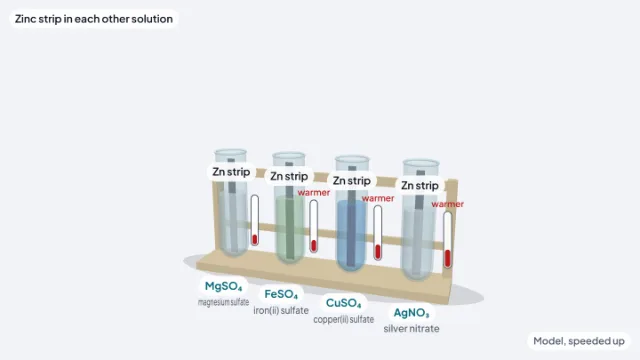
The reactivity and displacement simulation uses two of the AQA examples. Choose One metal, one solution, set the Metal strip to iron and the Solution to copper(II) sulfate, then press Add the metal. A red-brown coating of copper forms while the blue copper(II) colour gives way to the pale green of iron(II) ions: two coloured transition metal ions in one tube. The Equations panel shows iron forming Fe²⁺, one of its two common ions. In the 3D electron shells simulation, the table stops at calcium; the transition metals start right after it, at scandium, which is where the third shell begins to fill beyond 8. Copper's flame colour is in the flame tests simulation.