Skip to content

GCSE Chemistry — AQA (8462) · Atomic structure and the periodic table

Relative atomic mass and isotopes

4.1.1.6

Relative atomic mass, Ar, is the average mass of an element's atoms, weighted by how common each isotope is. Multiply each mass number by its percentage, add them up and divide by 100. Chlorine, 75% chlorine-35 and 25% chlorine-37, comes out at 35.5.

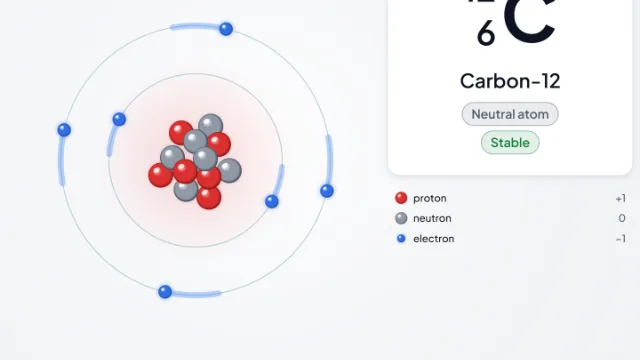
Loading simulation…

Symbols match your course. Open the full isotopes and atom builder simulation for more presets and teacher tools.

Where this sits in AQA chemistry

What does relative atomic mass mean?

Most elements are a mixture of isotopes: atoms sharing a proton count but differing in neutron count, and so in mass. A sample of chlorine, for instance, is roughly three parts chlorine-35 to one part chlorine-37. The relative atomic mass (symbol ArA_r) is the mean mass of an atom of the element, worked out so that each isotope counts in proportion to how common it is. That kind of average, where more common values count for more, is called a weighted mean.

Two details:

  • ArA_r has no units. It compares atoms with one another, on a scale where an atom of carbon-12 has a mass of exactly 12.
  • The values on the AQA periodic table are rounded. Most are printed as whole numbers; chlorine is shown as 35.5 and copper as 63.5 because rounding those to whole numbers would be too far out.

How do you calculate relative atomic mass?

Treat each mass number as being "worth" its percentage:

Ar=(mass number×%)+(mass number×%)+…100A_r = \frac{(\text{mass number} \times \%) + (\text{mass number} \times \%) + \dots}{100}

  1. Multiply each isotope's mass number by its percentage abundance.
  2. Add the products together.
  3. Divide by 100 (the total of the percentages).
  4. Round sensibly, usually to one decimal place, and check that the answer lies between the lightest and heaviest isotope and is pulled towards the most common one.

If the abundances are given as a ratio rather than percentages, divide by the total of the ratio instead of by 100.

Worked example: chlorine and magnesium

Three quarters of natural chlorine is chlorine-35 (75%); the other quarter (25%) is chlorine-37.

Ar=(35×75)+(37×25)100=2625+925100=35.5A_r = \frac{(35 \times 75) + (37 \times 25)}{100} = \frac{2625 + 925}{100} = 35.5

The simple average of 35 and 37 would be 36, which is wrong: there is three times as much chlorine-35, so the answer is pulled towards 35. The same answer comes from the ratio 3 : 1, since (35 × 3 + 37 × 1) ÷ 4 = 35.5.

Magnesium has three isotopes. Magnesium-24 makes up 79% of its atoms, magnesium-26 makes up 11%, and the last 10% is magnesium-25.

Ar=(24×79)+(25×10)+(26×11)100=1896+250+286100=24.32A_r = \frac{(24 \times 79) + (25 \times 10) + (26 \times 11)}{100} = \frac{1896 + 250 + 286}{100} = 24.32

To one decimal place, that is 24.3. The AQA periodic table rounds it to 24.

Worked example: working backwards to an abundance

Question: The two isotopes of gallium are gallium-69 and gallium-71, and gallium's relative atomic mass is 69.8. Find the percentage of each isotope.

  1. Let the percentage of gallium-69 be xx. The rest, 100−x100 - x, is gallium-71.
  2. Set up the weighted mean: 69x+71(100−x)=69.8×100=698069x + 71(100 - x) = 69.8 \times 100 = 6980.
  3. Expand: 69x+7100−71x=698069x + 7100 - 71x = 6980, so −2x=−120-2x = -120 and x=60x = 60.
  4. Gallium is 60% gallium-69 and 40% gallium-71.

Check: (69 × 60 + 71 × 40) ÷ 100 = (4140 + 2840) ÷ 100 = 69.8. The value 69.8 sits nearer 69 than 71, which agrees with gallium-69 being the bigger share.

Why is relative atomic mass an average?

You cannot weigh a single atom on a balance; any sample you handle in a lab contains billions of billions of atoms, in the natural mix of isotopes. Because isotopes of an element have the same electrons, they behave the same way in reactions, so chemists can treat the sample as if every atom had the average mass. That is what makes ArA_r useful when you go on to work out the relative formula mass of a compound, such as 23 + 35.5 = 58.5 for sodium chloride.

Beyond the specification: the percentages are measured with an instrument called a mass spectrometer, and the true mass of each isotope is not exactly a whole number (chlorine-35 is about 34.97). GCSE questions use the mass numbers.

Explore chlorine's isotopes in the simulation

Open the atom builder in Build mode and make chlorine with 17 protons. Add 18 neutrons and the Nucleus card reports a stable nucleus; with a neutron count that gives no known nucleus, a hint names the neutron numbers that stable chlorine has. Then switch to Compare and use the Atom 1 isotope and Atom 2 isotope menus to set chlorine-35 beside chlorine-37. The table shows the same atomic number and electrons but different neutron numbers and mass numbers, which is all an isotope is. Try boron, magnesium and silicon the same way, then use the abundances on this page to calculate their relative atomic masses yourself. For the particle counting behind this topic, see protons, neutrons and electrons.
Common mistakes

  • Taking a plain average of the mass numbers. For chlorine, (35 + 37) ÷ 2 = 36 ignores the fact that chlorine-35 is three times as common.
  • Leaving out the final ÷ 100 step, which gives answers like 3550 for chlorine.
  • Giving relative atomic mass a unit such as grams. It is a ratio, so it has none.
  • Not checking the answer. Ar must lie between the lightest and heaviest isotope, pulled towards the most abundant one.
  • Mixing up relative atomic mass with mass number. Mass number belongs to one isotope and is always a whole number; Ar is an average for the element.
  • Dividing by 100 when the abundances are a ratio such as 3 : 1. Divide by the total of the ratio, here 4.

Exam practice

Exam-style questions

Original questions written in the style of GCSE AQA Chemistry. Try each one before you reveal the answer.

  1. 1.Of the atoms in a boron sample, 19.9% are boron-10 and 80.1% are boron-11.

    1. (a)Calculate the relative atomic mass of boron to 1 decimal place.

      2 marks
      Show the answer

      Answer: (10 × 19.9 + 11 × 80.1) ÷ 100 = (199 + 881.1) ÷ 100 = 10.801, so 10.8

      Marking points

      • Correct weighted sum divided by 100
      • 10.8
    2. (b)Explain why the relative atomic mass of boron is not a whole number.

      1 mark
      Show the answer

      Answer: It is a weighted mean of two isotopes with different masses.

      Marking points

      • It is an average over isotopes of different mass / abundance
    3. (c)Boron's atomic number is 5. Work out the neutron number of boron-11.

      1 mark
      Show the answer

      Answer: 6 (11 − 5)

      Marking points

      • 6
  2. 2.Naturally occurring silicon is 92.2% silicon-28, 4.7% silicon-29 and 3.1% silicon-30.

    1. (a)Calculate the relative atomic mass of silicon. Give your answer to 1 decimal place.

      3 marks
      Show the answer

      Answer: (28 × 92.2 + 29 × 4.7 + 30 × 3.1) ÷ 100 = (2581.6 + 136.3 + 93) ÷ 100 = 28.109, so 28.1

      Marking points

      • Multiplies each mass number by its abundance
      • Adds and divides by 100
      • 28.1
    2. (b)A student's answer was 29.0. Without repeating the calculation, explain how you can tell it is wrong.

      2 marks
      Show the answer

      Answer: Silicon-28 makes up over 90% of the sample, so the weighted mean must be very close to 28. 29.0 is the simple average of 28, 29 and 30.

      Marking points

      • Silicon-28 is by far the most abundant isotope
      • So Ar must be close to 28 (29.0 is an unweighted average)
  3. 3.Gallium has two isotopes, gallium-69 and gallium-71. Its relative atomic mass is 69.8.

    1. (a)Calculate the percentage abundance of each isotope.

      3 marks
      Show the answer

      Answer: Let x% be gallium-69: 69x + 71(100 − x) = 6980, so 7100 − 2x = 6980 and x = 60. Gallium-69 is 60% and gallium-71 is 40%.

      Marking points

      • Sets up a weighted mean equation with x and 100 − x
      • Gallium-69 = 60%
      • Gallium-71 = 40%
    2. (b)State why both isotopes of gallium react in the same way.

      1 mark
      Show the answer

      Answer: They have the same number of electrons (in the same arrangement).

      Marking points

      • Same number / arrangement of electrons

Quiz

Quick check

6 questions

  1. 1.Which statement best describes relative atomic mass?
  2. 2.An element is 90% of an isotope with mass number 20 and 10% of one with mass number 22. What is its relative atomic mass?
  3. 3.Lithium is 7.5% lithium-6 and 92.5% lithium-7. Which value is closest to its relative atomic mass?
  4. 4.What are the units of relative atomic mass?
  5. 5.Why is the relative atomic mass of chlorine 35.5 and not a whole number?
  6. 6.Which statement about the relative atomic mass of an element with two isotopes is always true?

Related articles

Next step

Now see it move

Open the full isotopes and atom builder simulation for every preset, graphs and the teacher tools, then test yourself.

Isotopes and atom builder simulation: add protons, neutrons and electrons one at a time