Which syllabus statements does this cover?
What is an atom made of?
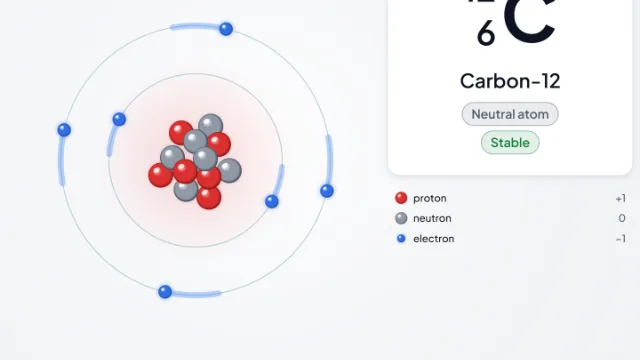
Every atom has two parts.
- The nucleus, at the centre. It holds the protons and the neutrons. It is tiny compared with the whole atom, yet it contains nearly all the mass of the atom.
- The electron shells, around the nucleus. The electrons sit in shells at different distances from the centre. Most of the atom's volume is the space taken up by these shells, so most of an atom is empty.
Because protons are positive and the nucleus contains no negative particles, the nucleus as a whole carries a positive charge. The negative electrons are held in their shells by their attraction to it.
What are the charges and masses of the three particles?
Real masses are far too small to work with easily, so chemists compare each particle with a proton. These are relative values: they have no units.
| Particle | Relative charge | Relative mass | Found in |
|---|---|---|---|
| Proton | +1 | 1 | Nucleus |
| Neutron | 0 | 1 | Nucleus |
| Electron | −1 | about 1/1840 (negligible) | Shells |
The electron's mass is close to 1/1836 of a proton's. Exam answers such as 1/1840, 1/2000 or "negligible" all carry the same meaning: an electron adds almost nothing to the mass of an atom.
Why does an atom have no overall charge?
In an atom the number of electrons equals the number of protons. Each proton's +1 cancels one electron's −1, so the total charge is zero. Neutrons have no charge and do not affect this. When the numbers stop matching, the particle is an ion: fewer electrons than protons gives a positive ion, more gives a negative ion.
What are proton number and nucleon number?
Two numbers describe any nucleus. Cambridge uses both pairs of names, so learn both.
- Proton number (also called atomic number, symbol Z): how many protons sit in the nucleus of the atom. It fixes which element the atom belongs to. Every carbon atom has 6 protons; any atom with 7 protons is nitrogen.
- Nucleon number (also called mass number, symbol A): the protons and neutrons in the nucleus added together. Protons and neutrons together are called nucleons.
From these two numbers you can work out every particle in a neutral atom:
- protons = proton number
- electrons = proton number (for an atom, not an ion)
- neutrons = nucleon number − proton number
Elements appear in the Periodic Table in order of proton number, so the proton number of each element can always be read from it.
Worked example: counting the particles
Question: An atom of aluminium has proton number 13 and nucleon number 27. How many protons, neutrons and electrons does it contain?
- Protons = proton number = 13.
- Neutrons = 27 − 13 = 14.
- The atom is neutral, so electrons = protons = 13.
- Check: 13 + 14 = 27 nucleons, which matches the nucleon number.
Now the other way round: a particle contains 20 protons, 20 neutrons and 18 electrons.
- Twenty protons make it calcium (proton number 20).
- Nucleon number = 20 + 20 = 40.
- It has two fewer electrons than protons, so its charge is 2+: this is the ion Ca²⁺, not a calcium atom.
How is the atom written as a symbol?
In a nuclide symbol the nucleon number is written as a raised number before the element symbol, with the proton number just below it, so aluminium-27 is written . Reading and using these symbols, for atoms and for ions, is part of the isotopes topic (2.3), where you will also see atoms of one element with different nucleon numbers.
Explore it in the atom builder
Open the atom builder in Build mode. Press Add a proton a few times and watch the Element card change with every proton, while adding a neutron with Add a neutron changes only the Nucleon number card (the mass number). Add electrons until the Charge card reads neutral, then remove one to make a positive ion. The table of The three particles shows the relative charges and masses from this page. Try Start from an element and pick potassium, then predict its neutron count before you read it. Switch to Scale to zoom from the whole atom down to its nucleus and see how much of the atom is empty space. The Challenge mode sets ten particles to build, including ions.
For the history of how scientists found the nucleus (beyond this syllabus), read how the gold foil results revealed the nucleus. When you are ready, test the whole chapter with the atoms, elements and compounds MCQs.