Skip to content

Cambridge IGCSE Chemistry (0620) · Atoms, elements and compounds

Ions and ionic bonds

2.4.12.4.22.4.32.4.42.4.52.4.62.4.7

Metal atoms lose electrons to form cations; non-metal atoms gain them to form anions. An ionic bond is the strong electrostatic attraction between these oppositely charged ions (Core). In the solid they form a giant lattice of alternating ions, so melting points are high (Supplement).

Loading simulation…

Symbols match your course. Open the full giant structures in 3d (sodium chloride, diamond, graphite and metals) simulation for more presets and teacher tools.

Syllabus 2.4 at a glance

How do cations and anions form? (Core)

Ions are atoms, or groups of atoms, that carry a charge because electrons have been lost or gained.

  • A cation is a positive ion. Metal atoms lose their outer-shell electrons: Na → Na⁺ + e⁻.
  • An anion is a negative ion. Non-metal atoms gain electrons into their outer shell: Cl + e⁻ → Cl⁻.

The protons in the nucleus are unchanged, so the charge equals the number of protons minus the number of electrons. Both ions finish with a noble gas configuration: Na⁺ is 2,8 and Cl⁻ is 2,8,8 (see electronic configuration).

GroupIIIIIIVVIVII
Usual ion charge1+2+3+3−2−1−
ExampleK⁺Ca²⁺Al³⁺N³⁻O²⁻Br⁻

Group IV elements such as carbon and silicon do not normally form simple ions, and Group VIII noble gases form none.

What is an ionic bond? (Core)

An ionic bond is a strong electrostatic attraction between ions of opposite charge. It forms when a metal reacts with a non-metal: the metal hands over electrons, the non-metal takes them, and the resulting cation and anion attract each other.

Drawing a Group I–Group VII compound (Core)

Take potassium chloride. Potassium is 2,8,8,1 and chlorine is 2,8,7.

  1. Draw the potassium ion's outer shell (now its full third shell, or leave it empty) and the chloride ion's outer shell with 8 electrons: 7 dots of its own and 1 cross from potassium.
  2. Enclose each ion in square brackets.
  3. Write the charges outside the brackets: [K]⁺ and [Cl]⁻.

One potassium atom gives exactly the one electron that one chlorine atom needs, so the formula is KCl. Showing outer shells only is normally enough.

Dot-and-cross diagrams for other metal–non-metal pairs (Supplement)

The method is the same; only the numbers change.

  • Magnesium oxide: Mg (2,8,2) gives 2 electrons to O (2,6). Ions [Mg]²⁺ and [O]²⁻, formula MgO.
  • Calcium chloride: Ca (2,8,8,2) gives one electron to each of two Cl atoms. Ions [Ca]²⁺ and 2[Cl]⁻, formula CaCl₂.
  • Sodium oxide: two Na atoms each give one electron to one O atom. Ions 2[Na]⁺ and [O]²⁻, formula Na₂O.

In each case the total positive charge must equal the total negative charge.

What is a giant ionic lattice? (Supplement)

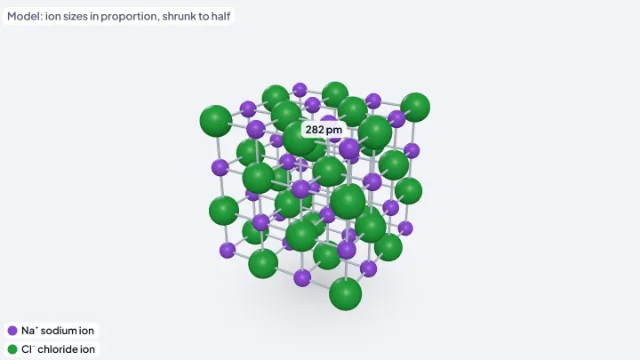
Solid ionic compounds are not made of pairs or molecules. They form a giant lattice, in which cations and anions alternate in an orderly pattern repeated in three dimensions. In sodium chloride, every Na⁺ has six Cl⁻ neighbours, and every Cl⁻ six Na⁺. The formula NaCl gives only the 1 : 1 ratio of ions.

Why do ionic compounds behave like this? (Core describe, Supplement explain)

Property (Core)Explanation from structure and bonding (Supplement)
High melting and boiling pointsMany strong electrostatic attractions between oppositely charged ions act throughout the lattice; a lot of energy is needed to overcome them
Poor electrical conductivity when solidEach ion is locked into its lattice site and cannot drift
Good electrical conductivity when molten or aqueousThe ions are free to move, so they can carry charge through the liquid

Notice that the charge carriers are ions, not electrons. For comparison, magnesium oxide (doubly charged ions) melts near 2850 °C, against 801 °C for sodium chloride.

Worked example: predicting and explaining (Supplement)

Question: Lithium (Group I) reacts with sulfur (Group VI). Give the formula of the compound and describe the bonding.

  1. Lithium loses 1 electron to form Li⁺; sulfur gains 2 to form S²⁻.
  2. Two Li⁺ ions balance one S²⁻ ion, so the formula is Li₂S.
  3. The compound is a giant lattice of alternating Li⁺ and S²⁻ ions held by strong electrostatic attraction.
  4. Prediction: high melting point; conducts when molten or dissolved, but not as a solid.

Explore the lattice in 3D

Sodium chloride is the first structure in the 3D giant lattice model. Press Highlight and count the six oppositely charged neighbours of the ringed ion. Press Apply p.d. with the solid: nothing drifts. Then press Molten and watch the cations move one way and the anions the other. To see the electron transfer itself, open the electron shells in 3D simulation and press Make ion on potassium and then chlorine.
Common mistakes

  • Calling a negative ion a cation. Cations are positive (metal ions); anions are negative (non-metal ions).
  • Saying ionic compounds conduct as solids because they contain ions. The ions must be free to move, which happens only when molten or in aqueous solution.
  • Saying electrons carry the current in molten sodium chloride. The moving ions carry the charge.
  • Drawing ions without brackets or charges, or leaving the transferred electron in a shared position between the two ions.
  • (Supplement) Describing sodium chloride as made of NaCl molecules. It is a giant lattice of alternating Na⁺ and Cl⁻ ions.
  • (Supplement) Writing the formula of calcium chloride as CaCl. One Ca²⁺ ion needs two Cl⁻ ions to balance its charge, so it is CaCl₂.

Exam practice

Exam-style questions

Original questions written in the style of Cambridge IGCSE Chemistry. Try each one before you reveal the answer.

  1. 1.Sodium reacts with chlorine to form sodium chloride.

    1. (a)Describe how a sodium atom becomes a sodium ion.

      2 marks
      Show the answer

      Answer: The sodium atom loses one electron, its outer-shell electron, forming a positive ion, Na⁺.

      Marking points

      • Loses one (outer) electron
      • Forms a positive ion / Na⁺ / cation
    2. (b)Draw a dot-and-cross diagram to show the ions in sodium chloride. Show outer shells only.

      3 marks
      Show the answer

      Answer: [Na]⁺ drawn with an empty outer shell or 8 electrons in its outer shell; [Cl]⁻ with 8 outer electrons, 7 shown as one symbol and 1 as the other; square brackets around each ion with the charges.

      Marking points

      • Sodium ion with no outer electrons shown (or a full outer shell of 8) and a 1+ charge
      • Chloride ion with 8 outer electrons: 7 of one symbol and 1 of the other
      • 1− charge on the chloride ion (brackets around each ion)
    3. (c)State what is meant by an ionic bond.

      1 mark
      Show the answer

      Answer: A strong electrostatic attraction between oppositely charged ions.

      Marking points

      • Electrostatic attraction between oppositely charged ions
  2. 2.Magnesium oxide, MgO, is an ionic compound with a melting point of about 2850 °C.

    1. (a)(Supplement) Describe the structure of solid magnesium oxide.

      2 marks
      Show the answer

      Answer: A giant lattice: a regular arrangement of alternating Mg²⁺ and O²⁻ ions.

      Marking points

      • Giant lattice / regular arrangement
      • Alternating positive (Mg²⁺) and negative (O²⁻) ions
    2. (b)(Supplement) Use structure and bonding to explain the high melting point of magnesium oxide.

      2 marks
      Show the answer

      Answer: There are strong electrostatic attractions between the oppositely charged ions throughout the giant lattice. Overcoming them requires a great deal of energy.

      Marking points

      • Strong attraction between oppositely charged ions (throughout the lattice)
      • Much energy needed to overcome these attractions
    3. (c)(Supplement) Explain why molten magnesium oxide conducts electricity but solid magnesium oxide does not.

      2 marks
      Show the answer

      Answer: In the solid the ions are fixed in position and cannot move. In the molten compound the ions are free to move and carry charge.

      Marking points

      • Solid: ions cannot move
      • Molten: ions free to move (and carry the charge)
  3. 3.The table shows four substances. A: melting point 770 °C, conducts when molten, not when solid. B: melting point −7 °C, does not conduct. C: melting point 1085 °C, conducts when solid and molten. D: melting point 1713 °C, does not conduct.

    1. (a)Which substance, A, B, C or D, is an ionic compound? Give two reasons.

      3 marks
      Show the answer

      Answer: A. It has a high melting point, it does not conduct when solid, and it does conduct when molten.

      Marking points

      • A
      • High melting point
      • Conducts when molten but not when solid
    2. (b)Name the type of particle that carries the charge when substance A conducts.

      1 mark
      Show the answer

      Answer: Ions.

      Marking points

      • Ions

Quiz

Quick check

6 questions

  1. 1.What is a cation?
  2. 2.What charge does an ion of a Group VII element usually have?
  3. 3.(Supplement) Which describes the structure of solid sodium chloride?
  4. 4.Why does aqueous potassium bromide conduct electricity?
  5. 5.(Supplement) Aluminium and oxygen combine to form an ionic oxide. What is its formula?
  6. 6.Which pair of elements forms an ionic compound?

Related articles

Next step

Now see it move

Open the full giant structures in 3d (sodium chloride, diamond, graphite and metals) simulation for every preset, graphs and the teacher tools, then test yourself.

Giant structures in 3D simulation: the sodium chloride lattice, diamond, graphite, a metal and silicon dioxide3D